Arabic AI Voice Agents in Large Call Centers: How to Plan Scientifically?

Large Arabic inbound voice agent planning: analyze first, automate later; beware integration and dialect recognition risks.
The article discusses how a small team with a narrow-scope outbound Arabic voice agent in production should plan an inbound call center AI agent for a large transportation operator. It notes inbound is harder than outbound due to long-tail intents, emotional callers, stricter regulation, and real-time ticketing/CRM integration. It breaks down six planning questions: full voice vs. low-risk entry, intent prioritization, warm vs. cold transfer, legacy integration, pilot metrics, and Arabic dialect STT and turn detection performance. The conclusion recommends a staged path of call analytics → chat channels → voice agents, early integration work, written metric definitions, real-recording stress tests, and a non-overselling attitude.
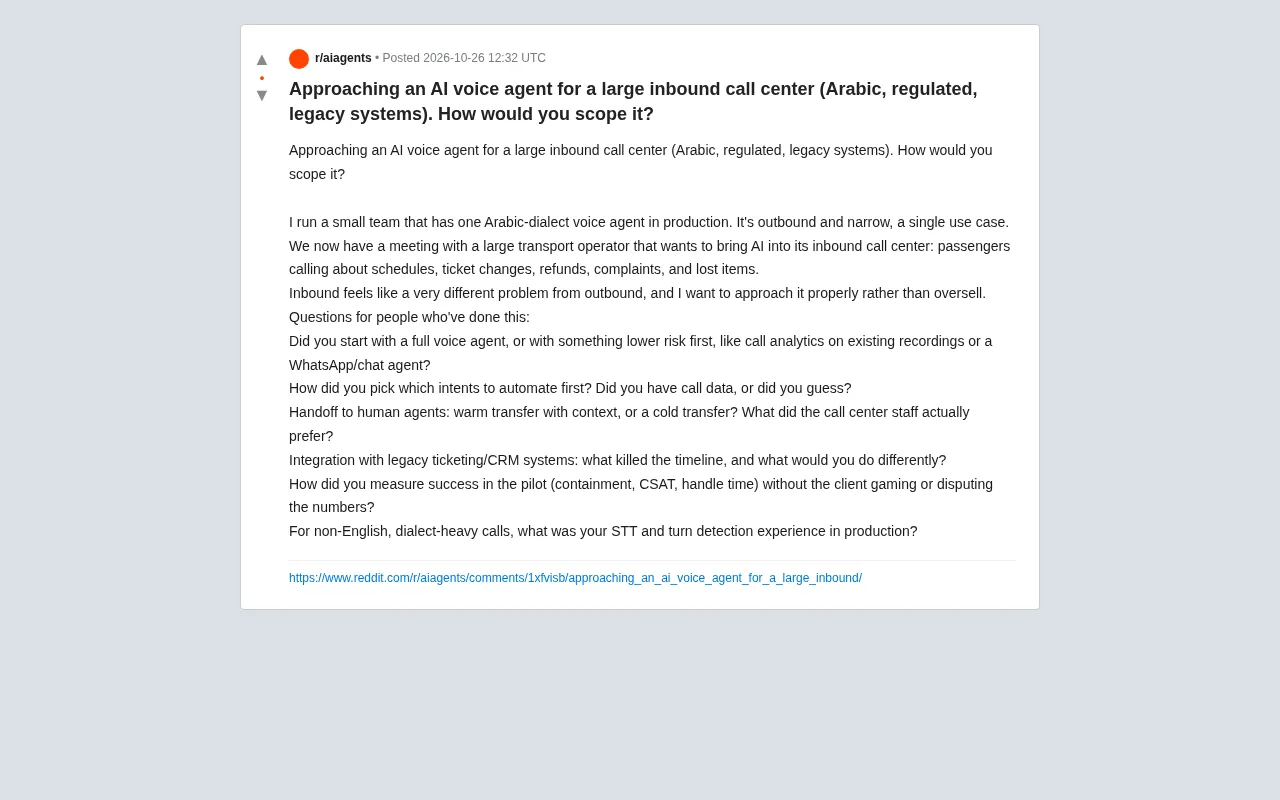
A small team that already has a narrow-scope outbound Arabic dialect voice agent in production received an inquiry from a large transportation operator: the operator wants to bring AI into its inbound call center to handle passenger calls about schedules, ticket changes, refunds, complaints, and lost and found. The poster is clear-eyed that inbound and outbound are entirely different problems, and wants to "plan properly rather than oversell." The six questions he raised on Reddit cover nearly every key decision point in enterprise-grade voice AI deployment.
Why inbound scenarios are harder than outbound
Outbound tasks have a single goal, controllable scripts, and limited cost when a call fails. Inbound is the opposite: callers arrive with emotions and specific demands, intent distribution has a long tail and is unpredictable, regulatory compliance requirements are stricter, and the system must integrate with existing ticketing systems and CRM in real time. The poster's team has only one narrow-scope outbound dialect agent in production; migrating this experience to a large inbound center would multiply the risks.
The transportation operator's scenario is especially tricky—schedule queries are relatively structured, but ticket changes and refunds involve amounts and policy judgments, while complaints and lost and found are highly unstructured and often require human intervention. Handing these intents indiscriminately to a voice agent can easily fail on both regulatory review and user experience.
Six planning questions: a breakdown
Start with a full voice agent, or begin with low-risk entry points?
The poster himself offered candidate paths: call analytics on existing recordings, or starting with a WhatsApp/chat agent. The logic behind this order is clear—call analytics doesn't face passengers directly but can validate intent recognition and transcription quality on real data; a chat agent reduces interaction pressure from real-time voice to text, a low-cost way to validate business processes and the knowledge base. For regulated industries, accumulating data assets first and then gradually automating is far more prudent than promising a full voice agent from the start.
Call Analytics refers to batch transcription, intent clustering, and sentiment recognition on historical customer service recordings, to understand call distribution without touching real passengers. Common approaches include: using ASR to generate transcripts, then tagging with LLMs or rule engines, outputting statistics such as frequency, duration, and transfer-to-human rate for each intent type. It is essentially the "requirements research" for a voice agent, exposing the real ASR error rate on dialects before project approval, preventing demo performance from being mistaken for production readiness.
WhatsApp/chat agents downgrade interaction from real-time voice to asynchronous text, bypassing voice-specific challenges like turn detection, background noise, and accent robustness, while still validating whether the knowledge base, business processes, and ticketing integration work smoothly. For regulated industries, text channels also make it easier to retain complete audit logs, making them the lowest-risk validation vehicle.
How to select intents to prioritize for automation?
The key dividing line is "do you have call data." With data, rank by three dimensions: frequency, automation feasibility, and cost of failure; without data, you can only guess—and guessing in regulated scenarios is dangerous. High-frequency, low-risk intents with deterministic answers like schedule queries are usually first; refunds and complaints involve policy and emotion and should come later.
Human transfer: warm handoff with context, or cold transfer?
The poster specifically asked about call center staff preferences. Warm transfer means handing over the conversation summary and collected information to the human agent; cold transfer means just routing the call over. The former offers better experience but is more complex to implement and increases agent wait time; the latter is simple but forces passengers to repeat themselves. There's no standard answer—frontline agents must be involved in the decision, as their preferences directly determine whether the system is truly adopted.
Warm Transfer in phone customer service typically means: the AI agent pushes the conversation summary, passenger identity, verified information, and attempted solutions to the human agent's screen (i.e., screen pop), and informs the passenger before handing off, so the agent has context when connecting. Cold Transfer simply routes the call over, and the agent starts from scratch.
The cost of warm transfer is additional engineering integration (connecting with CTI/agent desktop systems) and longer passenger wait; cold transfer is simple to implement but leads to repeated statements, lower CSAT, and can escalate emotions in complaint calls. The industry typically grades by intent: cold transfer for low-risk queries, mandatory warm transfer for amounts, complaints, and failed identity verification.
Legacy system integration: what kills timelines?
This is the most common failure point in enterprise projects. Ticketing systems and CRMs often have outdated interfaces, missing documentation, and long permission approval chains. The poster asked "what kills timelines," implying he wants to avoid pitfalls in advance. A viable approach is to break integration work into minimum viable interfaces and start early in the project, rather than waiting until the voice agent works before connecting.
How to define pilot success metrics so clients don't question them?
The poster mentioned containment (self-service resolution rate), CSAT, and call duration, and worried that clients might "manipulate or question the numbers." The response is to jointly define metric definitions, data sources, and calculation methods with the client before the pilot starts, preferably introducing third-party data or system logs for cross-validation, and writing metric definitions into the contract rather than explaining afterward.
Dialect-dense Arabic: real performance of STT and turn detection
This is the most technically substantive follow-up in the thread. Arabic dialects vary widely; speech recognition performance under dialects, accents, and background noise directly determines agent usability; turn detection determines conversation rhythm—judging whether the other party has finished speaking—and misjudgment in phone scenarios causes interruptions or awkward silences. The poster wants production experience rather than demo performance, a point every team building non-English voice agents should heed.
STT (Speech-to-Text) challenges in Arabic include: significant differences between Modern Standard Arabic (MSA) and dialects such as Egyptian, Gulf, Levantine, and Maghrebi—the same word can be pronounced and used completely differently across dialects; narrowband telephony audio (8kHz) also loses high-frequency information, further reducing accuracy. Evaluation should not only look at word error rate (WER) but also key entity recognition rate—if station names, ticket numbers, dates, and amounts are misrecognized, all downstream processes collapse.
Turn Detection is the mechanism for judging "whether the user has finished speaking," typically combining voice activity detection (VAD) and semantic endpoint detection. In phone scenarios, VAD that is too sensitive to pauses interrupts users, while too sluggish causes awkward silence; common trailing vowels and speech rate changes in Arabic amplify this difficulty. Production environments should tune parameters on real recordings and retain a fallback design that "users can interrupt at any time."
Consensus and divergence across multiple perspectives
Based on the Reddit original post's question framework and general industry discussion on voice AI deployment, several judgments have strong consensus: start with low-risk entry points, use real call data to drive intent selection, integration work is the biggest timeline variable, and metric definitions must be agreed upfront. Divergence centers on technical路线—some practitioners advocate starting directly with voice agents to obtain real interaction data, while others insist on text/analytics first to reduce risk. For dialect-dense non-English scenarios, single-source experience (such as the poster's own narrow outbound scenario) is insufficient to support conclusions; more production cases are needed for cross-validation.
Practical advice for similar projects
Break planning into stages: first use call analytics to understand intent distribution and transcription quality, then use chat channels to validate business processes, and finally launch voice agents in regulated inbound scenarios. Set clear exit criteria for each stage. Co-create the human transfer plan with frontline agents in early design. Start integration interfaces as an independent workflow early. Confirm pilot metrics in writing with the client before launch. Dialect speech recognition and turn detection must be stress-tested with real recordings, not vendor demo data.
The poster's attitude is itself the best demonstration: don't oversell, ask clearly before committing. In large regulated inbound scenarios, this restraint is more important than any technology choice.
One-line Summary
Planning a large Arabic inbound voice agent: analyze first, automate later; watch out for integration and dialect recognition risks.
Paragraph Summary
The article discusses how a small team with a narrow-scope outbound Arabic voice agent in production should plan an inbound call center AI agent for a large transportation operator. The author notes that inbound is harder than outbound: long-tail intents, emotional callers, stricter regulation, and real-time integration with ticketing and CRM. The article breaks down the poster's six planning questions one by one, including whether to start with full voice or low-risk entry points, how to prioritize intents, the trade-off between warm and cold transfer, legacy system integration, pilot metric definitions, and the real performance of STT and turn detection in Arabic dialects. The conclusion is to adopt a staged path of call analytics → chat channels → voice agents, start integration work early, confirm metrics in writing upfront, stress-test dialect recognition with real recordings, and use a restrained, non-overselling attitude as the project model.
Related articles

14 Core Concepts of Reasoning Models: From Chain of Thought to GRPO Explained
A systematic breakdown of 14 core concepts of reasoning models: chain of thought, test-time compute, verifiers, RLVR and GRPO, distillation, and reward hacking, plus rules for controlling thinking-token costs to help you decide when reasoning is worth paying for.

OpenAI's Claimed Refutation of ETH Sparks Debate, Meta Bets Big on AI Infrastructure
OpenAI claims an AI-assisted discovery that challenges the Exponential Time Hypothesis (ETH) and launches the mid-tier GPT-6.1 Tera. Cloudflare discloses a cross-customer data leak postmortem, and Meta plans $95B in AI infrastructure financing.

Data Scraping, AI Proofs, and Open Source Contracts: This Week's Deep Dive into the Tech World
From the 3D model crawler controversy and OpenAI's Lean formal proofs to AI agents challenging Brooks' Law and Debian rejecting LLM review, this week's tech discussions center on openness and verifiability.