Assur-KB: Improving Mechanism Design Learning Efficiency with Reusable Constraint Modules

Assur-KB achieves a 1.8× sample efficiency improvement under data scarcity by modularly representing planar mechanisms.
Assur-KB proposes a structured representation for planar mechanisms, decomposing them into irreducible modules, boundary interfaces, and solving dependencies while preserving source geometry. Under identical MLP architectures and training budgets, it achieves a geometric-mean 1.8× sample efficiency advantage over flattened adjacency plus position inputs across 50 to 10,000 mechanisms. Theoretical analysis characterizes transfer conditions through module interfaces and identifies missing interface information and cumulative sensitivity as physical limits. Experiments also verify joint relabeling invariance, higher effective generation rates under dyadic composition, and structural indexing over 10.02 million mechanisms. The work shows that injecting physically constrained structured representations is more effective than simply scaling models in data-scarce engineering prediction tasks.
Machine learning often struggles with data scarcity when predicting the behavior of mechanical systems. A recent study proposes that explicitly representing reusable constraint subassemblies can significantly improve model predictive capability under limited data. This work, named Assur-KB, approaches the mechanism design problem from a representation learning perspective, offering a new idea for data-efficient scientific machine learning.
Why Mechanism Learning Needs Better Representations
The motion of planar mechanisms is jointly determined by the constraints between connected components. Traditionally, representing mechanisms as adjacency matrices or node positions loses critical physical structural information—which constraints are reusable and how information is passed between module interfaces. The paper points out that learning mechanism behavior requires a representation that reflects "how connected parts jointly constrain motion."
The core idea of Assur-KB is to decompose planar mechanisms into irreducible modules, explicitly model boundary interfaces and solving dependencies, while preserving source geometry information. This representation allows the model to see the constrained subassembly structure, rather than just flat connectivity relationships.
Irreducible Modules and Assur Graphs: In mechanism theory, an Assur graph is a method for decomposing planar linkage mechanisms into basic kinematic chains. Its core idea is to split a mechanism into several "irreducible" substructures—these substructures contain no simpler closed loops internally and are connected to each other only through boundary hinges or sliders. Each irreducible module corresponds to an Assur group with zero degrees of freedom, meaning the relative motion of components within the module is fully constrained. The physical significance of this decomposition lies in the fact that constraints are local and reusable, and different mechanisms may share the same module types. Assur-KB leverages this classical theory to represent mechanisms as module graphs, where nodes are irreducible modules and edges represent interface constraints between modules. Compared with adjacency matrices, this representation explicitly preserves information about "which constraints belong to the same rigid unit" and "how motion is transmitted between modules," thereby avoiding the structural information loss caused by flattened representations.
How Reusable Modules Bring Sample Efficiency Advantages
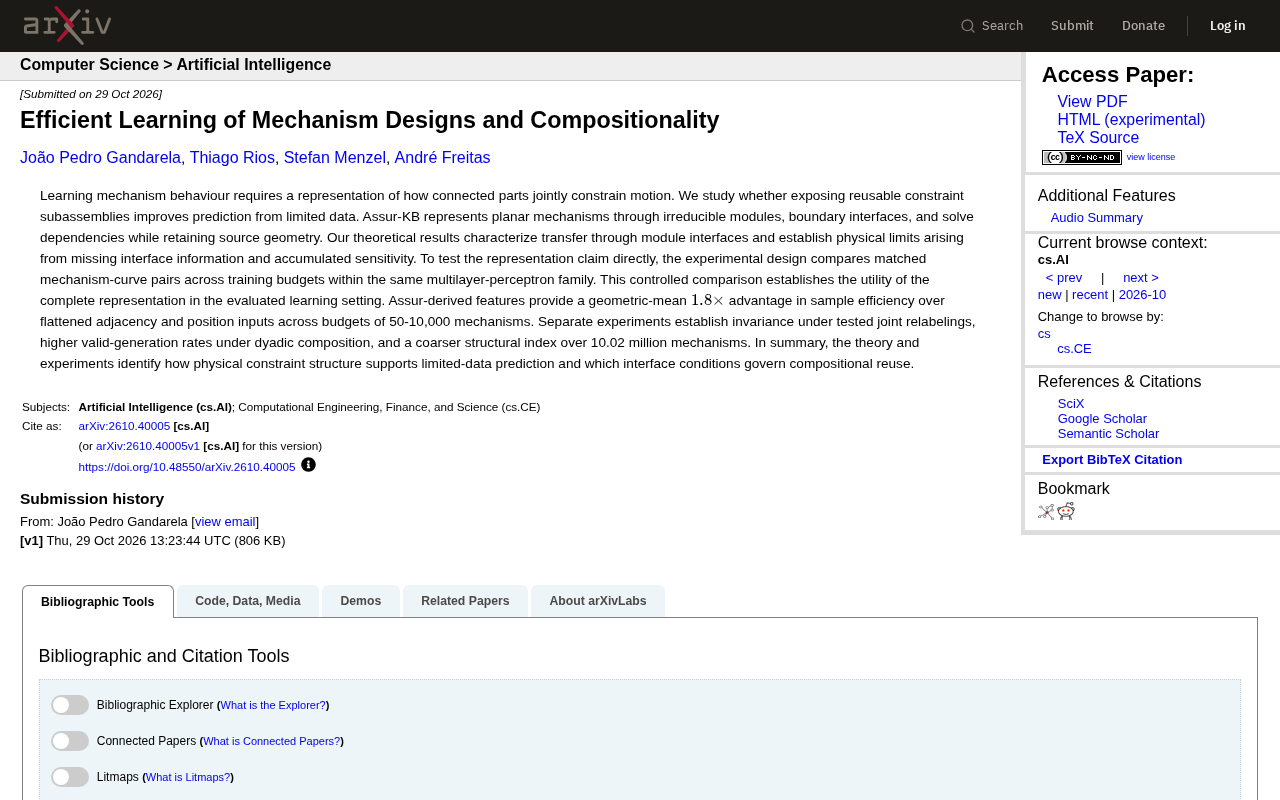
To validate the effectiveness of the representation, the researchers designed a controlled experiment: within the same multi-layer perceptron (MLP) family, comparing the full representation against flattened adjacency plus position inputs under the same training budget.
The results show that Assur-derived features provide a geometric-mean 1.8× advantage in sample efficiency, covering training budgets from 50 to 10,000 mechanisms. This means that when data is limited, introducing structured constraint representations allows the model to learn effective patterns faster.
Original text: Assur-derived features provide a geometric-mean 1.8× advantage in sample efficiency over flattened adjacency and position inputs across budgets of 50-10,000 mechanisms.
This advantage does not come from a more complex model, but from the representation itself. For engineering practice, this is an important reminder: in domains where data collection is costly, improving input representations may be more effective than stacking model parameters.
Measuring Sample Efficiency: Sample efficiency refers to the number of training samples required for a model to reach a certain performance level. The "geometric-mean 1.8× advantage" in the paper means that across multiple training budgets (50 to 10,000 mechanisms), the model using Assur features requires approximately 1/1.8 of the samples needed by the baseline to achieve the same prediction error. This metric is obtained by taking the geometric mean of sample efficiency ratios across different budgets, comprehensively reflecting the overall advantage of the representation in both data-scarce and data-abundant regimes. The experimental controls are strict: same MLP architecture, same hyperparameter search space, and same number of training epochs, with only the input representation differing. Therefore, performance differences can be attributed to the inductive bias carried by the representation itself—structured inputs make it easier for the network to learn the patterns of constraint propagation, rather than fitting from scratch.
Theoretical Characterization: Interface Information and Sensitivity Accumulation
In addition to experiments, the paper also provides theoretical results characterizing the conditions for transfer through module interfaces and identifying the sources of physical limits: missing interface information and cumulative sensitivity.
Simply put, modular representations naturally support compositional reuse, but the effectiveness of reuse is limited by the completeness of interface information. If the interfaces between modules are not sufficiently represented, transferability will degrade. Additionally, the cumulative sensitivity of solving dependencies can also affect prediction accuracy. These theoretical analyses provide a formal foundation for understanding "why certain structural representations are more effective."
Interface Information and Cumulative Sensitivity: Interface information refers to the amount of information carried at the connections between modules (such as hinge positions and constraint directions) that is sufficient to determine the relative motion between modules. In modular representations, if interface variables are adequately encoded, the model can transfer module behavior learned on one mechanism to new compositions; conversely, missing interface information leads to transfer failure. Cumulative sensitivity describes the error amplification effect along the solving dependency chain: when a mechanism is solved by connecting multiple modules in series, prediction errors from preceding modules are passed through interfaces and may be amplified by subsequent modules. The paper theoretically characterizes these two types of physical limits, showing that even with a perfect representation, prediction accuracy remains constrained by the observability of interface information and the sensitivity of the dependency chain. This provides formal boundaries for understanding "why certain structural representations are more effective."
Experimental Evidence for Compositionality and Generalization
The paper also reports several other experiments: invariance under the tested joint relabelings; higher effective generation rates under dyadic composition; and construction of a coarser structural index over more than 10.02 million mechanisms.
Together, these results demonstrate that physical constraint structures not only aid prediction under limited data but also determine the interface conditions for compositional reuse. For scenarios requiring compositional generalization, such as mechanism design automation and robot motion planning, this representation method has potential value.
Implications for AI-Assisted Engineering Design
Assur-KB's research reminds us that in scientific machine learning, the way domain knowledge is injected is crucial. Decomposing physical constraints into reusable modules and explicitly modeling interfaces is a representation design principle worth adopting. It does not pursue end-to-end black boxes, but instead makes the learning problem simpler through structured representations.
Of course, this work currently focuses on planar mechanisms, and extension to three-dimensional mechanisms and more complex systems still requires further research. However, the validated idea that "representation matters more than scale" has general reference significance for engineering prediction tasks with scarce data.
One-line Summary
Assur-KB achieves a 1.8× sample efficiency improvement under data scarcity by modularly representing planar mechanisms.
Paragraph Summary
Assur-KB proposes a structured representation method for planar mechanisms, decomposing mechanisms into irreducible modules, boundary interfaces, and solving dependencies while preserving source geometry information. Under the same MLP architecture and training budget, this representation achieves a geometric-mean 1.8× sample efficiency advantage over flattened adjacency plus position inputs, covering training scales from 50 to 10,000 mechanisms. Theoretical analysis characterizes the conditions for transfer through module interfaces and identifies missing interface information and cumulative sensitivity as physical limits. Experiments also verify joint relabeling invariance, higher effective generation rates under dyadic composition, and construction of structural indices over more than 10.02 million mechanisms. This work demonstrates that in engineering prediction tasks with scarce data, injecting structured representations with physical constraints is more effective than simply scaling up models.
Related articles

DeepSeek Open-Sources DeepInfer: What Is an Inference Framework Actually For?
DeepSeek open-sources its inference framework DeepInfer under Apache 2.0, supporting DeepSeek V4.1 Flash offline inference. This article explains its request scheduling, FlashMLA/DeepGEMM compute optimization, DSPark speculative verification acceleration, and what it means for developers and ordinary users.

Open-Source AI Learning Agent: A Full Workflow Experience from Topology Graphs to Exam Generation
Explore an open-source AI learning agent: built on DeepSeek API, it constructs knowledge systems via topology graphs, with automatic document generation, notes, super documents, and exams. Learn about its Agent workflow and design highlights.

DeepSeek Whale Girl Open-Source MV Meme: AI Industry Coded Slang About Pivoting to Closed Source
Bilibili's DeepSeek Whale Girl rap MV uses fictional memes to tease the AI open-source vs. closed-source debate, with lyrics full of industry slang. This article explains the meme culture, the Whale Girl symbol, and the open/closed tension.