Attention as Lattice Gauge Theory: Relations Interact Only Through Wilson Loops

The paper uses gauge field theory to prove edge attention must use Wilson loops and shows training-free inference.
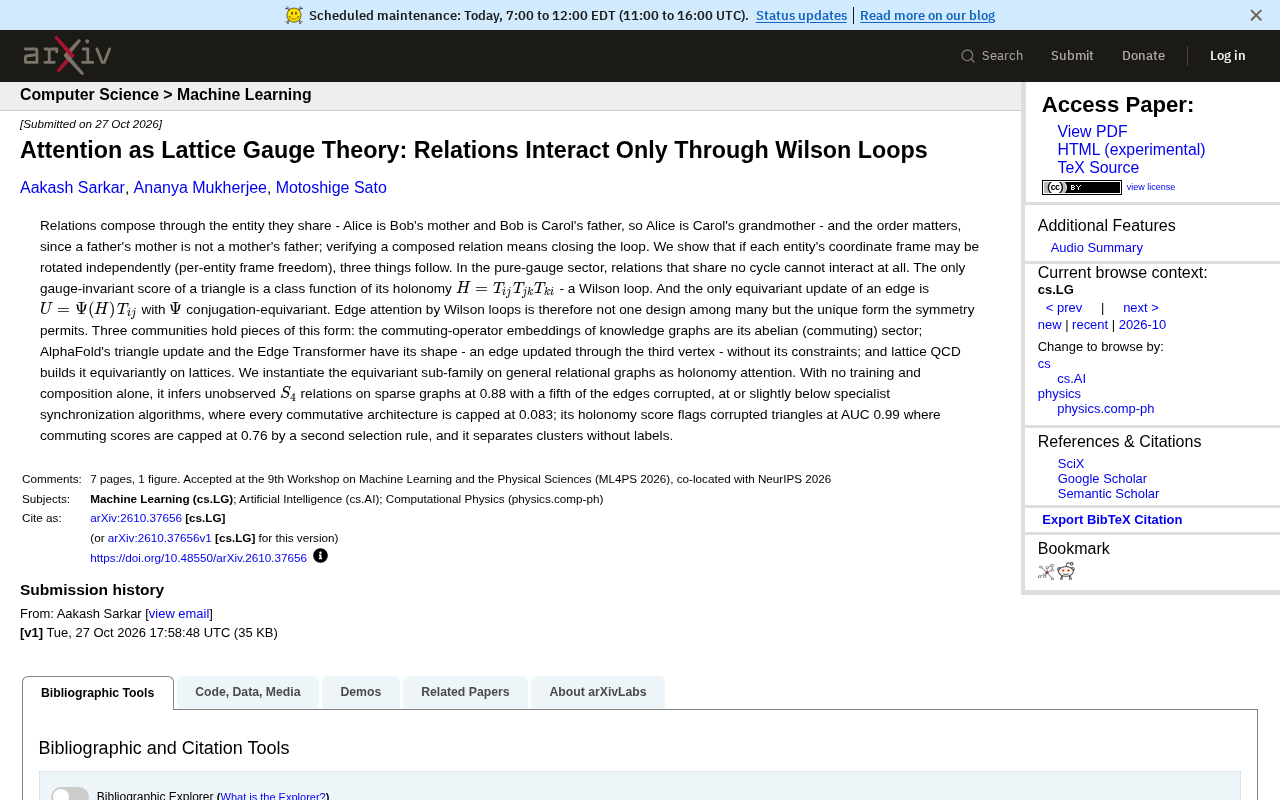
This work formalizes order-sensitive relation composition as a lattice gauge field theory. Under per-entity frame freedom, it derives three results: relations not sharing a loop cannot interact; the only gauge-invariant triangle score is the Wilson loop; and the only equivariant edge update is U=Ψ(H)T_ij. Edge attention via Wilson loops is thus the unique symmetry-allowed form. Holonomy attention needs no training: 0.88 accuracy on sparse S_4 inference, AUC 0.99 for corrupted triangles, far above commutative ceilings.
Title
Attention as Lattice Gauge Theory: Relations Interact Only Through Wilson Loops
Meta Description
A study linking attention mechanisms to lattice gauge theory proposes that under per-entity frame freedom, edge attention via Wilson loops is the only symmetry-allowed form. Holonomy attention infers unobserved relations on sparse graphs without training, achieving 0.88 accuracy, far exceeding the 0.083 ceiling of commutative architectures.
Article Content
The core challenge of relational reasoning lies in how relations compose and why the order of composition matters. Alice is Bob's mother, and Bob is Carol's father, so Alice is Carol's grandmother—this chain of reasoning depends on shared entities and is non-commutative: the mother of one's father is not the same as the father of one's mother. Verifying a composed relation is equivalent to closing a loop.
A paper titled Attention as Lattice Gauge Theory: Relations Interact Only Through Wilson Loops formalizes this intuition into a gauge field theory framework and derives a striking conclusion: edge attention based on Wilson loops is not one design among many, but the only form allowed by symmetry.
From "Frame Freedom" to a Unique Form: Three Corollaries
The paper starts from a seemingly mild assumption: the coordinate frame of each entity can be rotated independently—so-called "per-entity frame freedom." Once this is accepted, three conclusions follow.
First, in the pure gauge sector, relations that do not share any loop cannot interact at all. In other words, if two edges cannot together close a loop, there is no gauge-invariant correlation between them.
Second, the only gauge-invariant score for a triangle is a class function of its holonomy $H = T_{ij} T_{jk} T_{ki}$—precisely the Wilson loop.
Third, the only equivariant update form for an edge is $U = \Psi(H), T_{ij}$, where $\Psi$ satisfies conjugate equivariance. The paper thus asserts: edge attention implemented through Wilson loops is not an optional design, but the unique solution under symmetry constraints.
The significance of this derivation is that it turns "what relational reasoning should look like" from empirical trial and error into a symmetry derivation. Traditional attention mechanisms allow edges to freely exchange information through shared nodes, whereas gauge constraints require such interactions to proceed along closed loops.
Gauge Field Theory and Wilson Loops
The core idea of gauge field theory is that a physical system possesses a local symmetry: each point in space can independently choose a "reference frame" (gauge), and physical observables must be independent of this choice (gauge invariance). To compare quantities at different points, one introduces a "connection" (gauge field) that defines how to parallel-transport a value from one point to another. After parallel transport around a closed path, the transformation upon return is called the holonomy.
In lattice gauge theory, spacetime is discretized into lattice sites, and connections are defined on edges. The product along a closed loop (such as a triangle) $T_{ij}T_{jk}T_{ki}$ is the Wilson loop, which is gauge-invariant because gauge transformations at each vertex cancel in pairs. Wilson loops thus become the fundamental building blocks for constructing gauge invariants in gauge theory, and their class functions (such as the trace) can characterize the physical effects of the gauge field.
Transplanting this structure to relational reasoning: entities correspond to lattice sites, relations correspond to connections on edges, and frame freedom corresponds to local gauge symmetry. The non-commutativity of relation composition corresponds exactly to the non-Abelian nature of gauge fields. Therefore, triangle scores must be class functions of Wilson loops, and edge updates must also be implemented through Wilson loops to preserve gauge equivariance.
Three Communities Each Hold a Piece of the Puzzle
The paper points out that this form has been partially touched upon by three independent research communities, but each holds only a fragment.
Commutative operator embeddings in knowledge graphs correspond to the Abelian (commutative) sector of this framework—they naturally satisfy the commutative law, but for that reason cannot express order-sensitive relation composition.
AlphaFold's triangle update and the Edge Transformer already structurally possess the form of "updating an edge through a third vertex," but lack the layer of gauge constraints. They have shape, but no constraints.
Lattice QCD constructs the complete form equivariantly on the lattice. In other words, physicists have long implemented this structure in lattice gauge theory, but have not connected it to attention mechanisms for relational reasoning.
The intersection of the three communities points to exactly the same mathematical object, and this fact itself constitutes cross-disciplinary validation: knowledge graph embedding, protein structure prediction, and lattice quantum chromodynamics have approached the same form from different paths.
Commutative Operator Embeddings and Order Sensitivity
Commutative operators in knowledge graph embeddings (such as complex multiplication in ComplEx) satisfy the commutative law, i.e., $f(a,b)=f(b,a)$. This design is convenient for computation but cannot distinguish "father's mother" (grandmother) from "mother's father" (maternal grandfather), because the composition order of the corresponding relations differs. In the gauge field theory framework, commutative operators correspond to the Abelian sector, whose Wilson loops degenerate into commutative products, thereby losing order information.
Non-commutative structures (such as matrix multiplication) can preserve order but must satisfy gauge equivariance, i.e., edge updates must be compatible with local transformations at vertices. Wilson loops provide this non-commutative gauge-invariant score, thereby enabling order-sensitive relation composition. Therefore, to handle such relations, knowledge graph embeddings must go beyond commutative operators and introduce non-Abelian gauge structures.
Holonomy Attention: Training-Free Relational Inference
The paper instantiates the equivariant subfamily on general relational graphs, naming it holonomy attention.
The experimental setup is noteworthy: the model does no training at all, relying solely on compositional operations. When inferring unobserved $S_4$ relations on sparse graphs, even with one-fifth of edges corrupted, accuracy reaches 0.88, comparable to or slightly lower than specialized synchronization algorithms. As a control, all commutative architectures are limited to 0.083 on the same task.
For detecting corrupted triangles, the holonomy score achieves AUC 0.99, while the commutative score, constrained by the second selection rule, caps at 0.76. Furthermore, the method can separate clusters without labels.
The implications of these results go beyond performance numbers. They show that gauge constraints are not a mere regularization add-on, but the source of relational reasoning capability: commutative architectures that abandon constraints have a structural ceiling on tasks requiring order-sensitive composition.
$S_4$ Relations and Synchronization Algorithms
$S_4$ is the symmetric group on four elements, containing 24 permutations. In relational reasoning tasks, $S_4$ relations can represent permutation operations between entities, such as "rearranging four objects." Inferring unobserved $S_4$ relations means that given some edges (known permutations), one must recover the missing edges so that the permutations over the entire graph satisfy consistency (i.e., the product around any closed loop is the identity).
Synchronization algorithms are a class of algorithms specifically for solving such problems, recovering missing group elements through iterative propagation and consistency projection. Holonomy attention requires no training and, through compositional operations alone (i.e., computing loop products and updating edges), achieves accuracy comparable to synchronization algorithms (0.88 vs. slightly higher), indicating that gauge constraints themselves provide powerful reasoning capability. Commutative architectures, unable to express non-commutative $S_4$ composition, are limited to 0.083 accuracy, highlighting the necessity of non-commutative structures.
Implications for AI Architecture Design
The implications of this work for relational AI architectures can be summarized in a few points.
First, symmetry can serve as a design principle rather than a post-hoc explanation. When frame freedom holds, the attention form is uniquely determined, providing a prior constraint for architecture search rather than blind exploration in a vast design space.
Second, order-sensitive reasoning requires non-commutative structures. Knowledge graph embeddings have long relied on commutative operators for computational convenience, but this in principle excludes distinctions such as grandmother versus maternal grandmother. Wilson loops provide a natural extension beyond the commutative sector.
Third, training-free inference capability deserves attention. On sparse and noisy graphs, pure compositional methods achieve performance comparable to specialized algorithms, suggesting that some relational inference tasks may not require large-scale parameter fitting.
The paper also exposes a gap: AlphaFold and the Edge Transformer have the shape of triangle updates but lack constraints, implying that introducing gauge constraints into existing models may be a low-cost, high-reward direction for improvement.
Open Questions
The paper's derivation rests on the assumption of per-entity frame freedom. Whether frame freedom generally holds in real-world scenarios, and at what granularity, still requires further examination. Moreover, experiments focus on discrete groups such as $S_4$ and sparse graphs; extensions to larger scales, continuous groups, and dense graphs have not yet been explored. Whether the forms from the three communities can truly be unified into a single set of engineering practices also remains for future work.
But the core thesis is already clear: relations interact only through Wilson loops. This is not an empirical finding, but a symmetry theorem.
One-line Summary
Using gauge field theory, the paper proves that edge attention must be implemented via Wilson loops and demonstrates training-free inference capability.
Paragraph Summary
This work formalizes the order-sensitive composition problem in relational reasoning into a lattice gauge field theory framework. Under the per-entity frame freedom assumption, it derives three conclusions: relations not sharing a loop cannot interact; the only gauge-invariant score for a triangle is the Wilson loop; and the only equivariant update form for an edge is $U=\Psi(H)T_{ij}$. It thus asserts that edge attention based on Wilson loops is not an optional design, but the only form allowed by symmetry. The paper notes that three communities—knowledge graph commutative operator embeddings, AlphaFold's triangle update and the Edge Transformer, and lattice QCD—each hold fragments of this form. The instantiated holonomy attention requires no training and achieves 0.88 accuracy in inferring unobserved $S_4$ relations on sparse graphs, with AUC 0.99 for detecting corrupted triangles, far exceeding the ceiling of commutative architectures. This reveals that gauge constraints are the source of relational reasoning capability and provides a symmetry prior for AI architecture design.
Related articles

The Truth Behind Titanic's Sinking: Key Decisions and Communication Failures in the National Geographic Documentary
National Geographic's The Unsinkable Ship uses survivor testimony to reconstruct Titanic's fatal decisions—from the missing MSG telegram prefix and the broken boiler-room-to-bridge link to how 'unsinkable' thinking delayed damage control and evacuation.

74M-Parameter Open-Source Model Partially Outperforms Jev AI in Testing
Fastino AI's Glider 2.5 models, with just 74M–300M parameters, reportedly outperform Jev AI in some guardrail benchmarks per YouTube testing, run on consumer hardware, and even play Doom. We analyze small models' competitiveness and deployment value on specific tasks.

Gemini 4 Argon Hands-On: Aggressive Pricing, 3D Capabilities Need Coaching
Gemini 4 Argon hands-on: limited-time $2/$10 pricing, million-token output, strong 3D and reverse-engineering work, but weak front-end aesthetics and zero-shot ability need coaching.