Beyond the DRW Model: Generative Model Nullasar Learns Quasar Variability

Generative model Nullasar uses flow matching to learn quasar variability, replacing the DRW null hypothesis to reduce bias in periodic signal detection.
Quasar variability is typically modeled with the damped random walk (DRW) as a null hypothesis, but DRW is incomplete, and misspecification leads to systematic bias in periodic signal significance estimates, affecting supermassive black hole binary searches, tidal disruption event identification, and reverberation mapping time-delay measurements. A preprint proposes the generative model Nullasar, based on flow matching, which learns the statistical properties of variability directly from time-series data without explicitly assuming a noise form, capturing non-Gaussianity and complex temporal dependencies, thereby serving as a flexible, learnable null hypothesis. In synthetic variability tests, Nullasar as a null hypothesis performs comparably to fitting the correct DRW to each curve, and outperforms parametric fitting when variability follows an AR(2) model. The paper also notes that training set contamination by non-null signals is a major limitation, which can be greatly mitigated by projecting condition vectors onto principal components. This work provides a new approach to data-driven null hypothesis construction.
Title
Beyond the DRW Model: Generative Model Nullasar Learns Quasar Variability
Meta Description
The generative model Nullasar uses flow matching to learn quasar variability directly from time-series data, without presupposing a DRW noise model. Studies show that as a null hypothesis it performs comparably to correct DRW fitting in periodic signal detection, outperforms parametric fitting under AR(2) variability, and discusses practical limitations such as training set contamination.
Article Content
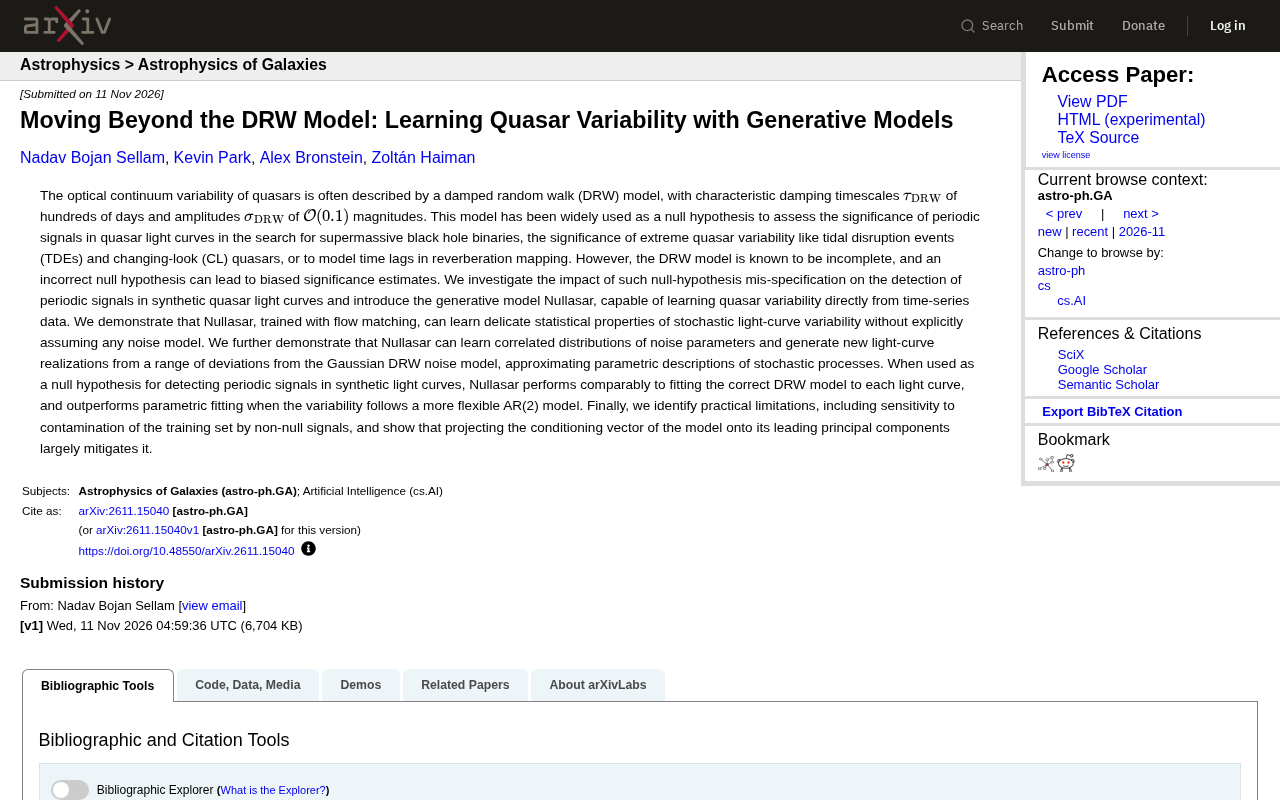
Quasar optical continuum variability is typically described by the damped random walk (DRW) model, with damping timescales of a few hundred days and amplitudes of about 0.1 mag. As a null hypothesis, DRW is widely used to assess the significance of periodic signals in quasar variability to search for supermassive black hole binaries; it is also used to evaluate extreme variability such as tidal disruption events (TDEs) and changing-look quasars, as well as to model time delays in reverberation mapping. However, the DRW model is known to be incomplete, and an incorrect null hypothesis can bias significance estimates.
A recent preprint proposes the generative model Nullasar, which attempts to learn quasar variability directly from time-series data and systematically studies the impact of null hypothesis misspecification on periodic signal detection.
Limitations of the DRW Model and Null Hypothesis Bias
The DRW model treats quasar variability as a Gaussian random process, summarized by two parameters: damping timescale and amplitude. This simplification suffices in many scenarios, but when the true variability deviates from a Gaussian DRW, significance estimates using DRW as the null hypothesis can produce systematic biases. The paper points out that an imperfect null hypothesis affects the reliability of periodic signal detection, which in turn impacts binary black hole searches, extreme variability identification, and reverberation mapping time-delay measurements.
The problem is that it is difficult to specify the correct parametric noise model for each quasar. Generative models offer a new path: instead of presupposing a noise form, let the data speak for itself.
Damped random walk (DRW) is the most commonly used stochastic process model in astronomy for describing quasar optical variability. It is essentially a continuous-time random walk with mean reversion (the Ornstein-Uhlenbeck process): brightness diffuses freely like a random walk on short timescales but is pulled back toward the long-term mean on long timescales, with the speed of reversion characterized by the "damping timescale." DRW is a Gaussian process; its joint distribution at any finite set of times is multivariate Gaussian, so it is fully determined by its mean function and covariance function. This property makes DRW mathematically very convenient for likelihood analysis and significance testing, but it also means it inherently cannot describe phenomena common in real quasar variability, such as non-Gaussian fluctuations, asymmetric outbursts, or state switching. When observed data actually deviate from DRW, the distribution of the test statistic constructed with DRW as the null hypothesis becomes mismatched, systematically overestimating or underestimating the significance of periodic signals.
Nullasar: Learning Variability Statistics with Flow Matching
The core of Nullasar is flow matching, a generative modeling technique. The paper demonstrates that Nullasar can learn the subtle statistical properties of stochastic variability without explicitly assuming any noise model. This means the model can capture correlation structures beyond DRW, such as non-Gaussianity, correlations between parameters, and more complex temporal dependencies.
More specifically, Nullasar can learn the correlated distribution of noise parameters and generate new variability realizations from a range of distributions that deviate from Gaussian DRW, thereby approximating a parametric description of the stochastic process. This makes Nullasar not just a generator but a flexible, learnable null hypothesis.
Flow matching is a class of generative modeling methods that has emerged in recent years, belonging to the same "continuous-time generation" framework as diffusion models. The basic idea is to construct a continuous probability flow from a simple prior distribution (e.g., standard Gaussian) to the target data distribution, use a neural network to learn the velocity field corresponding to this flow, and then transform noise samples into data samples by numerically integrating the ordinary differential equation. Compared to diffusion models, flow matching has a more direct training objective—regressing the conditional velocity field—without simulating a complex noising process, resulting in more stable training and fewer sampling steps. In astronomical time-series scenarios, the advantage of flow matching is that it does not require specifying an analytical form of the noise in advance; instead, the network implicitly learns the joint distribution from a large number of light curves, including non-Gaussianity and dependency structures across different timescales—precisely what parametric DRW models struggle to cover.
Performance in Periodic Signal Detection
The paper tests the effectiveness of Nullasar as a null hypothesis using synthetic quasar variability. The results show that when detecting periodic signals, Nullasar performs comparably to fitting the correct DRW model to each light curve; and when the variability follows the more flexible AR(2) model, Nullasar outperforms parametric fitting.
The significance of this result is that, in the face of an unknown true noise process, generative models provide an alternative that approaches the "correct null hypothesis," reducing significance bias caused by model misspecification.
The AR(2) model, i.e., the second-order autoregressive process, is a classic model in discrete-time series analysis: the value at the current time is determined by a linear combination of the values at the two preceding times plus white noise. Compared to DRW (a continuous-time OU process), AR(2) can produce richer autocorrelation structures, such as quasi-periodic oscillations or damped oscillatory behavior, and under certain parameters its spectral density can exhibit peaks, so it is often used to simulate quasar variability that deviates from simple exponential decay. In the tests of this paper, when the synthetic variability is generated by AR(2), the DRW null hypothesis itself is misspecified—significance obtained by DRW fitting would be distorted; whereas Nullasar, since it does not presuppose a parametric form, can approximate the statistical properties of AR(2), thus outperforming parametric DRW fitting in that case. This also shows that the value of generative models is mainly realized when the true noise process is unknown and may be more complex than DRW.
Practical Limitations and Mitigation Methods
The paper also points out limitations in practical applications, including sensitivity to contamination of the training set by non-null signals—if the training data contain real periodic signals or other non-null signals, the null hypothesis distribution learned by the model may be distorted. The authors find that projecting the model's condition vectors onto their principal components can greatly mitigate this problem.
This suggests that in practical deployment, the purity of training data and post-processing strategies are equally important.
Principal component projection is a dimensionality reduction and decorrelation technique: for a set of vectors (here, the model's condition vectors), compute the covariance matrix, take its first several eigenvectors as principal components, and project the original vectors onto the low-dimensional subspace spanned by these principal components. The effect is to retain the main directions of greatest variance in the condition vectors while suppressing directions introduced by training set contamination that have smaller variance but may carry spurious signals. The paper finds that projecting condition vectors onto their principal components can greatly mitigate the bias caused by training set contamination with non-null signals. The intuition is that true periodic signals often appear as perturbations in specific directions in the condition space, and principal component projection amounts to filtering that direction to some extent, bringing the generative model closer to the distribution corresponding to a pure null hypothesis. This post-processing strategy is simple and effective, but it also suggests that quality control of training data remains a fundamental prerequisite.
Multi-Source Perspectives and Outlook
This work is consistent with the recent trend of exploring generative models in astronomical time-series analysis: from simulating observations to anomaly detection, generative models are gradually entering the foundational step of null hypothesis construction. According to the paper's authors, Nullasar demonstrates the feasibility of data-driven null hypotheses, but training set contamination and model interpretability remain open problems. Whether generative models should become standard null hypothesis tools still requires further validation on real survey data.
For readers working on quasar variability, binary black hole searches, and time-domain astronomy, this study offers a noteworthy idea: rather than assuming a parametric model that may be wrong, let a generative model learn the shape of the null hypothesis from the data.
One-line Summary
Generative model Nullasar uses flow matching to learn quasar variability, replacing the DRW null hypothesis to reduce bias in periodic signal detection.
Paragraph Summary
Quasar variability is typically modeled with the damped random walk (DRW) as a null hypothesis, but DRW is incomplete, and misspecification leads to systematic bias in periodic signal significance estimates, affecting supermassive black hole binary searches, tidal disruption event identification, and reverberation mapping time-delay measurements. A preprint proposes the generative model Nullasar, based on flow matching, which learns the statistical properties of variability directly from time-series data without explicitly assuming a noise form, capturing non-Gaussianity and complex temporal dependencies, thereby serving as a flexible, learnable null hypothesis. In synthetic variability tests, Nullasar as a null hypothesis performs comparably to fitting the correct DRW to each curve, and outperforms parametric fitting when variability follows an AR(2) model. The paper also notes that training set contamination by non-null signals is a major limitation, which can be greatly mitigated by projecting condition vectors onto principal components. This work provides a new approach to data-driven null hypothesis construction.
Related articles

How Fast Can AI Become an Expert? Lessons from Napoleon and Rockefeller
From Napoleon's victories at 27 to Rockefeller running a major refinery at 25, we explore why AI can accumulate experience far faster than humans: reading a company's entire history in days, reaching top performance in months, and the real bottleneck of serial feedback.

US Air Traffic Control Keeps Breaking Down—Can Canada's Model Fix It?
A botched copper cable upgrade grounded thousands of US flights. Vox analysis: aging equipment, overworked controllers, and the FAA's annual funding battles are the root causes—Canada's 1996 nonprofit ATC model offers a way out.

Why Can't an AI with 20 PhDs Get Anything Done in the Enterprise?
OpenAI co-founder Greg Brockman uses the "20 PhDs with no data access" analogy to reveal the core bottleneck of enterprise AI: business context and permission guardrails are both essential. This article covers his conversation with the Databricks CEO and the Genie product's implementation approach.