Bilibili AI Agent Hands-On Course: From Fundamentals to Enterprise-Level Projects

A Bilibili creator's AI Agent course four months in the making, systematically introducing the field through three chapters: fundamentals, advanced, and hands-on.
The article introduces a systematic AI Agent course compiled by a Bilibili creator over four months. The author notes that most tutorials either stop at piling up concepts or just throw code at learners. The course has three chapters: fundamentals (everyday analogies for Agent concepts, ReAct, planning, reasoning, memory, and a first demo), advanced (LangChain and AutoGen, multi-Agent collaboration, Function Calling, hybrid ReAct architectures, plus evaluation and security), and hands-on (intelligent customer service, automated data analysis, and a multi-Agent collaborative production line). Source code, courseware, Prompt templates, and a learning roadmap are included.
Title
Bilibili AI Agent Hands-On Course: From Fundamentals to Enterprise-Level Projects
Meta Description
A Bilibili creator launches an AI Agent hands-on course, split into fundamentals, advanced, and hands-on chapters, covering the ReAct framework, LangChain and AutoGen, Function Calling, and enterprise-level projects, with source code, courseware, and a learning roadmap.
Article Content
The AI Agent concept is hot, but most tutorials stop at piling up terminology or patching together code. One Bilibili creator spent four months going through almost all Agent-related content on Bilibili and YouTube, and summed up the pain points of over 90% of tutorials—either they only discuss concepts like autonomous planning and tool calling without putting them into practice, or they just throw code at you with no explanation. This course attempts to use three chapters—fundamentals, advanced, and hands-on—to let learners first understand how an Agent thinks, then build a usable agent themselves.
Fundamentals: Building Core Understanding with Everyday Analogies
The course doesn't start with code, but rather clarifies a fundamental question: what's the difference between an Agent and a regular large model conversation. According to the creator, the fundamentals chapter breaks down abstract concepts like the React framework, planning, reasoning, and memory mechanisms using everyday analogies, so even complete beginners can quickly grasp them.
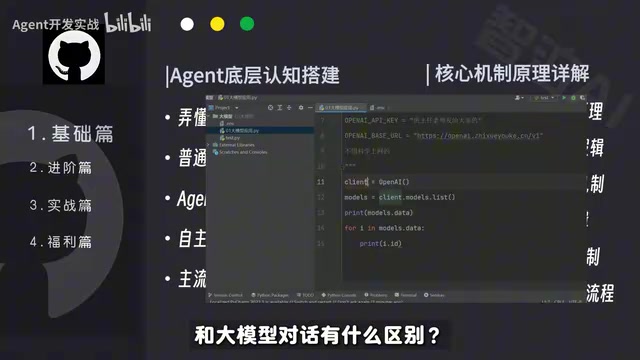
This section also walks through the first Agent demo, letting learners experience what it feels like to have an agent do work before they start coding. This "understand first, then practice" approach contrasts with the common practice of directly calling APIs.
The ReAct framework is one of the most frequently cited foundational paradigms in the Agent field, short for Reason + Act. Its core idea is to have the large model first output a "Thought" at each step, explaining the information it currently has and its next plan, then output an "Action", such as calling a tool or retrieving information, and then continue the next round of thinking based on the "Observation" returned by the environment. This "Thought—Action—Observation" loop breaks down black-box one-shot generation into traceable steps, enabling the model to dynamically adjust its strategy based on intermediate results rather than guessing the final answer all at once. It is also the foundation for understanding subsequent Function Calling, planning, and tool-calling mechanisms.
Advanced: Framework Practice and Security Boundaries
The advanced chapter moves into frameworks, covering hands-on LangChain and AutoGen, multi-agent collaboration, Function Calling tool invocation, and hybrid architectures combining ReAct and Agents. Each section comes with accompanying code courseware, lowering the barrier to following along.
You might not have noticed, but the course specifically includes content on evaluation, debugging, and security boundaries. In the process of deploying Agents, how to measure effectiveness and avoid risks often tests developers more than piling on features. This part is especially critical for learners who want to put Agents into actual business use.
LangChain and AutoGen are two types of Agent development frameworks with different positioning. LangChain leans more toward a "component library + orchestration chain", providing modules such as model wrappers, prompt templates, tool calling, memory, and retrieval. Developers build single agents or workflows by combining these modules, with a mature ecosystem and abundant resources. AutoGen, launched by Microsoft, has the core idea of "multi-agent conversation", putting multiple Agents with different roles and capabilities (such as assistant, executor, reviewer) into the same conversation to speak and collaborate on completing tasks, naturally suited for multi-agent collaboration scenarios. Understanding the difference in abstraction levels between the two helps determine when to use chain-based orchestration and when to use conversational collaboration.
Function Calling is the key mechanism that lets large models "take action". The model itself can only generate text and cannot query databases or send emails. Function Calling works like this: developers pre-declare available functions with structured descriptions (name, parameters, purpose), the model determines during the conversation whether a call is needed and outputs the call intent and parameters as structured JSON, and an external program actually executes it and passes the result back to the model to continue reasoning. It decouples "language understanding" from "actual execution", serving as the bridge for Agents to connect to the external world and complete real tasks, and is also the technical prerequisite for scenarios like intelligent customer service ticket routing and data analysis.
Hands-On: Three Enterprise-Level Projects in Practice
The hands-on chapter ties together what has been learned with three projects: an intelligent customer service Agent system from intent recognition to automatic ticket routing; an automated data analysis Agent that supports uploading Excel files to automatically generate reports and charts; and a multi-Agent collaborative production line that lets multiple agents divide labor and collaborate like a team.
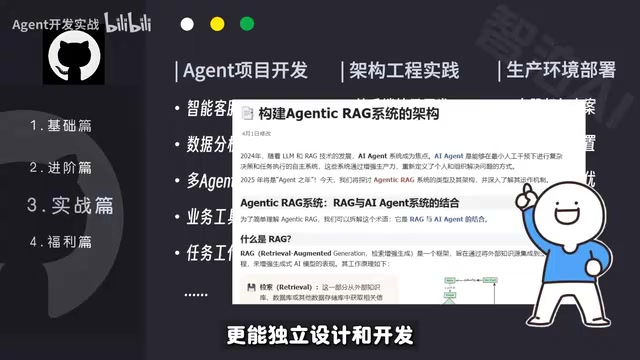
The creator emphasizes that after completing the course, learners will not only understand the underlying principles of Agents, but also be able to independently design and develop agent applications that solve real business problems. These three projects cover three typical scenarios—customer service, data analysis, and collaborative workflows—and are somewhat representative.
Multi-Agent collaboration is the idea of splitting a complex task among multiple agents with their own responsibilities—for example, one responsible for understanding requirements, one for retrieving information, one for generating reports, and one for reviewing and correcting errors—advancing collaboratively through message passing or shared state. Compared with a single large, all-encompassing Agent, a multi-agent structure has clear responsibilities, is easier to debug and replace, and is closer to how real teams work. But it also brings new challenges: how to design role division, how to control communication costs and infinite loops, and how to ensure final result consistency—these are exactly the engineering issues that need to be weighed carefully in hands-on projects.
Accompanying Resources and Learning Advice
The course provides source code, courseware, Prompt templates, and an AI Agent developer learning roadmap compiled by the creator. For learners who want to systematically get started with Agent development, this progressive structure from fundamentals to frameworks to projects makes it easier to form a complete knowledge system than scattered tutorials. However, note that the course information comes from the creator's own description; the actual depth and update pace should be judged by the actual content.
One-line Summary
A Bilibili creator's AI Agent course four months in the making, systematically introducing the field through three chapters: fundamentals, advanced, and hands-on.
Paragraph Summary
The article introduces a systematic AI Agent course compiled by a Bilibili creator over four months. The author points out that most tutorials on the market either stop at piling up concepts or just throw code at learners, making it hard to build complete understanding. The course is therefore divided into three chapters: the fundamentals chapter uses everyday analogies to explain the difference between Agents and large model conversations, the ReAct framework, planning, reasoning, and memory mechanisms, and walks through the first demo; the advanced chapter moves into LangChain and AutoGen frameworks, multi-Agent collaboration, Function Calling, and hybrid ReAct architectures, with dedicated discussion of evaluation, debugging, and security boundaries; the hands-on chapter puts things into practice through three enterprise-level projects: intelligent customer service, automated data analysis, and a multi-Agent collaborative production line. The course also provides accompanying resources such as source code, courseware, Prompt templates, and a learning roadmap.
Related articles
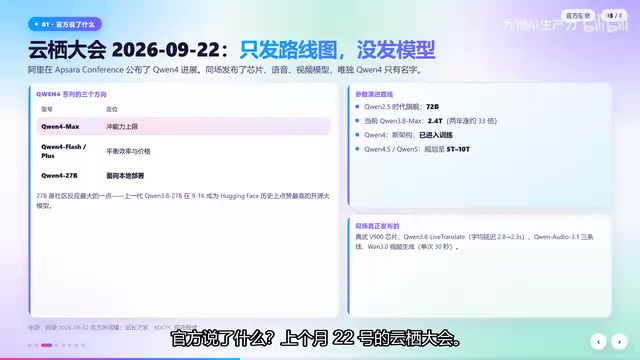
Qwen4 Architecture Preview Open-Sourced: 125B Parameters, 512 Experts, Designed for VRAM-Constrained Hardware
Qwen4 isn't released yet, but its architecture is previewed via open-source Qwen3.8 Flash Next: 125B params, 6B activated per token, 512 experts, 262K context, built for VRAM-limited hardware. This article covers official confirmations, key config.json metrics, and local deployment tests on 24G memory.
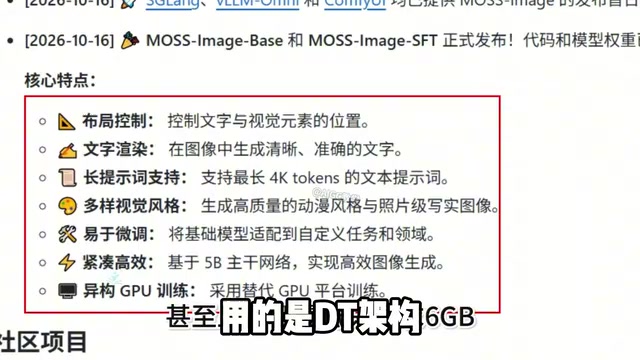
Run 8K Images on 6GB VRAM! Hands-On Test of Fudan's Open-Source MOSS-Image Model
Fudan OpenMouse team and Shanghai MOSS Intelligence open-source MOSS-Image, a 500M-parameter DT architecture text-to-image model that runs locally on 6GB VRAM with precise text rendering, structured layout control, and 4K Token prompt support—ideal for e-commerce posters and local deployment by individual creators.
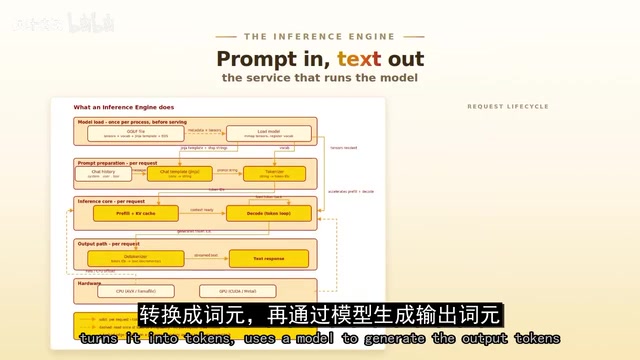
Overseas Blogger Tests Local Deployment of 100B-Parameter MoE Model: Key Lessons on Quantization and Tool Calling
Overseas blogger tests local deployment of Alibaba's Qwen 3.8 Flash Next 100B MoE model on a Strix Halo mini PC and CUDA workstation, revealing how quantization precision affects tool-calling success and the real-world performance of the Strata and GUFO inference engines.