Bilibili's 748-Episode Agent Development Course: A Complete Breakdown from Zero to Enterprise-Level Practice

Bilibili's 748-episode AI Agent course spans cognition, advanced, and practice stages—understand principles first, then build.
The article introduces a 748-episode beginner AI Agent course gaining attention on Bilibili. The creator notes that most tutorials either pile on jargon or jump straight to code, skipping the key step of understanding Agent decision logic. The course has three stages: Cognition (explaining ReAct, planning, and memory through analogies), Advanced (LangChain, AutoGen, Function Calling, debugging, and security), and Practice (intelligent customer service, automated data analysis, and a multi-Agent production line). The author considers the structure a genuine response to real teaching pain points, but views the "expert in seven days" claim as marketing.
A 748-episode AI Agent course for beginners on Bilibili has drawn attention. The creator claims to have scoured nearly all Agent-related content on Bilibili and YouTube, spending four months polishing the course to address a common pain point: 90% of Agent tutorials on the market either pile up buzzwords without explaining concepts, or jump straight into code while skipping problem definition. The course's positioning is clear—first help people understand how Agents think, then build usable intelligent agents step by step.
Why Most Agent Tutorials Fail to Teach
The problems the creator points out in the opening are worth taking seriously. There is a clear teaching gap in Agent development: one type of content indulges in stringing together terms like "autonomous planning," "tool calling," and "memory mechanisms," leaving listeners unsure what problem Agents actually solve; the other jumps straight into API calls, with learners debugging before they've even established basic concepts. Both paths bypass the most critical step—understanding the Agent's decision-making logic.
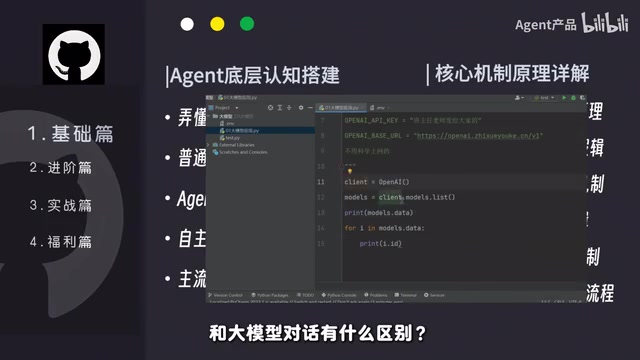
This course takes a different approach: build a cognitive framework first. It uses everyday analogies to explain intimidating concepts like the ReAct framework, planning and reasoning, and memory mechanisms, then lets learners experience an intelligent agent completing a task through the first demo. This "understand first, then build" order is indeed friendlier for beginners.
The ReAct framework is one of the core paradigms of Agent reasoning, short for Reasoning and Acting, proposed by Shunyu Yao et al. in 2022. Its core idea is to have large models alternate between "Reasoning" and "Acting" at each step: first output a thought process to decide what to do next, then call tools to execute and observe the results, looping until the task is complete. Unlike traditional Chain-of-Thought, which only performs static reasoning, ReAct allows models to dynamically adjust strategies based on feedback from the external environment, giving Agents the ability to handle uncertain tasks. The "React framework" mentioned in the text usually refers to this paradigm, an essential foundational concept for understanding Agent decision logic.
Breaking Down the Three-Part Course Structure
The course is divided into three stages: Cognition, Advanced, and Practice, each with different goals.
The Cognition section's core task is building foundational understanding. The creator emphasizes clearly explaining the essential difference between Agents and large model conversations—something many tutorials gloss over. Whether the analogy-based explanation of the ReAct framework as a core Agent reasoning paradigm works depends on the quality of the analogy, but at least the direction is right. The first demo is designed to let learners experience the complete process of an intelligent agent "doing work" before writing any code, building intuition.
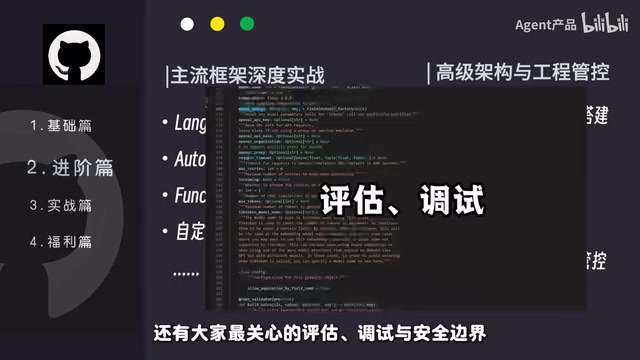
The Advanced section moves into framework practice. LangChain and AutoGen are currently mainstream choices for Agent development, and multi-Agent collaboration, Function Calling tool invocation, and hybrid ReAct-Agent architectures are all covered. Notably, debugging and security boundaries are listed separately—precisely the areas most tutorials ignore but where real projects most easily stumble. The practice of providing code and courseware with each lesson lowers the barrier to following along.
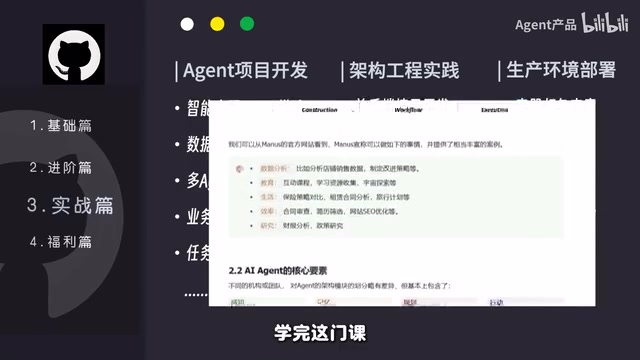
The Practice section implements three enterprise-level projects: an intelligent customer service Agent system covering the full chain from intent recognition to automatic ticket routing; an automated data analysis Agent that produces reports and charts automatically from uploaded Excel files; and a multi-Agent collaborative production line simulating team division of labor. The three projects cover three high-frequency scenarios—customer service, data analysis, and process automation—offering some reference value for job seekers.
Function Calling is the standardized mechanism for large models to interact with external tools. Based on the user's natural language request, the model outputs a structured function name and parameters (usually JSON), which an external program executes and returns the result to the model, which then generates the final answer. It is the underlying implementation of an Agent's "tool calling" capability, freeing models from text generation alone to query databases, call APIs, and perform calculations. OpenAI pioneered this capability in June 2023, and it has since become standard among mainstream large model providers. Understanding the input-output protocol of Function Calling is a threshold that must be crossed before building Agents.
LangChain and AutoGen represent two different approaches to Agent development. LangChain is an earlier general-purpose LLM application framework that connects prompt engineering and tool calling through abstractions like Chain, Agent, Tool, and Memory. It has a large ecosystem and abundant resources, suited for building single Agents or linear workflows. AutoGen, launched by Microsoft Research, focuses on multi-Agent conversational collaboration, where multiple Agents with different role settings work together through dialogue—closer to modeling "team division of labor." The former leans toward engineering pipelines, the latter toward multi-agent interaction, and in practice the two are often used together.
Supporting Resources and Learning Path
Course resources include all source code, courseware, prompt templates, and a learning roadmap for AI Agent developers compiled by the creator. For self-learners, the roadmap's value may rival the course itself—Agent development spans prompt engineering, framework usage, system design, and evaluation methods, and without a clear path it's easy to fall into a state of "learning a bit of everything but mastering nothing."
Objectively Assessing "From Beginner to Expert in Seven Days"
The sheer volume of 748 episodes itself shows that Agent development is not something you can master in seven days. The marketing language in the title should be discounted, but the course structure does attempt to solve real teaching problems: the disconnect between concepts and practice, framework learning without project guidance, and neglected evaluation and debugging.
For readers wanting to get started with Agent development, this course can serve as a starting point for systematic learning, but the promise of "job-ready upon completion" should be treated with caution. Competitiveness in Agent development ultimately comes from the ability to independently design and implement solutions to real business problems; the course provides frameworks and paths, but depth of practice still depends on individual effort. The multi-source approach to organizing course content reduces the filtering cost for learners, which is commendable.
One-line Summary
Bilibili's 748-episode AI Agent course spans cognition, advanced, and practice stages—understand the principles first, then build.
Paragraph Summary
The article introduces a 748-episode beginner AI Agent course gaining attention on Bilibili. The creator notes a common teaching gap: tutorials either pile on jargon or jump straight to code, bypassing the key step of understanding Agent decision logic. The course has three stages: the Cognition section uses everyday analogies to explain the ReAct framework, planning and reasoning, and memory mechanisms, building intuition through the first demo; the Advanced section covers LangChain and AutoGen, multi-Agent collaboration, Function Calling, and debugging and security boundaries; the Practice section implements three enterprise-level projects—intelligent customer service, automated data analysis, and a multi-Agent collaborative production line. The course includes source code, courseware, prompt templates, and a learning roadmap. The author believes the structure genuinely addresses real teaching pain points, but "from beginner to expert in seven days" is marketing language, and competitiveness ultimately depends on the ability to independently deliver business solutions.
Related articles

Build a Reasoning Model from Scratch: An 11-Hour Open-Source Course Breakdown
Sebastian Raschka releases a free 8-episode, ~11-hour video course teaching you to build a reasoning model from scratch with Python and PyTorch—from a small Qwen3 model through Verifier, Inference Time Scaling, GRPO, and distillation, with open-source code on GitHub.

An 11-Hour Reasoning Model Course in Practice: How Small Models Learn to Think
Starting from Sebastian Raschka's 11-hour reasoning model course and HN buzz, this analyzes small-model training, legal text version control, Anthropic data policy, and product reliability reviews.

Lightpanda: A Headless Browser Built for AI and Automation
Lightpanda is a headless browser built from scratch in Zig for AI and automation, with 37,852 GitHub stars. This analysis covers its technical approach, design choices, and use cases.