Binance's $6.3 Billion Crypto Theft: The Largest Hack in History

Binance disclosed that $6.3 billion in crypto assets were stolen, saying about $3 billion has been recovered or frozen.
Binance disclosed via X that $6.3 billion worth of crypto assets were stolen from the platform, far exceeding historical events such as Mt. Gox and Coincheck and making it the largest cryptocurrency hack to date. Binance emphasized that user funds are safe and said approximately $3 billion of the affected assets have been recovered or frozen. The incident shocked the market and raised community doubts, with focus on why such a huge amount of assets could be transferred, possibly involving internal security vulnerabilities or private key management issues. The article argues that the incident will strengthen regulatory scrutiny, weaken user trust in centralized custody, and may push funds toward DeFi and self-custody wallets, while recommending that users use hardware wallets, diversify storage, and enable two-factor authentication.
Event Overview: Binance Discloses Record-Breaking Crypto Theft
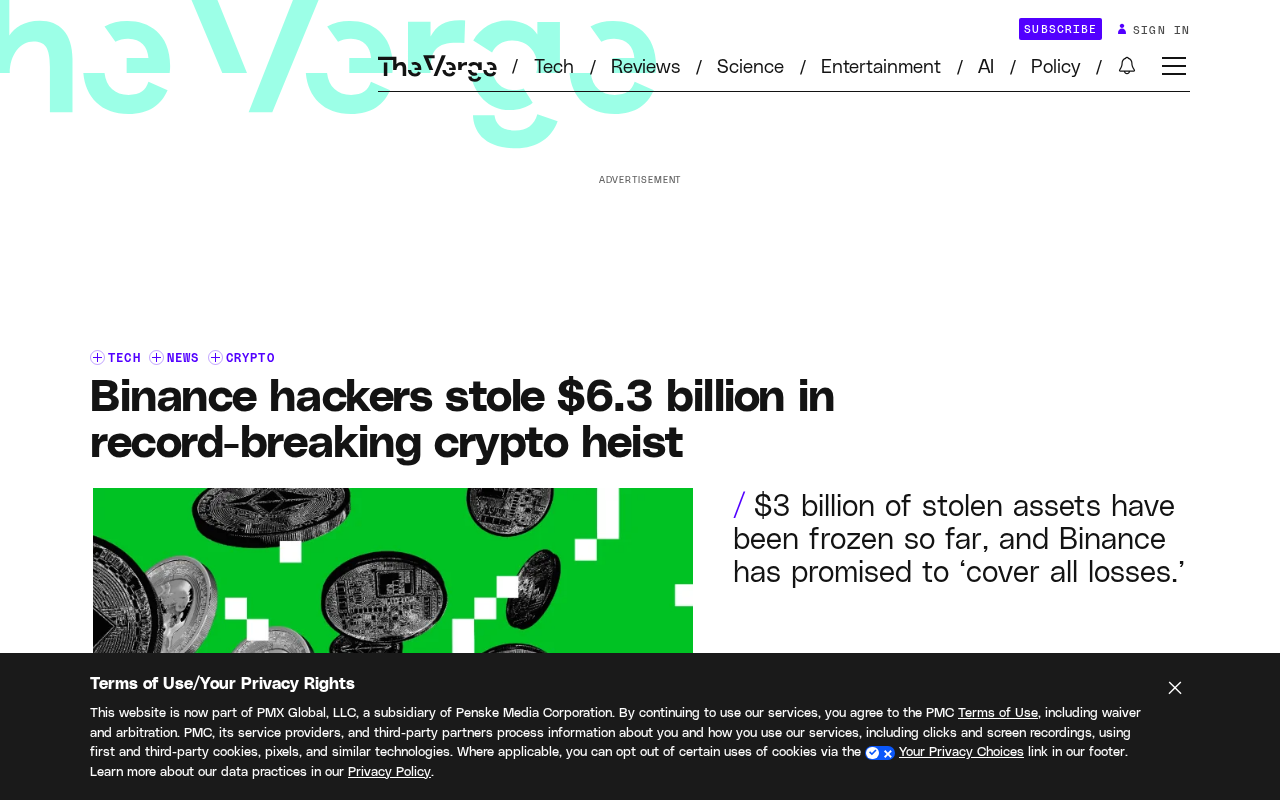
Cryptocurrency exchange Binance recently disclosed that $6.3 billion worth of crypto assets were stolen from the platform, which is considered the largest cryptocurrency hack to date. Binance announced the news through a series of updates on X, emphasizing that user funds are safe and stating that approximately $3 billion of the affected assets have been recovered or frozen.
The incident quickly sent shockwaves through the market, not only because of the massive sum involved but also because it occurred at one of the world's largest cryptocurrency exchanges. Although Binance tried to reassure users, the incident has undoubtedly sounded another alarm bell for the security model of centralized exchanges.
User Fund Safety Commitment and Market Reaction
Binance explicitly stated in its announcement that "user funds are safe" and revealed that approximately $3 billion of the affected assets have been protected. This statement was intended to stabilize market sentiment and avoid triggering a large-scale bank run. However, the crypto community's reaction has been mixed: on one hand, some users acknowledged Binance's speed in responding; on the other, some questioned how such a huge amount of funds could be transferred.
According to analysis from Bilibili creators and YouTube channels, the incident may involve internal security vulnerabilities or private key management issues, but specific details have not yet been made public. Cross-verification of multiple sources shows that Binance quickly froze some assets after the incident and cooperated with law enforcement agencies to launch an investigation.
Largest in History: Comparison with Previous Hacks
Previously, the largest hacks in the cryptocurrency space included Mt. Gox (approximately 850,000 bitcoins stolen) and Coincheck (approximately $530 million). Binance's $6.3 billion scale far exceeds these historical events, making it the new "record holder." Analysts point out that this scale reflects the growth of the crypto market's total market capitalization, but also exposes that centralized exchanges still face severe security challenges.
Interestingly, Binance has invested heavily in security in recent years, including establishing the SAFU fund (Secure Asset Fund for Users) and strengthening KYC/AML processes. However, this incident shows that even the top-tier exchanges cannot completely avoid security risks.
The SAFU fund is the "Secure Asset Fund for Users" established by Binance in 2018. By continuously allocating a portion of trading fees into a separate wallet, it is used to compensate users for losses in extreme security incidents. It was one of the earlier proactive risk reserve mechanisms among centralized exchanges. Proof of Reserves is an audit method that uses technical means such as Merkle trees to prove to users and the public that the exchange actually holds sufficient assets to cover all customer liabilities. It was widely adopted by the industry after the FTX incident. In essence, both are trust patches designed to address "information asymmetry" and "opaque solvency" in centralized custody, but their effectiveness depends on the exchange's honest disclosure and the independence of third-party audits.
Far-Reaching Impact on the Crypto Industry
This hack may trigger a series of chain reactions. Regulators are likely to strengthen scrutiny of centralized exchanges, requiring stricter security standards and proof of reserves. Users' trust in centralized custody may further decline, pushing more people toward decentralized finance (DeFi) or self-custody wallets.
In addition, Binance's platform token BNB may face selling pressure, while mainstream assets such as Bitcoin and Ethereum may also experience short-term volatility due to market panic. However, since Binance has promised user fund safety, the long-term impact may depend on the subsequent investigation results and compensation plans.
Self-custody wallets refer to wallets where users control their own private keys (such as hardware wallets or non-custodial software wallets). Asset control does not pass through the exchange, so they are not directly affected when an exchange is attacked, but users must bear the risk of private key loss or operational errors themselves. Decentralized finance (DeFi) refers to lending, trading, and liquidity protocols built on smart contracts. Users complete operations by interacting with contracts without depositing assets into a centralized platform. In theory, DeFi reduces single-point custody risk, but its smart contract vulnerabilities, oracle manipulation, and governance attacks can also cause huge losses. Therefore, it is not an absolutely safe alternative, but rather shifts risk from "platform credit" to the "code and protocol" level.
Security Recommendations and Future Outlook
For ordinary users, this incident once again reminds us: do not store large amounts of assets on centralized exchanges for the long term. Using hardware wallets, diversifying storage, and enabling two-factor authentication (2FA) are basic security measures. At the same time, paying attention to exchanges' proof of reserves and insurance fund status is also crucial.
Binance said it will continue investigating and updating progress. Regardless of the final outcome, this $6.3 billion theft will become an important turning point in the crypto industry's security evolution—it may accelerate the improvement of regulatory frameworks and may also drive innovation in insurance and audit services.
Two-factor authentication (2FA) is a method of adding a second layer of verification beyond a password. Common forms include SMS verification codes, dynamic codes generated by authenticator apps, and hardware security keys. SMS verification codes are vulnerable to SIM-swapping attacks, so the security community generally recommends prioritizing TOTP-based authenticator apps or FIDO hardware keys. Hardware wallets store private keys offline in dedicated devices, and the signing process does not expose the private key, effectively defending against phishing and malware. It should be emphasized that these measures mainly prevent account-level intrusions and cannot defend against exchange-level private key leaks or insider actions. This is also why diversifying storage and controlling exposure to any single platform are repeatedly emphasized.
One-line Summary
Binance disclosed that $6.3 billion in crypto assets were stolen, saying about $3 billion has been recovered or frozen.
Paragraph Summary
Binance disclosed via X that $6.3 billion worth of crypto assets were stolen from the platform, far exceeding historical events such as Mt. Gox and Coincheck and making it the largest cryptocurrency hack to date. Binance emphasized that user funds are safe and said approximately $3 billion of the affected assets have been recovered or frozen. The incident shocked the market and raised community doubts, with focus on why such a huge amount of assets could be transferred, possibly involving internal security vulnerabilities or private key management issues. The article argues that the incident will strengthen regulatory scrutiny, weaken user trust in centralized custody, and may push funds toward DeFi and self-custody wallets. It also recommends that users use hardware wallets, diversify storage, and enable two-factor authentication.
Related articles

Vibe Coding Full-Stack in Practice: AI Programming from Beginner to Enterprise Deployment
From Cursor to Claude Code, this Bilibili AI programming course uses four progressive projects to cover full-stack development, open-source secondary development, and team collaboration. The article analyzes the shock to frontend roles, the efficiency shift from 50 people to 5, and the methodology required for enterprise-grade projects.

David Blaine's Global Quest for Real Magic: From South Africa to Japan and India
David Blaine travels to South Africa, Japan, and India in his Do Not Attempt special, documenting Spinning drivers, black mamba rescuers, iaijutsu masters, and ascetics—exploring the boundary between magic and real human极限 challenges.

Is a Touchscreen MacBook Coming? Vergecast Reveals Apple Executive's Response
Vergecast podcast reveals a conversation between a reporter and Apple executive John Ternus about a touchscreen MacBook and Apple Pencil support. Ternus says iPad is the best device for a stylus, while the reporter bets MacBook will eventually support Apple Pencil.