Bird-Mimicking Drone Successfully Evades Detection in US Military Exercise
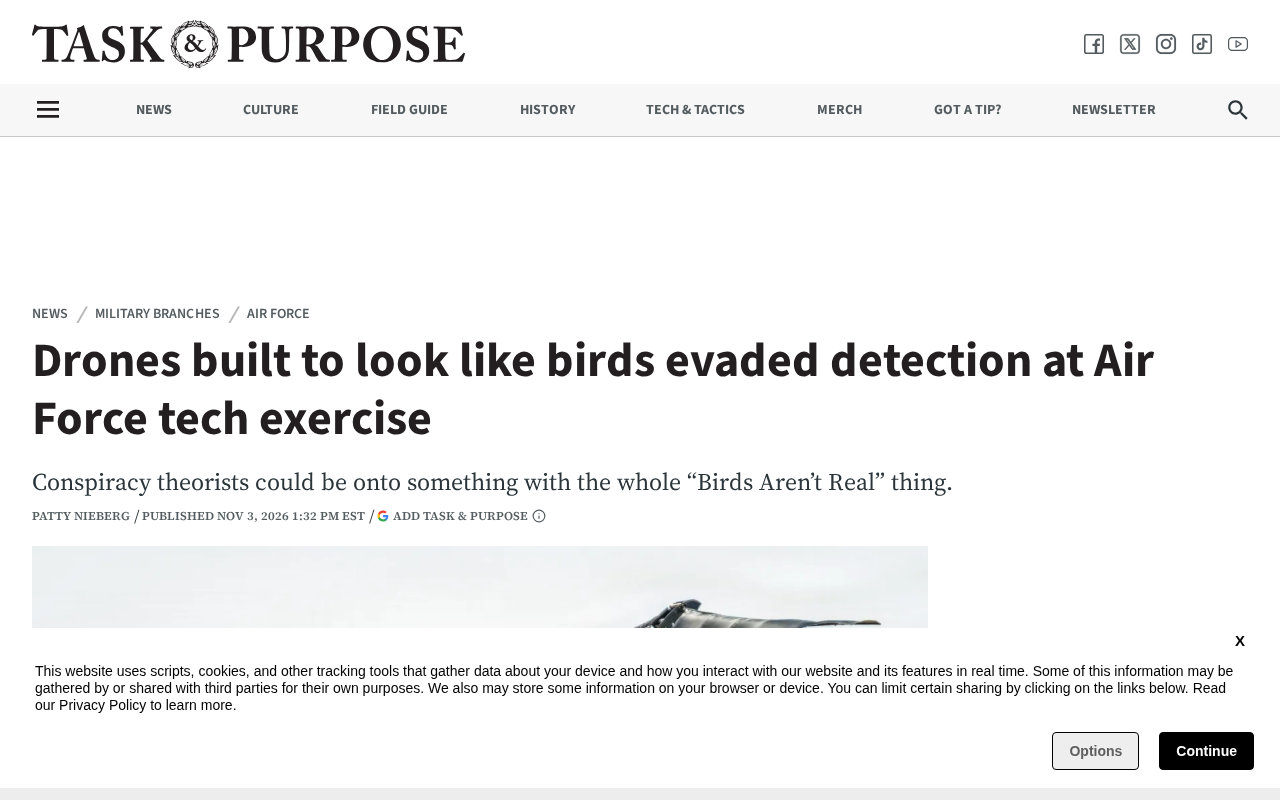
A bird-mimicking drone evaded detection in a US Air Force exercise, exposing counter-drone blind spots for low-signature targets.
The article examines a bird-mimicking drone that evaded detection in a US military exercise, analyzing how appearance, flight posture, and radar cross-section design help it blend with real birds and background clutter. It notes that radar, electro-optics, RF, and acoustic detection each have blind spots, and that multi-sensor fusion faces a confidence-threshold dilemma between false alarms and missed threats. The author argues that low-cost biomimetic platforms will make low-signature targets widespread, escalating the detection-versus-camouflage race.
According to discussions in the Hacker News community, a drone designed to resemble a bird successfully evaded detection systems during a US Air Force technology exercise. Though brief, this news touches on the core tension in the ongoing contest between counter-drone technology and camouflaged UAVs: when an aircraft's appearance and movement patterns closely mimic those of natural organisms, the effectiveness of traditional detection methods is significantly degraded.
The Technical Logic of Camouflaged Drones
The core idea behind bird-mimicking drones is not complicated—through design of appearance, flight posture, and radar cross-section, the drone is made to appear closer to a real bird at both the visual and sensor levels. Such platforms typically use lightweight materials and flapping-wing or gliding flight modes to reduce the probability of recognition by the naked eye and optical devices.
From a detection perspective, the difficulty lies in the high degree of overlap between target signatures and background clutter. Birds are numerous and active in airspace; if a detection system lacks high-confidence classification capability for small, slow-moving targets, it will easily classify a bird-mimicking drone into the "non-threat" category. The results of this Air Force technology exercise show that existing detection chains still have clear gaps when dealing with such low-signature targets.
According to information on Hacker News, the exercise was an Air Force technology validation activity focused on testing detection and identification capabilities. The fact that the bird-mimicking platform was able to "evade detection" means that the camouflage design did indeed produce results in an operationalized scenario.
Radar cross-section (RCS) is a physical quantity that measures how strongly a target reflects electromagnetic waves under radar illumination, typically expressed in square meters. It is not the target's actual geometric area but is closely related to shape, material, and angle of incidence—through inclined surfaces, radar-absorbing coatings, and avoidance of corner-reflector structures, RCS can be significantly reduced. Bird-mimicking drones exploit exactly this principle: a miniaturized fuselage inherently has a small reflective cross-section, and flapping-wing or gliding postures cause echoes to exhibit irregular fluctuations similar to those of birds, making it difficult for radar to distinguish them from natural flying objects. Another key metric alongside RCS is the micro-Doppler signature—the periodic frequency modulation produced by rotors or flapping wings—which is an important basis for distinguishing mechanical flight from biological flight and is also something biomimetic platforms deliberately imitate or suppress.
Implications for Counter-Drone Systems
This result poses a direct challenge to counter-drone technology roadmaps. Current mainstream detection methods include radar, RF detection, acoustic sensing, and electro-optical identification, each with its own blind spots:
- Radar has limited classification capability for small, slow-moving targets, and the low-cross-section design of bird-like shapes further compresses signal signatures;
- Electro-optical identification relies on target appearance features, and bird-like shapes directly target this link;
- RF detection becomes less effective against platforms that fly autonomously or maintain silent links;
- Acoustic sensing struggles to distinguish biological flight from mechanical flight in noisy environments.
Multi-sensor fusion is widely recognized in the industry as the response direction, but fusion presupposes that each sensor can provide features with sufficient discriminative power. When a target deliberately mimics natural objects across multiple dimensions, setting confidence thresholds for the fusion system becomes very delicate—too low a threshold produces large numbers of false alarms, while too high a threshold may miss real threats.
RF detection works by intercepting the communication link or video transmission signal between a drone and its control station, then identifying and locating the drone through signal characteristics. Its advantages are passive operation and long range, but it has two inherent shortcomings: first, platforms using autonomous flight (predefined routes, inertial navigation, or onboard vision) do not emit control signals, leaving RF detection with nothing to work on; second, even when a link exists, frequency hopping, spread spectrum, and low-power transmission reduce the probability of interception. If a bird-mimicking platform uses silent autonomous flight, the RF dimension is essentially ineffective, so this method is better suited as a supporting source of evidence within a fusion system rather than as an independent basis for judgment.
Multi-sensor fusion refers to correlating and integrating data from different sources such as radar, electro-optics, RF, and acoustics at the feature level or decision level to compensate for the blind spots of any single sensor. Common approaches include state-estimation fusion such as Kalman filtering, as well as machine-learning-based feature concatenation and voting mechanisms. The core difficulty lies in confidence calibration: different sensors vary greatly in reliability across environments, and a fusion system needs to dynamically weight each source of evidence. When a target deliberately mimics natural objects, features across all dimensions shift toward "non-threat," systematically lowering the fusion result—this is precisely the root of the threshold-setting dilemma.
The Long-Term Contest Between Camouflage and Detection
From a broader perspective, biomimetic drones are not a new concept, but incorporating them into an Air Force technology exercise and openly discussing detection-evasion results indicates that this direction is moving from the laboratory toward operational validation. The low-cost nature of such platforms also means that once the technology proliferates, defenders will face not a small number of high-value targets but a considerable number of low-signature aircraft.
The Hacker News discussion on this topic also reflects a consensus: relying on any single detection method alone is insufficient to counter camouflaged targets, and future counter-drone systems will need stronger target classification capabilities and more flexible deployment approaches. As for whether bird-mimicking drones will become a mainstream infiltration method, there is still insufficient public data to judge, but this exercise at least proves one point—the tactical value of appearance-based camouflage holds up in real test environments.
For readers concerned with drone security and defense technology, this case is worth continued tracking. The technological race between detection and camouflage is likely to continue escalating for some time to come.
One-line Summary
A bird-mimicking drone evaded detection in a US Air Force exercise, exposing counter-drone systems' blind spots for low-signature targets.
Paragraph Summary
The article examines a bird-mimicking drone that successfully evaded detection in a US military exercise, analyzing the technical logic of camouflaged drones: by designing appearance, flight posture, and radar cross-section to resemble real birds, the target's signature highly overlaps with background clutter. The article notes that mainstream detection methods—radar, electro-optics, RF, and acoustics—each have blind spots, and while multi-sensor fusion is the response direction, confidence thresholds face a dilemma between false alarms and missed detections. The author argues that once low-cost biomimetic platforms proliferate, defenders will face a considerable number of low-signature targets, and the technological race between detection and camouflage will continue to escalate.
Related articles

Microsoft WebIQ: Verifiable Real-Time Web Grounding for AI Agents
Microsoft WebIQ gives AI Agents real-time, citable web grounding across web, news, images, videos, and Places—164ms P95 latency, 50% fewer tokens, Scopes source control, and MCP integration.

Augmentable Gaussian Splatting: Building Photorealistic Simulation Environments for Robot Training
Team combines Gaussian Splatting with meshes to build photorealistic robot simulation environments, integrating MuJoCo Warp physics and Franka Panda for augmentable, relightable real-site simulation.

Gemini 4 Carbon Released: The Leap from Gemini 3 to Gemini 4 in Under a Year
Google releases Gemini 4 Carbon, less than a year after Gemini 3. In the official demo, Carbon reverse-engineered the Theme Park binary, added a new DeepMind-themed ride, and ported it to the web in one shot.