Blue Wave Hits AI: Democrats Seize Congress, Tech Regulation Landscape Shifts

Democrats win both chambers in midterms; blue wave may drive federal AI regulation, rejecting current governance path.
In the U.S. midterm elections, Democrats swept the House and Senate, creating a "blue wave" and historic firsts like the first Black female governor and first Native American female governor. This political reshaping is seen as a "total repudiation" of current AI regulation. Analysts suggest Democrats may push for a unified federal AI governance framework covering transparency, algorithmic accountability, and privacy, ending fragmented state rules. Compliance costs may rise, but regulatory uncertainty could decrease. However, political promises and legislative reality still diverge, and partisan disagreements over innovation and risk control remain; companies must prepare for multiple scenarios.
The results of the U.S. midterm elections are in, and the Democratic Party has swept control of both the House and the Senate, with a "blue wave" washing over traditionally red and swing states. According to RSS sources, this election set multiple historic firsts: Georgia elected the country's first Black female governor, New Mexico elected its first Native American female governor, and a Maine senator conceded defeat. This reshaping of the political map is being interpreted by observers as a "total repudiation" of the current approach to AI regulation.
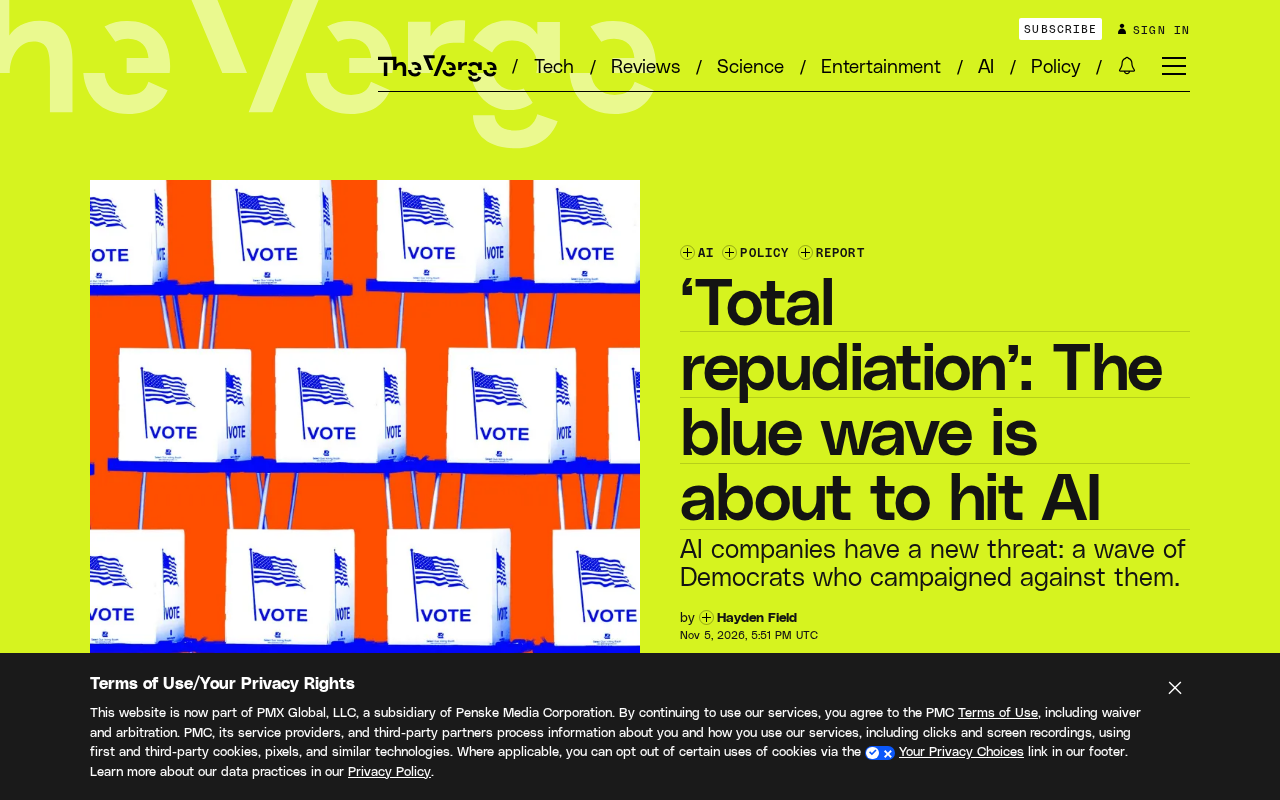
How the Political Shift Connects to AI Regulation
Although the original report did not elaborate on AI policy details, the phrase "total repudiation" in the headline suggests the election results reject the existing path of tech governance. For some time, AI-related legislative discussions have been deadlocked in Congress, while states have pursued fragmented regulatory attempts. With Democrats now in full control of the legislative branch, they are expected to push for a more unified federal AI governance framework covering transparency, algorithmic accountability, and privacy protection.
For the tech industry, this could mean higher compliance costs, but it may also end the troubles caused by current regulatory uncertainty. Some companies that have long called for clear rules may see this as a positive development.
Institutional Background of U.S. Midterm Elections: U.S. midterm elections refer to congressional elections held in the second year of a presidential term, in which all 435 House seats and about one-third of Senate seats (roughly 35 this time) are up for election, along with gubernatorial races in many states. Historically, midterms almost always disadvantage the sitting president's party, so a "blue wave"—Democrats taking both chambers—represents a significant rebuke to the ruling party. This "reverse pendulum" effect means election results are often interpreted as a referendum on the incumbent administration's policy direction, including tech and AI governance.
Federal and State AI Regulatory Landscape: U.S. AI regulation has long been fragmented, with "federal absence and states leading the way." States like Colorado and Illinois have passed legislation on algorithmic discrimination and biometric privacy, while at the federal level there are only executive orders and agency guidance, lacking a unified statute. With Democrats controlling Congress, they may push for a risk-tiered framework similar to the EU AI Act, but the U.S. tends to favor sectoral regulation rather than a single comprehensive law. The Federal Trade Commission's (FTC) enforcement authority over "unfair or deceptive acts" under Section 5 of the FTC Act has been the main tool for AI consumer protection. Understanding this institutional context is key to judging what "total repudiation" actually rejects—more than anything, it rejects the federal regulatory delays and patchwork of state-level rules over the past two years.
Signals Behind the Historic Election Results
The victories of multiple women and minority candidates in this election reflect changes in the electorate's composition. The breakthroughs in Georgia and New Mexico, along with the Maine senator's defeat, together form a clear signal: the progressive agenda has gained real support in key states. This shift in political energy is likely to extend to tech policy, pushing AI regulation toward greater emphasis on fairness and accountability.
Outlook for the AI Industry
In the short term, AI companies need to watch for legislative drafts the new Congress may propose. Regulatory agencies like the FTC may also step up enforcement. In the long term, if a unified federal AI law can be passed, it will replace the patchwork of state rules and reduce compliance complexity for cross-state operations.
However, there is still a gap between political promises and legislative reality. AI regulation involves balancing innovation incentives and risk control, and partisan disagreements over details will not disappear because of election results. The industry needs to prepare for multiple policy scenarios.
Algorithmic Accountability and Transparency Regulation: The "algorithmic accountability" mentioned in the article is not a new concept; its core requires companies to document and disclose the decision logic, training data sources, and potential biases of AI systems. The U.S. has a draft Algorithmic Accountability Act (requiring impact assessments for large AI systems), but it has never become law. If Democrats push legislation, they may draw on the experience of New York City Local Law 144 (requiring annual bias audits for hiring AI tools). Rising compliance costs mainly come from auditing, documentation, and third-party assessments, rather than outright bans on certain AI applications.
The Two Sides of Regulatory Uncertainty for Businesses: The tech industry's attitude toward "regulatory uncertainty" is not uniform. Large companies typically have the resources to handle a patchwork of state rules and can even use them to build compliance moats; startups are more troubled by fragmented compliance. Therefore, a unified federal framework is beneficial for the industry as a whole, but specific provisions—such as whether to establish AI safety permits or impose additional obligations on foundation models—will still spark intense lobbying. Understanding this divide helps clarify that "rising compliance costs" and "the end of uncertainty" are not contradictory, but rather different impacts on companies of different sizes.
Conclusion
The "blue wave" brings not only a change in congressional seats but also a recalibration of tech governance philosophy. The AI industry stands at the threshold of a changing regulatory environment; actively participating in policy discussions and establishing responsible AI practices will be pragmatic choices for companies to navigate uncertainty.
One-line Summary
Democrats take both chambers in midterms; the blue wave may push for a federal AI regulatory framework, rejecting the existing governance path.
Paragraph Summary
In the U.S. midterm elections, Democrats swept control of the House and Senate, forming a "blue wave" and setting historic firsts such as the first Black female governor and first Native American female governor. Observers interpret this political reshaping as a "total repudiation" of the current AI regulatory stance. Although the original report did not detail AI policy, analysts believe that with Democrats in full control of the legislative branch, they may push for a more unified federal AI governance framework covering transparency, algorithmic accountability, and privacy protection, ending the fragmented state-level regulatory landscape. For the AI industry, compliance costs may rise, but regulatory uncertainty is expected to decrease; companies that have long called for clear rules may see it as a positive. However, there is still a gap between political promises and legislative reality, and partisan disagreements over innovation incentives and risk control will not disappear. Companies need to prepare for multiple policy scenarios.
Related articles
 Tech Frontiers
Coldframe: A Honeypot Disguised as a Supermarket Freezer Controller
Coldframe is a honeypot disguised as Danfoss AK-SM 800A and Dixell XWEB freezer controllers, built as a single Python file that detects CVE-2025-41450 attempts and is identified as real devices on Shodan.
 Tech Frontiers
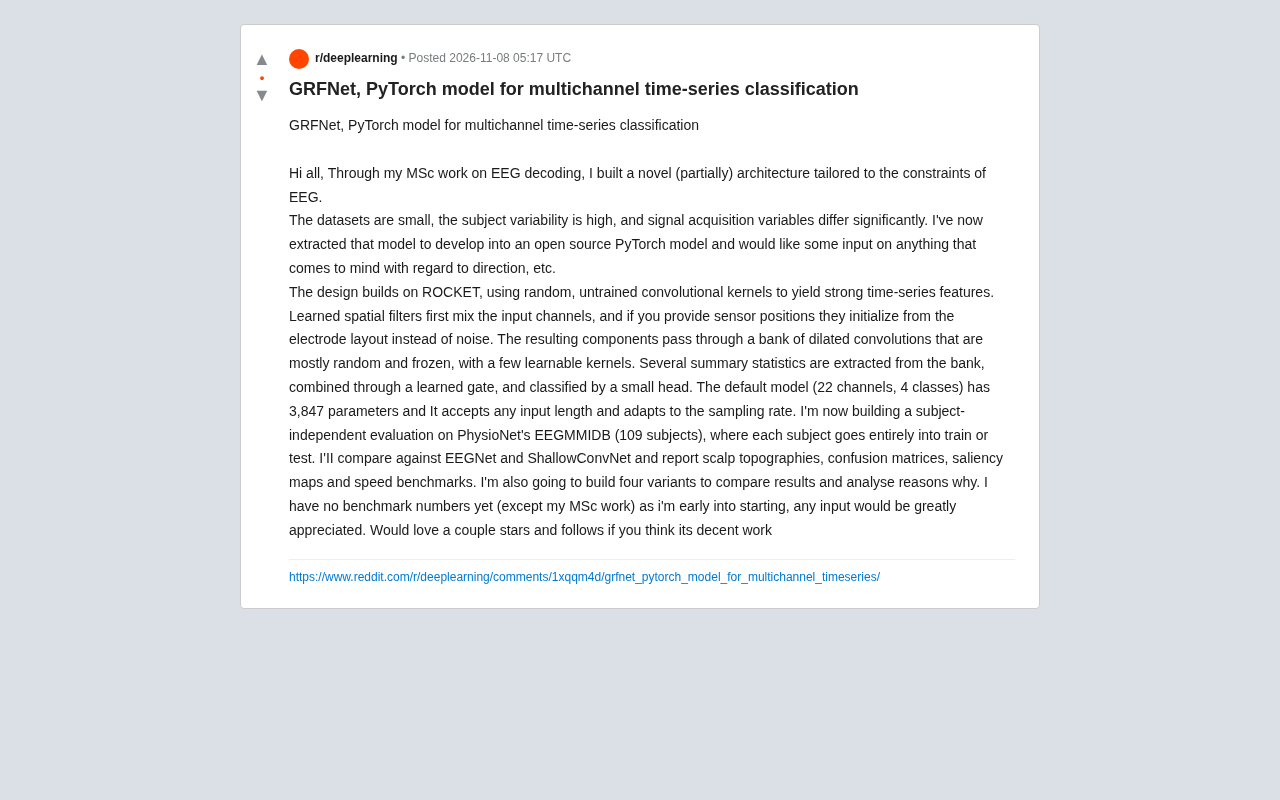
GRFNet: A Lightweight PyTorch Model Designed for Multichannel Time-Series Classification
GRFNet is a lightweight PyTorch model for multichannel time-series classification, originating from EEG decoding research. With only 3,847 parameters, it is based on the ROCKET architecture, combining random convolution kernels with learnable spatial filters, supports arbitrary input lengths, and will soon be evaluated on the PhysioNet dataset.
 Tech Frontiers
CUDA-Accelerated Rocket League Simulator: A Player-Made Hardcore Experiment
A Reddit post shows a "100% Accurate" Rocket League simulator accelerated with CUDA. We analyze its technical context, CUDA's value in game physics simulation, and the significance and limitations of such community projects.