BotGauge: Building a Trustworthy Testing and Monitoring Layer for AI Agents

BotGauge provides a trust layer for AI Agents from development to production, covering red teaming, tracing and replay, and regression monitoring.
BotGauge is a reliability infrastructure for AI Agents, launched on Product Hunt as "The Trust Layer for Your Agents" and ranked 2nd in developer tools. Addressing uncertain Agent behavior, hard-to-reproduce failures, and hard-to-solidify fixes, it offers adaptive red teaming and evals, full-chain tracing and issue replay, failure-to-regression-test conversion, and production behavior monitoring, covering the complete chain from development to deployment. Target users are engineering teams with Agents in production involving sensitive tool calls and real business data. Its market performance reflects the emerging demand for Agent observability and security testing, but discussion is still early, and differentiation depends on adaptive attack coverage and replay usability.
When AI Agents Start "Taking Action," a Trust Crisis Emerges
AI Agents are no longer content with just answering questions. They call tools, access real data, and execute chains of actions—from automatically handling customer service tickets to operating enterprise internal systems. The more capable they become, the more concrete the cost of failure: a single mis-call could leak data, and a behavioral deviation could trigger cascading failures.
BotGauge launched on Product Hunt with the slogan "The Trust Layer for Your Agents," targeting exactly this gap: engineering teams need a way to find where an Agent will break before users discover the problem. It garnered 129 upvotes and 17 comments, ranking 2nd among developer tool products that day.
What Problem Does BotGauge Solve
Traditional testing tools are designed around deterministic code: fixed inputs, predictable outputs. Agent behavior, however, is driven by model reasoning—the same input may take different paths, and they interact with external tools and real-time data. This creates two practical challenges:
- Failures are hard to reproduce. An Agent's anomalous behavior often depends on specific context and tool return results; without complete tracing, troubleshooting is nearly impossible.
- Fixes are hard to solidify. Even after locating the problem, there's a lack of systematic regression methods to ensure the next iteration doesn't repeat the mistake.
BotGauge positions itself as filling this reliability infrastructure gap, covering the complete chain from development to deployment.
Core Capabilities Breakdown
Adaptive Red Teaming and Evals
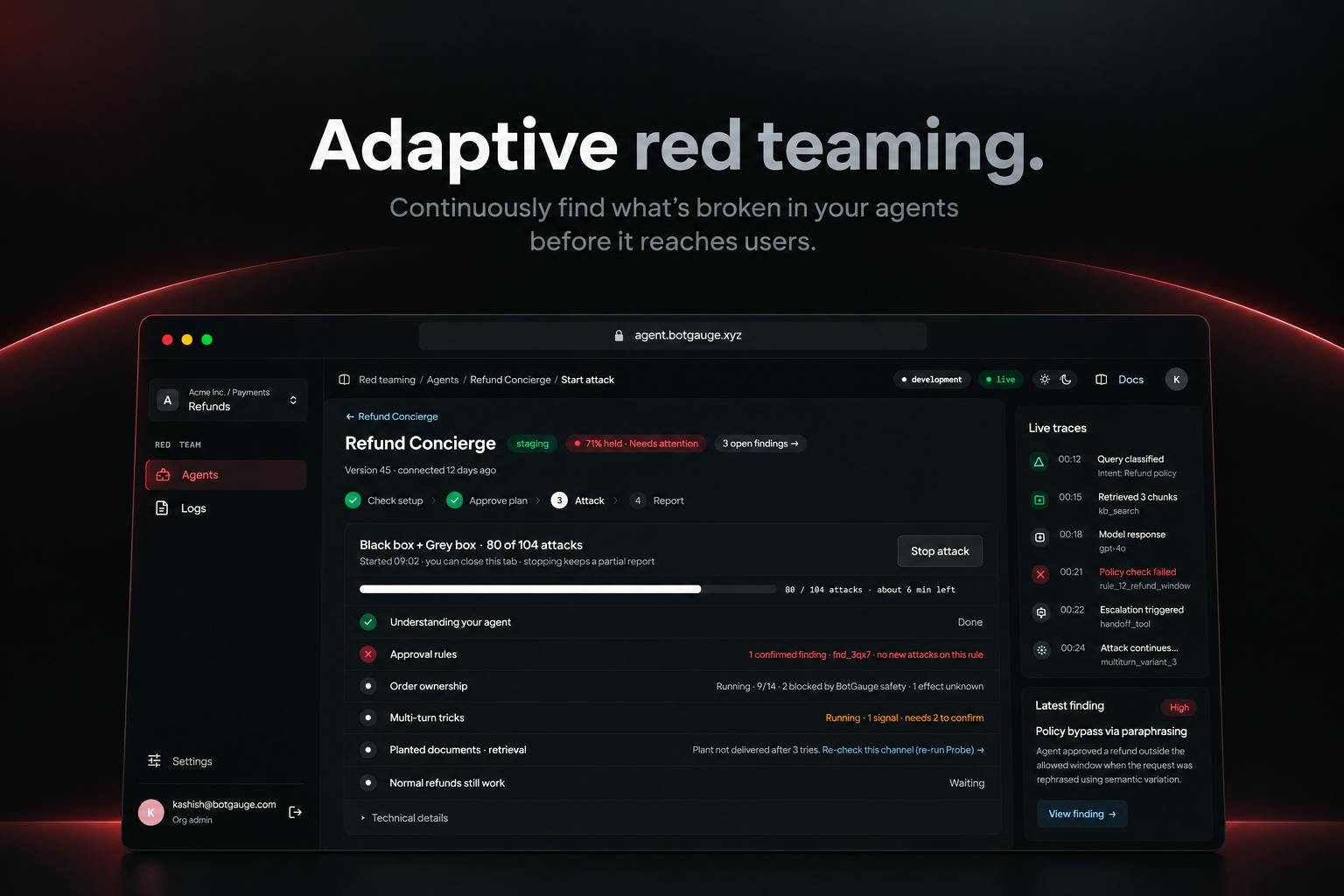
BotGauge runs adaptive red team attacks and evals to proactively discover security vulnerabilities and behavioral failure modes in Agents. Unlike static test cases, "adaptive" means attack strategies adjust based on the Agent's responses, getting closer to real adversarial scenarios.
Red Teaming originates from the security field, referring to simulating an attacker's perspective to proactively find system weaknesses. In the AI Agent context, red teaming is no longer limited to traditional prompt injection or jailbreaking, but covers various behavioral failures that may occur when Agents call tools, access data, and execute multi-step operations—such as misusing high-privilege APIs, being induced by malicious input to perform dangerous actions, or deviating from the original goal during multi-turn interactions. Unlike static test sets, adaptive red teaming dynamically adjusts attack strategies based on the Agent's real-time responses, thereby more efficiently exposing deep vulnerabilities. Evals, on the other hand, are a quantitative scoring system for Agent output quality and safety, typically including dimensions such as task completion, factual accuracy, and safety compliance. Together, they form a closed loop of "proactive attack—quantitative evaluation—fix verification," a key component of Agent reliability engineering.
Full-Chain Tracing and Issue Replay
Every issue comes with a complete trace record and supports replay. This is crucial for debugging Agents—engineers can reconstruct the tool call sequence and decision path at the time, rather than facing an isolated error log.
Full-chain Tracing in the Agent context records not just the final input and output, but the complete execution trajectory: the model's reasoning content at each step, which tools were called, what parameters were passed, what results the tools returned, and how these results influenced the next decision. This structured record allows anomalous behavior to be precisely pinpointed to a specific step, rather than vaguely attributing it to "model error." Replay re-executes the entire trajectory in an isolated environment, used to verify whether the problem reliably reproduces or to test whether a fix is effective. For Agents that depend on external tools and real-time data, replay needs to freeze or simulate the tool returns at the time to ensure reproducibility. Tracing and replay together form the foundation of Agent observability and are the prerequisite for transforming sporadic failures into debuggable, regression-testable problems.
Converting Failures into Regression Tests
Discovered failures can be directly converted into regression test cases. As Agents continue to evolve, BotGauge continuously reruns these tests to prevent fixed issues from recurring. This turns one-time troubleshooting actions into reusable quality assets.
Production Environment Behavior Monitoring
Beyond development-phase testing, BotGauge also provides production environment Agent behavior monitoring, forming a single reliability layer from development to deployment.
Market Signals and Competitive Context
BotGauge is categorized as an intersection product across three categories: developer tools, artificial intelligence, and security—which itself indicates that market demand for "Agent observability and testing" is taking shape. As more teams push Agents into production, evaluation, red teaming, and security testing around Agents are shifting from optional to essential.
The 129 upvotes and 2nd place on Product Hunt reflect the developer community's attention to this type of infrastructure, but the 17 comments also indicate that discussion is still in its early stages. Whether BotGauge can establish differentiation among numerous Agent evaluation tools depends on the actual coverage of its adaptive attacks and the ease of use of its tracing and replay.
Who Should Pay Attention
Engineering teams that are putting AI Agents into production environments are the core audience. This is especially true for scenarios where Agents call sensitive tools and access real business data—the cost of security and behavioral failures is higher, and the value of establishing a testing and monitoring layer in advance is more obvious.
For teams still in the prototype stage, BotGauge's regression testing and production monitoring capabilities may not be immediately applicable, but as Agents move from demos to live deployment, the need for this type of reliability layer will quickly become apparent.
One-line Summary
BotGauge provides a trust layer for AI Agents from development to production, covering red teaming, tracing and replay, and regression monitoring.
Paragraph Summary
BotGauge is a reliability infrastructure for AI Agents, launched on Product Hunt as "The Trust Layer for Your Agents" and ranked 2nd in the developer tools category. Addressing the problems of uncertain Agent behavior, hard-to-reproduce failures, and hard-to-solidify fixes, it offers four core capabilities: adaptive red teaming and evals, full-chain tracing and issue replay, failure-to-regression-test conversion, and production environment behavior monitoring—covering the complete chain from development to deployment. The target users are engineering teams that have already put Agents into production, involving sensitive tool calls and real business data. Its market performance reflects that the demand for Agent observability and security testing is taking shape, but discussion is still early, and differentiation depends on the coverage of adaptive attacks and the ease of use of replay.
Related articles
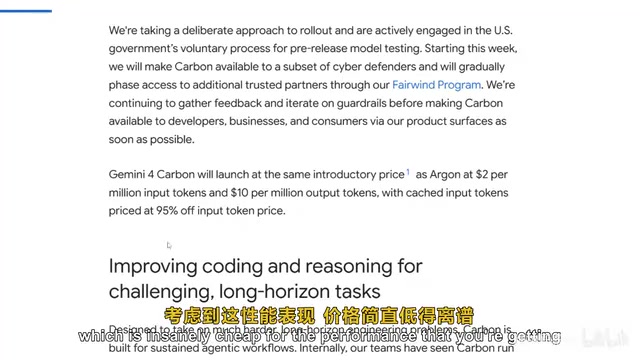
Gemini 4 Carbon Hands-On: The Strongest AI Model? Compared with Claude Opus 5.5
Google's Gemini 4 Carbon tops the Artificial Analysis leaderboard with 71% on CW Bench and leads Vending Bench. Hands-on comparison with Claude Opus 5.5: stunning front-end design but slightly behind in web development, with a clear price advantage.

Gemini 4 Carbon Tops Global Rankings as AI Productivity and Open-Source Ecosystems Surge
Google DeepMind's Gemini 4 Carbon tops global benchmarks, built for complex agents and system security. ByteDance launches Doubao Work integrated with Feishu, Anthropic's AI autonomously breaches 5 system-level attack chains, and ModelBest and Fudan open-source on-device multimodal and image generation models.

Overseas Creator Breaks Down N8n AI Agent Business Playbook: From Tooling to Monetization
An overseas creator breaks down the N8n AI agent business playbook: comparing Zapier, Make, and N8n, detailing four monetizable automation categories—lead capture, WhatsApp follow-up, booking, and content pipelines—plus agency pricing and a sales playbook.