Building AI Apps with Claude Code from Scratch: A ZTM Free Course Review

ZTM launches a beginner Claude Code course using the Battleground project to help newcomers build a deployable AI app, free for a limited time while seeking feedback.
A Reddit creator releases their first course, "Claude Code for Beginners," on ZTM, aimed at newcomers who have never written code and are just getting started with Claude. Free until 11:59PM EST on November 12 with open feedback sought. The course skips syntax and guides students through the Battleground project: pick two fighting characters and let Claude decide the winner, plus custom character art, redesigning the interface with Claude Design, and deployment—covering the full chain from logic to visuals. The author admits the course isn't perfect and will keep updating. The article finds it good for beginners building intuition, limited in depth for experienced developers, and notes its free-in-exchange-for-feedback model as a useful reference for independent creators.
A Claude Code course for complete beginners
A creator on Reddit has released their first course, "Claude Code for Beginners," launched on the ZTM platform, and announced that it is completely free until 11:59PM EST on November 12, openly seeking feedback from real Claude users.
According to the author, the target audience is very clear: newcomers who have never written code and are just getting started with Claude. The course doesn't lay groundwork in programming syntax but instead takes students straight to building a working AI application. This "results first, concepts later" approach differs significantly from traditional introductory programming courses.
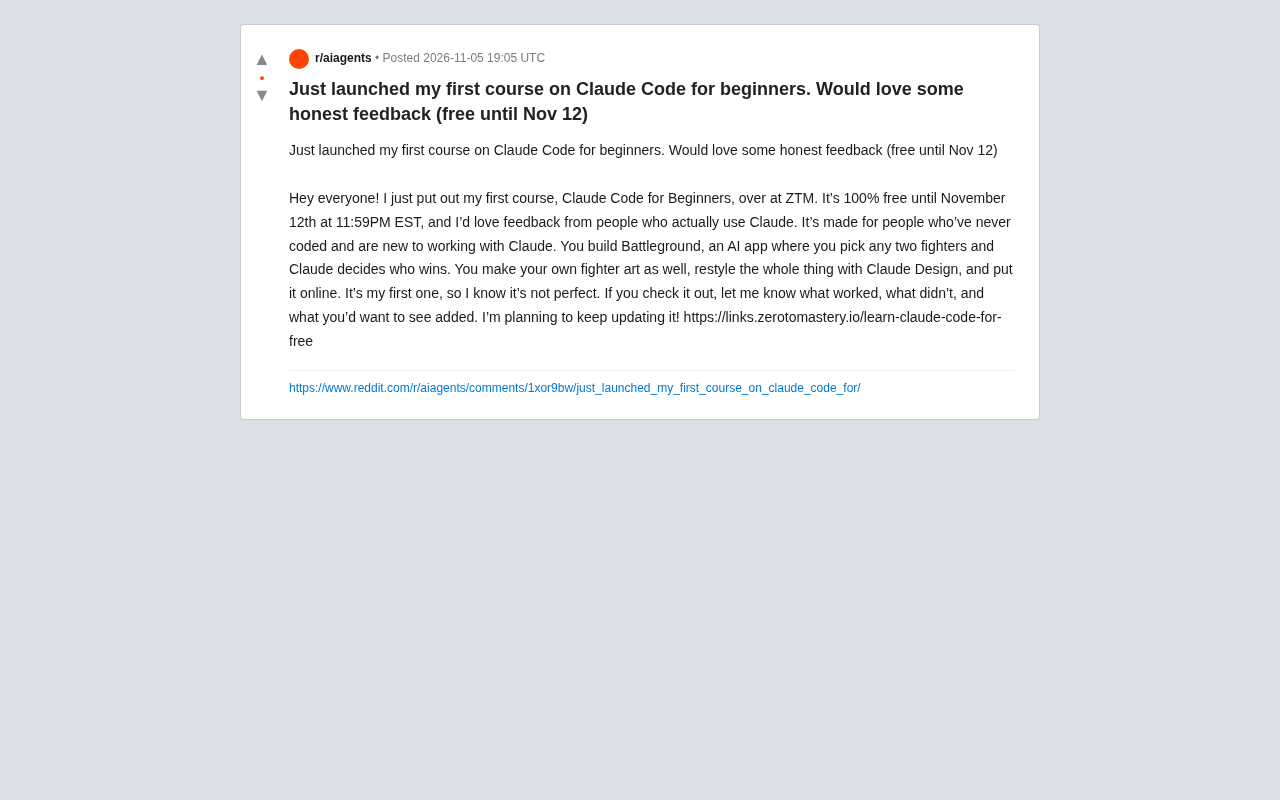
The author admits in the post that this is their first course, "I know it's not perfect," and explicitly states they will keep updating it, hoping for specific feedback on "what works, what doesn't, and what you'd like to see added."
Course project: Building an "anything goes" AI battle app
The core hands-on project is called Battleground: users pick any two fighting characters, and Claude decides who wins. The project is broken into several deliverable stages:
- Character selection and judgment logic: feed two characters to Claude and have the model output a verdict
- Custom fighter art: students generate their own visual assets for the characters rather than using stock images
- Redesigning the overall style with Claude Design: reworking the interface look
- Deployment: publishing the finished app online
The project design has several clever touches. The judgment logic itself has no standard answer—it's an open-ended problem, so beginners don't get stuck on "correctness." The art and styling rely on generative capabilities—low barrier to entry but with immediate visual feedback. The final deployment step gives students a real, shareable link, creating a strong sense of completion.
One detail: the course uses both Claude Code and Claude Design. The former handles code generation and modification, while the latter handles interface and visual style. Together they cover the full chain from logic to appearance.
Claude Design is Anthropic's entry point for interface and visual generation in Claude, dividing labor with the code-oriented Claude Code: the former produces layout, color schemes, component styles, and other design solutions from natural language descriptions, while the latter turns those solutions into runnable code. For complete beginners, it transforms "what the interface looks like"—a step that traditionally requires design experience and CSS knowledge—into a process of describing requirements, picking a solution, and fine-tuning the style. Using it in the course to rework Battleground's overall style lets students experience the full iteration from functional to visually polished without writing any styling code.
How Claude Code lowers the barrier
What makes it feasible to combine "zero experience" and "building a complete app" in one course is that tools like Claude Code have changed the learning curve for beginners.
The traditional path is: learn language basics, then frameworks, then deployment—getting stuck at any step can make people give up. In Claude Code's interactive mode, students describe their intent in natural language, and the model generates and iterates on code. The feedback loop compresses from "read docs—write code—debug" to "describe—check result—keep modifying." Beginners can focus on "what I want the app to do" rather than "where is the missing semicolon in this line."
This approach has costs too. The author positions the course as "beginner" rather than "mastery," indicating it's more of an intuition-building experience than systematic training. How deeply students understand code structure and debugging after finishing Battleground depends on how much they probe along the way.
Claude Code is Anthropic's command-line coding agent tool. Unlike web-based chat, it can directly read and write project files, execute commands, run tests, and modify code based on errors, completing multi-step tasks in real codebases. This "agentic" way of working means the model doesn't just provide code snippets for people to copy—it participates in the full loop from creating files to running verification. For beginners, the benefit is eliminating the friction of environment setup and manual pasting; the cost is that students tend to see only results without observing the process. So the course's positioning as intuition-building rather than systematic training is a relatively honest approach.
Who this course is for—and who it isn't
Based on the course design, it's best suited for three types of people: beginners with no programming experience who want to see results quickly; users already using Claude for conversation who want to learn how to build apps with it; and people who want to evaluate the actual AI-assisted development experience before deciding whether to invest further.
It's less suited for developers with existing experience who want systematic engineering practice. A project like Battleground has limited complexity and won't cover architecture, testing, or performance in depth. The author themselves calls this "my first course" and openly seeks improvement directions, indicating the content is still iterating.
Another practical factor is timing: the free window ends at 11:59PM EST on November 12. Whether it will be paid afterward and at what price isn't stated in the post. Those who want to try it for free should note this deadline.
ZTM (Zero To Mastery) is an online coding education platform known for being project-driven, with courses typically centered on "building real projects alongside instruction," supported by a community and update mechanisms. Its audience is mostly career changers and self-learners, and the format leans toward long videos plus hands-on assignments. Understanding this helps assess the course's positioning: it continues the platform's "build it first" style, but the author is a first-time independent creator, so content depth and production maturity still lag behind the platform's top courses. The free period is essentially a community-facing quality validation.
A public course iteration experiment
More noteworthy than the course content itself is how it's being run: the author pushes an unfinished product directly to the target audience, trading free access for real feedback, then updates accordingly. For independent creators, this is a low-cost, high-signal validation path.
The post doesn't provide course length, number of chapters, or student data. The only confirmed information is the project format, target audience, and free deadline. The actual quality can only be judged after the first batch of students gives feedback. If you happen to be a heavy Claude user, the author's invitation is direct—go try it, then tell them what doesn't work.
One-line Summary
ZTM launches a beginner Claude Code course that uses the Battleground project to help newcomers build a deployable AI app, free for a limited time while seeking feedback.
Paragraph Summary
A Reddit creator has released their first course, "Claude Code for Beginners," on the ZTM platform, aimed at newcomers who have never written code and are just getting started with Claude. It's free until 11:59PM EST on November 12 and openly seeks feedback. The course doesn't teach syntax but instead guides students through the Battleground project: pick any two fighting characters and let Claude decide the winner, including custom character art, redesigning the interface with Claude Design, and deployment—covering the full chain from logic to visuals. The author admits the course isn't perfect and will keep updating. The article suggests the course is good for beginners building intuition, has limited depth for experienced developers, and that its free-in-exchange-for-feedback approach offers a useful reference for independent creators.
Related articles
 Tech Frontiers
Stylome Bot Slammed as Useless Junk: Why Do AI Detection Tools Keep Failing?
Reddit users test the Stylome AI detection bot: Gemini-rewritten text judged human-written, consistently low confidence. An analysis of AI text detection's technical dilemmas, privacy concerns, and credibility crisis in community governance.
 Tech Frontiers
When AI Becomes a Productivity Divide: Clarity or "AI Psychosis"?
A civil engineer's deep use of agentic AI boosted efficiency but bred contempt for peers who refuse to learn. Is this clarity or AI psychosis? An analysis of the cognitive and psychological challenges behind the AI productivity divide.
 Tech Frontiers
Opus 5.5 Benchmark Scores Climb, Community Says Its "Weights Are Blessed"
Reddit community discusses Opus 5.5's rising scores on the Benchmaxxing Bench, with users describing its performance as "weights are blessed." This article interprets the community reaction and cautions against conflating benchmark scores with real capability.