Building Enterprise AI Agents from Scratch: A Complete Three-Stage Learning Path
A three-stage AI Agent tutorial—Cognition, Advanced, Hands-on—that advocates building mental models before writing code.
The article introduces a Bilibili AI Agent tutorial that criticizes most Agent courses for either piling on jargon or dumping code without context. It's organized into three stages: Cognition (everyday analogies for ReAct, planning, memory), Advanced (LangChain, AutoGen, Function Calling, safety boundaries), and Hands-on (three enterprise projects: customer service, data analysis, multi-Agent production line). Each section includes code materials. The author praises the structure but notes that ultimate value depends on code quality and maintenance.
I recently came across an AI Agent tutorial series on Bilibili. The creator claims to have scoured nearly all related content on both Bilibili and YouTube, and arrived at a rather sobering conclusion: over 90% of Agent tutorials either pile on buzzwords like "autonomous planning" and "tool calling" without ever getting their hands dirty, or they just dump code on you—learners start calling APIs before they even understand what problems Agents solve. This course attempts to break the cycle with a "understand the thinking first, then build" approach, splitting the core knowledge into three parts: Cognition, Advanced, and Hands-on, with code materials accompanying the entire journey.
Cognition Stage: First, Understand How Agents "Think"
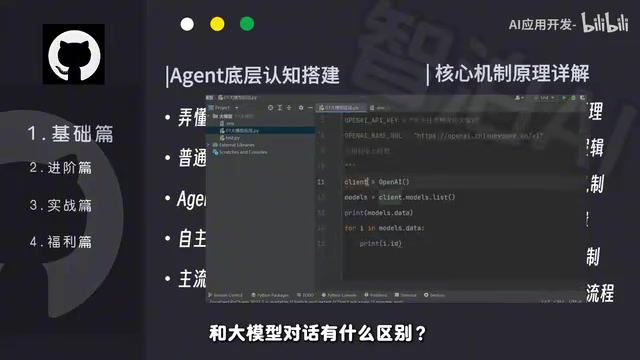
The first problem the creator raises is very real—many people are intimidated by Agent concepts. ReAct frameworks, planning and reasoning, memory mechanisms—these terms are individually familiar, but string them together and people are lost. The Cognition stage addresses this by explaining these concepts through everyday analogies, while walking learners through their first Agent Demo.
This order deserves praise. The essential difference between an Agent and a large model conversation is that the former has a "goal—plan—execute—observe" loop. Letting learners personally experience what it feels like for an intelligent agent to do work is far more effective than starting with architecture diagrams. The Cognition stage also covers the ReAct framework, one of the most cited paradigms in the Agent field—understanding it is like getting the key to reading all the frameworks that follow.
The ReAct framework—short for Reasoning and Acting—was proposed by Princeton University and Google in a 2022 paper. The core idea is to have the large model alternate between "thinking" and "acting": the model first outputs a reasoning step (Thought) explaining what should be done next; then executes an action (Action), such as calling a search tool or calculator; then observes the result returned by the action (Observation), and continues the next round of reasoning based on that observation. This "Thought→Action→Observation" loop repeats until the model determines the task is complete and provides a final answer. Compared to having the model output results in one shot, ReAct makes the reasoning process explicit—it both improves success rates on complex tasks and makes it easier to pinpoint which reasoning step or which tool call went wrong when errors occur. Agent implementations in mainstream frameworks like LangChain basically all follow this paradigm.
Advanced Stage: Framework Practice and Safety Boundaries
The Advanced stage moves into engineering territory, covering LangChain and AutoGen framework practice, multi-Agent collaboration, Function Calling tool invocation, and hybrid ReAct-Agent architectures. These are essentially the unavoidable tech stack for enterprises deploying Agents today.
One easily overlooked but important point is evaluation, debugging, and safety boundaries. Many tutorials stop at "the Agent can call tools," but in real business scenarios, Agents calling the wrong tool, getting stuck in loops, or performing unauthorized operations all come at a cost. The course dedicates separate sections to evaluation and safety, showing that the designer understands production environment challenges.
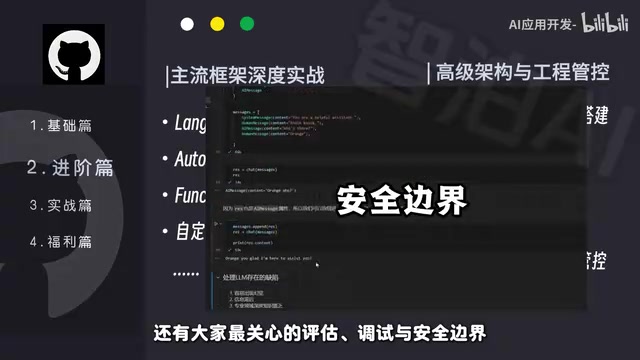
Having code materials for each section is key to lowering the barrier for beginners. Agent development involves extensive configuration and API calls—just watching videos without hands-on practice is essentially equivalent to not learning at all.
Function Calling is a structured output capability provided by large model vendors: developers pass the model the names, function descriptions, and parameter formats (usually JSON Schema) of available tools, and when needed, the model no longer outputs natural language but instead returns a structured invocation request specifying which function to call and with what parameters. The application parses this request, actually executes the function, and sends the result back to the model to continue the conversation. The difference from ReAct is that Function Calling delegates "deciding which tool to call" to the model's native capability, resulting in more stable formats and more reliable parsing, while ReAct emphasizes explicit reasoning chains. In practice, the two are often combined: ReAct organizes multi-step reasoning, while Function Calling ensures standardized tool invocation.
LangChain and AutoGen serve different purposes. LangChain is an earlier, more established LLM application development framework, offering modules like model wrappers, prompt templates, tool integration, memory management, and Agent executors—suitable for building single-Agent or tool-chain applications. AutoGen, introduced by Microsoft, focuses on multi-Agent collaboration, abstracting each agent as a configurable conversation participant that completes division of labor through message passing between them, supporting mixed human-AI participation. A practical rule of thumb for choosing: when business processes are relatively linear and centered on tool calling, lean toward LangChain; when multiple roles need to discuss, review, and relay tasks to complete complex work, AutoGen's multi-Agent model is more natural. The two can also be used together in the same system.
Hands-on Stage: Three Enterprise-Level Projects
The Hands-on stage presents three directions: an intelligent customer service Agent system, from intent recognition to automatic ticket routing; an automated data analysis Agent that uploads Excel files and automatically produces reports and charts; and a multi-Agent collaborative production line where multiple agents divide work like a team.
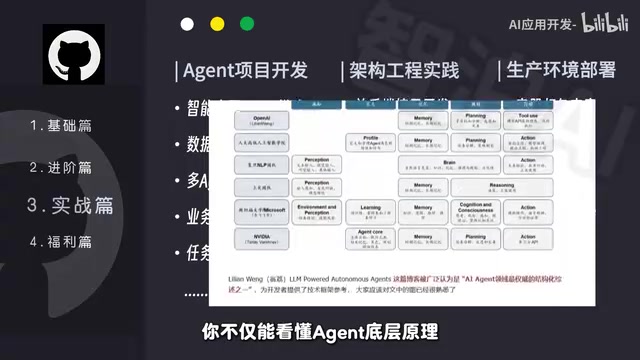
These three project choices are representative—customer service is one of the most mature Agent deployment scenarios, data analysis addresses the repetitive reporting needs of many enterprises, and multi-Agent collaboration is the most complex direction. The course's stated end goal is being able to independently design intelligent agent applications that solve real business problems.
The creator also provides source code, course materials, prompt templates, and an AI Agent developer learning roadmap as supplementary resources. For those wanting to systematically get started with Agent development, this "cognition first, frameworks next, projects last" structure is more efficient than piecing together scattered tech blogs.
One caveat: the value of tutorial content ultimately depends on the quality and maintenance of the accompanying code. Learners are advised to run the Demo first before committing to the full learning cycle.
One-line Summary
A three-stage AI Agent tutorial—Cognition, Advanced, Hands-on—that advocates building mental models before writing code.
Paragraph Summary
This article introduces a Bilibili AI Agent tutorial whose starting point is a critique of how over 90% of Agent tutorials either pile on jargon or dump code directly, leaving learners calling APIs before understanding what Agents can solve. The course is organized into three stages: Cognition uses everyday analogies to explain ReAct frameworks, planning and reasoning, and memory mechanisms, while having learners complete their first Demo; Advanced covers LangChain and AutoGen frameworks, multi-Agent collaboration, Function Calling, and hybrid ReAct architectures, with dedicated sections on evaluation, debugging, and safety boundaries; Hands-on presents three enterprise-level projects—intelligent customer service, automated data analysis, and a multi-Agent collaborative production line. Each section includes code materials, along with source code, prompt templates, and a learning roadmap. The author endorses this structure but cautions that the tutorial's value ultimately depends on code quality and maintenance.
Related articles

The Truth Behind Titanic's Sinking: Key Decisions and Communication Failures in the National Geographic Documentary
National Geographic's The Unsinkable Ship uses survivor testimony to reconstruct Titanic's fatal decisions—from the missing MSG telegram prefix and the broken boiler-room-to-bridge link to how 'unsinkable' thinking delayed damage control and evacuation.

74M-Parameter Open-Source Model Partially Outperforms Jev AI in Testing
Fastino AI's Glider 2.5 models, with just 74M–300M parameters, reportedly outperform Jev AI in some guardrail benchmarks per YouTube testing, run on consumer hardware, and even play Doom. We analyze small models' competitiveness and deployment value on specific tasks.

Gemini 4 Argon Hands-On: Aggressive Pricing, 3D Capabilities Need Coaching
Gemini 4 Argon hands-on: limited-time $2/$10 pricing, million-token output, strong 3D and reverse-engineering work, but weak front-end aesthetics and zero-shot ability need coaching.