Building the Big Fat Fish AI Livestream from Scratch: DeepSeek + Bailian TTS Full Workflow

Break down the full build workflow and practical pitfalls of the viral Bilibili AI virtual streamer Big Fat Fish.
Based on Bilibili creator Yuanbao's tutorial video, this article breaks down the complete technical pipeline of an AI virtual streamer that can think, speak, and perform. It outsources the brain, voice, and body to DeepSeek API, Alibaba Cloud Bailian Qwen TTS Flash, and Jimeng-generated three-view motions, with OBS as master control. It covers API integration, persona rewriting, voice training, three high-frequency motion pitfalls, and OBS WebSocket parameters, concluding that the real barrier is motion engineering patience and persona operations.
A recent video on Bilibili titled "DeepSeek Big Fat Fish Livestream Begging for Money" went viral—a chibi goldfish girl hangs a sign in the livestream saying "I'm starving to death," and people actually send her gifts. The creator, Yuanbao, turned 10 days of tinkering into a complete tutorial: building from scratch an AI virtual streamer that can think, speak, and perform. This article, based on that video, breaks down the underlying technical pipeline and practical pitfalls.
Tech Stack Breakdown: Three Pipelines Power a Streamer
The essence of this setup is to outsource the "brain—voice—body" pipelines to different services, then use a livestreaming software as the master control.
- Brain: DeepSeekAd official API. After topping up on the official site, create an API Key, fill it into the software's "Connection & Reply" page, configure the endpoint URL and model name, and once test replies work, it's connected.
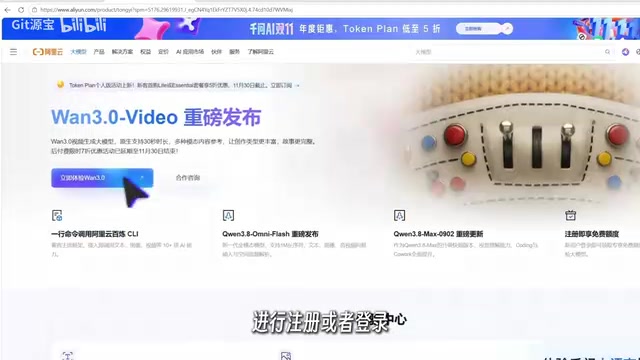
- Voice: Alibaba Cloud Bailian platform's Qwen TTS Flash model. After registering, create an API Key, prepare a clean 10–20 second recording, and hand it along with the Bailian API docs to an AI Agent (the creator used GPT) to complete voice cloning. Once you get the voice ID, fill in the business space ID, API Key, model, and voice ID.
- Body: Use a community chibi maid goldfish girl character, toss it into Jimeng to change outfit and hairstyle, then supply three reference images (front, side, back). All motions are generated based on this reference set.

Worth noting is the cost structure: DeepSeek bills by token, Bailian TTS calls cost "very, very little," and the creator suggests topping up one yuan to try it out. The real time cost isn't money—it's motion debugging.
DeepSeek API and Token Billing
The DeepSeek official API uses token-based billing. A token is the basic unit of text the model processes, roughly a "character/word fragment." Both input (prompt) and output (completion) consume tokens, and pricing varies by model. In a livestream scenario, each danmaku reply is an independent API call, with cost positively correlated to reply length and interaction frequency. The creator's suggestion to top up one yuan first is precisely to observe actual consumption rates at low risk. Note that the API Key must be kept secure; leakage could lead to quota theft.
TTS and Voice Cloning
TTS (Text-to-Speech) converts text to speech. Qwen TTS Flash is a low-latency speech synthesis model provided by the Alibaba Cloud Bailian platform. Voice cloning analyzes a clean 10–20 second recording, extracts the speaker's timbre features, and generates a reusable voice ID. Training samples must be clean, without background music, and with steady pacing; otherwise the cloned voice may carry noise or emotional deviation. Cloned voices synthesize speech in real time during livestreams, and latency directly affects interaction quality, so choosing a low-latency model like Flash is critical.
OBS WebSocket Remote Control
OBS is a common livestreaming software, and WebSocket is its remote control interface. Once enabled, external programs can connect to OBS via 127.0.0.1:4455 to switch scenes, show/hide sources, control audio, and more. In this article, the virtual streamer software uses this interface to automatically configure OBS, saving manual operations. Leaving the password blank means OBS has no authentication set—recommended only for local environments; public exposure carries security risks.
Persona and Voice: Turning "DeepSeek" into "Goldfish Girl"
After the API is connected, the first question is typical: ask who it is, and it will solemnly introduce itself as DeepSeek. The solution is to write a character setting in the software's "Streamer Persona" page, twisting it from a general assistant into a streamer with personality. This step determines the texture of subsequent danmaku interactions—the more specific the persona, the less the replies sound like customer service.
The voice pipeline has more details. On the Bailian platform, enter API Key management at the bottom left, create a Key at the top right with a description based on actual use, and download the key after creation. Recording samples need to be clean and 10–20 seconds. The trained voice was evaluated by the creator after listening as "clear articulation, soft and cute."
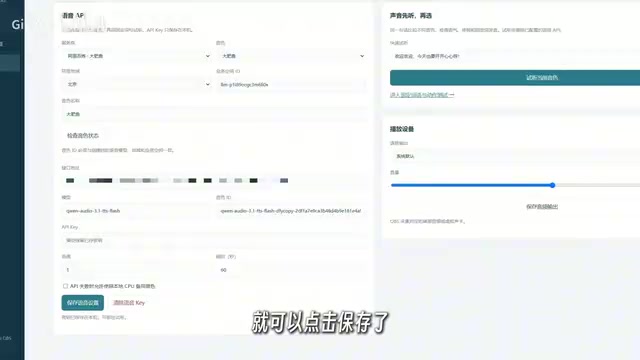
The voice page requires four fields: business space ID, API Key, model, and voice ID. Save only after the voice status shows OK. If any of these four is wrong, the symptom is "not speaking" or "error." When troubleshooting, check each item against the platform backend.
Motion and Livestream Integration: The Most Accident-Prone Part
The creator explicitly says the motion vocabulary is the most accident-prone part of the whole process. The approach is to use the three-view images with Jimeng to generate motions like idle, talking, waving, finger-heart, and dancing, then upload them to the motion vocabulary and fill in trigger words—when a viewer sends "dance," it plays the corresponding clip.
Three high-frequency pitfalls:
- Floating while walking: legs don't move, the fish floats. The solution is to split into start-step, stride, and stop segments and cut them in separately.
- Ghosting when switching: when switching motions, two semi-transparent copies appear. You need to re-find the entry point for the pose; don't force fade in/out.
- Tail clipping: watch the tail closely—don't let it clip through, don't let it leave the frame.
Additionally, the creator integrated a web cloud; after scanning to log in, viewers can send "song request + song name" in danmaku and it opens its mouth to sing. Random idle motions are set so it finds things to do when idle; it can even be picked up and placed in different positions, and shaking it twice makes it "dizzy."
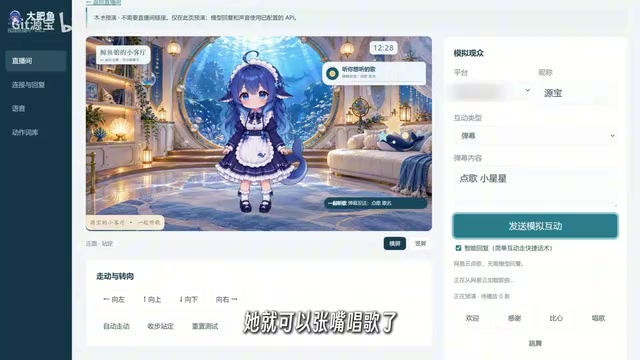
Livestream integration: fill in the livestream room to connect, drag the character, nameplate, and bubble to appropriate positions; open OBS and enable the WebSocket server; return to the software, expand "Startup & Audio Output Settings," check "Connect to filled livestream room on startup" and "Connect and configure OBS on startup"; fill OBS address as 127.0.0.1, port 4455, leave password blank, and the software will automatically use the local OBS configuration. Confirm the video and audio are normal, and the streamer is ready to go on duty.
Consistency Between Three-View Images and Motion Generation
Three-view images (front, side, back) are the foundational reference for character modeling and motion generation. AI image generation tools like Jimeng maintain character appearance consistency with reference images when generating motion frames, but proportion drift or clothing detail changes can still occur at different angles and poses. The trigger word mechanism of the motion vocabulary is like a "keyword → animation clip" mapping; when a viewer sends "dance," it matches the corresponding clip. To ensure smooth switching, each motion's start and end poses should align as closely as possible with the idle pose; otherwise, jumping or ghosting occurs. Clipping (e.g., tail passing through the body) is usually caused by incorrect 3D layering or inconsistent depth information in generated frames, requiring frame-by-frame inspection or regeneration.
Where the Real Barrier Lies
From the materials, the financial barrier is extremely low—DeepSeek top-up plus one yuan Bailian trial, and API call costs described by the creator as "extremely low." The real barrier is patience in motion engineering: reference image consistency, motion segmentation, clipping fixes—each requires repeated trials. Over the 10-day tinkering period, most time was likely spent here.
Another hidden cost is persona and content operations. The technical pipeline only guarantees "it can stream"; whether it retains viewers depends on whether the persona is interesting and whether danmaku interactions have memes. Big Fat Fish went viral not just because of TTS and APIs, but because of the "starving to death" meme itself.
For developers who want to replicate, the recommended order is: get the brain working first (API replies normally) → then connect voice (pass listening test) → finally tackle motions and OBS. The first two steps can be done within an hour; the third is a long-term project.
All technical details in this article come from the public tutorial video by Bilibili creator Yuanbao, with no additional parameters added. For issues, please provide feedback in the original video's comment section.
One-line Summary
Break down the full build workflow and practical pitfalls of the viral Bilibili AI virtual streamer "Big Fat Fish."
Paragraph Summary
Based on Bilibili creator Yuanbao's tutorial video, this article breaks down the complete technical pipeline of an AI virtual streamer "Big Fat Fish" that can think, speak, and perform. The solution outsources the "brain—voice—body" to DeepSeek API, Alibaba Cloud Bailian Qwen TTS Flash, and Jimeng-generated three-view motions, then uses OBS as livestream master control. The article details API integration, persona rewriting, voice training and four-field configuration, three high-frequency issues in motion vocabulary creation (floating while walking, ghosting when switching, tail clipping), and OBS WebSocket integration parameters. The author notes the financial barrier is extremely low; the real barrier lies in patience with motion engineering and persona operations, and suggests a replication order of "brain first, then voice, finally motions."
Related articles

AI Writes Your Code—Do You Still Need to Learn Git? Five Reasons
AI coding agents handle Git operations automatically—is it still necessary to learn Git? Five reasons: team communication, reviewing agent PRs, monitoring code changes, fallback when AI goes down, and the joy of learning—plus how the focus of learning Git is shifting in the agent era.

Anthropic Reportedly Prices IPO at $83 Per Share, Valuing Company at $1.5 Trillion
Anthropic reportedly prices IPO at $83 per share, above the expected range, with a fully diluted valuation of $1.5 trillion. This article analyzes the signal significance of the pricing and its impact on the AI industry's financing environment.
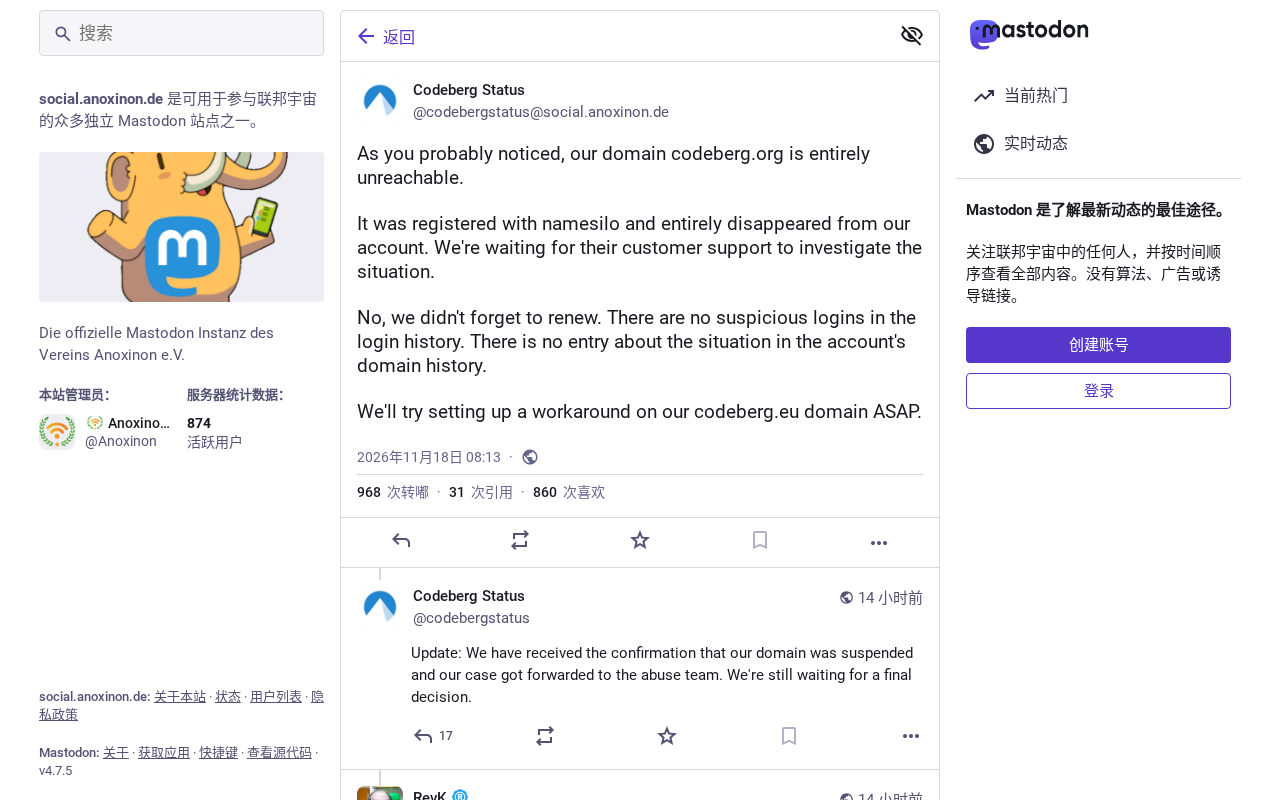
Open-Source Code Hosting Platform Codeberg Suffers Outage, Sparking Debate in Developer Community
Open-source code hosting platform Codeberg.org suffered an outage, sparking Hacker News debate over nonprofit platform stability and open-source infrastructure dependency risks.