Can Qwen 3.8 27B Really Read Neural Network Weights? A 16GB Hands-On Test

Reproduction shows models can read tiny network weights, but "native read/write" doesn't hold.
The article reproduces MIT's experiment on GPT-6 Astra reading neural network weights and runs Qwen 3.8 27B on a 16GB consumer GPU. The model can indeed identify the training game of tiny policy networks from plain-text weights, but inference is extremely slow and costly. The author used 25 lines of Python to sum squares of first-layer weights and recovered the answer in 0.3 seconds, proving the game rules are already drawn in the weights and the language model is merely doing inefficient numerical search. The article further points out that the claim "Astra natively reads and writes weights to improve Qwen" is misleading; the related experiments rely on code and dozens of evaluation loops and are essentially steering-vector engineering, not native model capability.
Title
Can Qwen 3.8 27B Really Read Neural Network Weights? A 16GB Hands-On Test
Meta Description
MIT researchers claim LLMs can directly read neural network weights and identify the training game. We tested Qwen 3.8 27B on a 16GB GPU and found the signal is real, but "native reading" doesn't hold up—a 25-line Python script recovers the answer in seconds.
Article Content
Recently, a claim that large models can "directly read neural network weights" set the tech community ablaze. It started when four researchers from MIT CSAIL published an article titled Sparks of Weight Space Programming, claiming that GPT-6 Astra can natively read the raw weights of a small neural network and state which game it was trained on. Subsequently, well-known developer Simon Willison said his locally running Qwen 3.8 27B could do it too. Discussion on Hacker News soared. We didn't stop at reading—we downloaded the same network files and prompts, ran them on a 16GB consumer GPU, and added one extra experiment nobody mentioned.
Background: MIT's "Weight Space Programming"
The MIT experiment design is very simple. The researchers used reinforcement learning to train four tiny policy networks to play grid-simplified versions of Breakout, Pong, Pac-Man, and Freeway. Each network had only 500 inputs, two hidden layers of 32 units each, and 5 outputs—17,253 weights in total. They pasted all the weights as plain text into the prompt and directly asked Astra which game it was. The result: four out of four correct, with confidence between 96% and 99%.
But the headlines missed a key number: each run involved roughly 73,700 input tokens, and Astra took 71 to 107 seconds to answer. This wasn't instant "intuition"—it was a lengthy inference. Simon Willison then loaded the 17GB Qwen 3.8 27B Q4 version in LM Studio and reproduced it on a laptop: Breakout correct, Pong correct, Pac-Man correct, but Freeway failed—the model guessed Pac-Man. Three out of four is still impressive for a model on a laptop.
Weight Space Programming refers to the hypothesis that language models can treat neural network parameters as readable, writable data structures without relying on external tools or code. In contrast, conventional "code space programming" has the model generate Python or other code to load, inspect, or modify weights. In the MIT experiment, Astra appeared to "natively read" because the researchers pasted 17,253 weights as plain text into the prompt; the model only needed to pattern-match within the token sequence. But for real networks with millions of parameters, serializing everything into context is neither realistic nor economical. The key controversy is whether the model is "understanding" the weight structure or performing inefficient numerical search. Subsequent heatmap experiments showed that, at least for tiny policy networks, the signal concentrates in the first layer—the model doesn't need to truly "program" the weight space to guess correctly.
Reproduction on a 16GB GPU: It Runs, but Astonishingly Slowly
We cloned the authors' code repository, which contains NPZ files for the four networks, the original prompts, Astra's answers, and even the ground truth—nothing needed guessing.
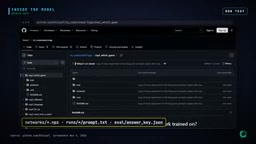
The hardware was an AMD Radeon RX 9060 XT with 16GB VRAM. Simon's 17GB file obviously wouldn't fit, so we switched to the IQ3 quantized version (10.9GB) and loaded the entire model onto the GPU using llama.cpp with the Vulkan backend. The first pitfall appeared quickly: the prompt alone was 104,813 tokens—42% more than Astra processed for the same text—because Qwen's tokenizer splits those decimal points differently. The default 8K context immediately errored out. Fortunately, Qwen 3.8 27B uses a hybrid architecture with only 16 of 64 layers being full attention, so KV cache overhead is relatively manageable, and VRAM remained sufficient after extending the context.
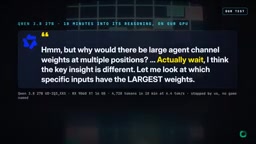
Reading those hundred-thousand-plus tokens took nearly 30 minutes. Then the model started "thinking" at roughly a few tokens per second. We gave it 18 minutes; it wrote 4,700 tokens, all of which was repeatedly checking "which grid cell does this input correspond to," hunting for the largest weights one by one, and constantly second-guessing itself—never naming the game. At this speed, Simon's inference of tens of thousands of tokens would take several hours on this card.
The Overlooked Truth: The Signal Is Actually Drawn in the First Layer
Here's the really interesting part: what did the model actually see in those 17,000 numbers? We wrote 25 lines of Python, with no AI involved—just summing squares. Each input corresponds to a cell in the grid and one of five channels (moving object, reward target, obstacle, previous frame). Summing the squares of the weights from each channel into the hidden layer yields a heatmap.
The result was surprisingly obvious. In Breakout, the agent channel is almost entirely concentrated in the bottom row—that's the paddle; the vast majority of agent weight energy lands in that row. The reward channel forms a band in the top brick area. The output layer distinguishes left/right far more strongly than up/down. In Pong, the agent is fixed to the leftmost column, and weights for up/down movement matter far more than left/right; the reward hugs the right wall. In Pac-Man, the agent channel shows a maze-like pattern with walls everywhere, and movement along both axes is represented. In Freeway, the agent crosses the grid along one column, and the reward is in the top row—a chicken crossing the road.
The whole script ran in 0.3 seconds. The same answer took Qwen over forty minutes to "reason" and Astra more than a minute. That is the core finding of this experiment: the game rules were plainly drawn in the first-layer weights all along.
First-layer weight heatmaps are a classic interpretability technique: sum the squares of the weights connecting each input unit to the hidden layer to get the "importance" distribution of that input to the network's output. Summing squares eliminates the sign and retains only magnitude; for inputs arranged as a grid (like game screens), mapping the energy back to the grid visually reveals which regions the network focuses on. This method doesn't rely on gradients or attention mechanisms and is extremely cheap computationally—it was used to analyze shallow networks back in the 1990s. This article uses it to prove: Breakout's paddle, Pong's racket, and Pac-Man's maze walls all concentrate in high-energy regions of specific channels in the first layer, so a model that can do addition, searching repeatedly among 17,000 numbers, can also find the pattern.
"Native" or "Engineering"? The Core of the Controversy
On the same day Simon's post went viral, Matthew Honnibal, creator of Spacy, published an article arguing that the framing "Astra reads and writes weights" is misleading. We think he's right.
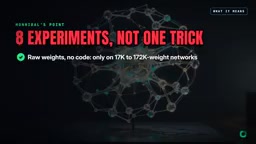
The MIT article actually contains eight experiments, and they are not the same trick. What truly works as "no-code, pure raw weight reading" are the small networks with 17,000 to 172,000 weights. All experiments involving real language models—including the much-hyped "Astra fixed Qwen's math ability"—used Python and ran the model up to 50 times. That fix is real: it changed only a tiny fraction of weights but lifted math benchmark scores from single-digit percentages to nearly half. But that was a "steering vector" found through code and an evaluation loop—machine learning engineering, not telepathy.
The heatmaps we generated explain exactly why this works for tiny policy networks: the game is drawn in the first layer, and a model that can do addition will eventually find it by searching slowly. But whether this "naked reading" still works for networks with millions of weights or more—there is currently no evidence either way.
Steering vectors are a common intervention in machine learning engineering: find or construct a direction vector in a model layer's activation space and add it to the hidden state during inference, thereby changing model behavior without retraining. MIT's so-called "Astra fixed Qwen's math ability" experiment is essentially a Python script plus dozens of evaluation loops searching for a steering vector that improves math benchmark scores, then writing that vector into weights or activations. This is different from "the model natively reads and writes weights": the former is the product of an external optimization loop, while the latter implies the model itself can understand parameter structure. Distinguishing the two is key to judging whether "weight space programming" holds up.
Want to Try It Yourself? Three Practical Tips
If you also want to reproduce this on Qwen 3.8 27B, there are a few things you must know in advance. First, set the context to at least 100K before loading the model—the prompt alone exceeds the default window. Second, on a 16GB GPU, use a three-bit quantized version with quantized KV cache to keep the entire model on the GPU; even then, inference will be slow enough that you need to plan in hours. Third, don't make the language model do arithmetic itself—the same analysis takes only seconds with a Python tool; the model's job should become "reading the heatmap," not "computing the heatmap." This trick applies to your own models too: sum the squares of the first-layer weights for each input to see which inputs the network is actually using. It's an interpretability method that dates back to the 1990s and still works today.
Conclusion: The Signal Is Real, "Native" Is Not
Qwen 3.8 27B can indeed read the weights of tiny networks and name the game—that part is real. Simon got three out of four, Astra got four out of four, and our heatmaps prove the signal truly exists in the weights. But the claim that "Astra natively reads and writes weights to improve Qwen" does not hold up given current evidence: it requires code, dozens of evaluation loops, and a known steering technique. The improvement is real; "native" is not. A reasonable prediction: someone will soon release a formal weight-reading benchmark, frontier models will excel on networks under 200,000 weights and start failing above a million. By then, the answer will be much clearer.
One-line Summary
Reproduction shows models can read tiny network weights, but the "native read/write" claim doesn't hold.
Paragraph Summary
The article reproduces MIT's experiment on GPT-6 Astra reading neural network weights and runs Qwen 3.8 27B on a 16GB consumer GPU. The results show the model can indeed identify the training game of tiny policy networks from plain-text weights, but inference is extremely slow and costly. The author used 25 lines of Python to sum squares of first-layer weights and recovered the answer in 0.3 seconds, proving the game rules are already drawn in the weights and the language model is merely doing inefficient numerical search. The article further points out that the claim "Astra natively reads and writes weights to improve Qwen" is misleading; the related experiments rely on code and dozens of evaluation loops and are essentially steering-vector engineering, not native model capability.
Related articles

Deleted Reddit Post Sparks Debate Over AI Content Moderation
A Reddit post removed with only a 'Removed by Reddit' notice highlights AI content moderation's transparency gaps, misjudgment risks, and appeal challenges for platforms and creators.

DSH + Ollama Local LLM Deployment in Practice: Free Chat with Da Fei Yu
Bilibili creator tests DSH + Ollama local LLM deployment end to end: Ollama install, Xunlei-accelerated downloads, ModelScope GGUF model import, DSH custom API address setup, and a comparison of Qwen 3.5 4B, 8B, Gemma, and other models on 8GB VRAM, with advice on choosing local deployment vs. API calls.

Tested: A $899 Mac Mini vs. a $200/Month AI Subscription
Real-world test of whether an M4 Mac mini can replace a $200 AI subscription: 16GB can't fit large models, and both speed and quality fall short—but privacy, no caps, and near-zero running costs make it an ideal host for an always-on agent. Includes buying advice per configuration and money-saving strategies.