Capcom's AI Push: The Next Evolution of the RE Engine

Capcom officially embraces AI game development through the REX project, its next evolution of the proprietary RE Engine.
At Capcom Open Conference RE: 2026, programmer Satoshi Ishida signaled that Capcom is preparing for 'a future of creating games together with AI.' The initiative centers on the REX project — the next phase of the RE Engine — which aims to deeply integrate AI into the development pipeline, targeting asset creation, scene building, and QA testing. Ironically, Capcom's upcoming title Pragmata explores the dangers of AI as its central narrative theme, creating a sharp contrast with the company's own technical direction. As a top Japanese publisher with a fully proprietary engine, Capcom's public commitment marks a meaningful milestone: generative AI is entering the active roadmaps of mainstream studios.
Capcom's AI Ambitions: From Horror Narratives to Development Tools
Capcom's highly anticipated new title Pragmata centers on the potential dangers of AI, depicting a tense relationship between humanity and artificial intelligence. Yet in reality, Capcom's stance toward the technology is strikingly different — the Japanese gaming giant is actively embracing AI and positioning it as a core part of future game development.
At Capcom Open Conference RE: 2026, Capcom programmer Satoshi Ishida delivered a keynote titled "The Vision and Future of the REX Project: Further Evolution of the RE Engine." The talk sent a clear signal that Capcom is preparing for "a future of creating games together with AI."
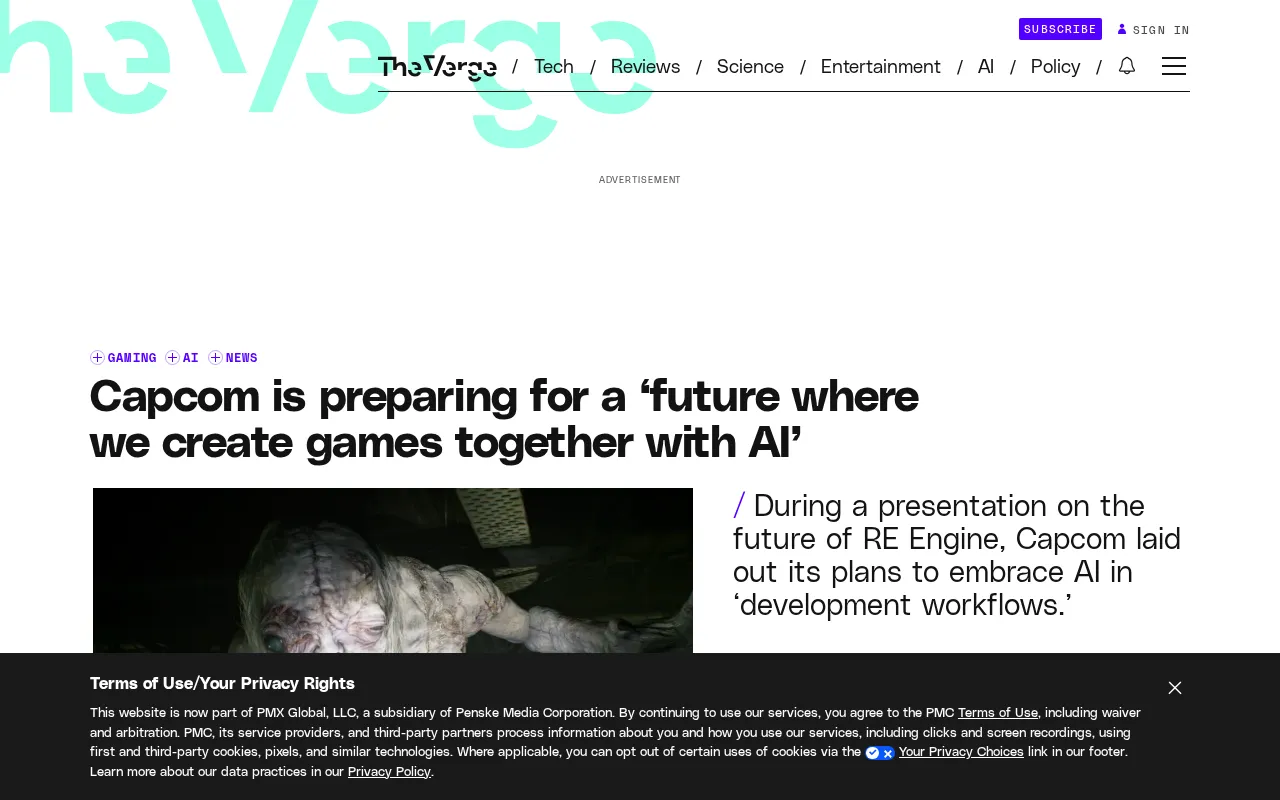
The Ongoing Evolution of the RE Engine
Since its debut, the RE Engine has become the technical backbone of Capcom's flagship titles, powering the Resident Evil remake series, Monster Hunter, Devil May Cry 5, and more. Known for its efficient development pipeline and impressive visual fidelity, the engine has been a key driver behind Capcom's commercial and critical successes in recent years.
The REX project represents the next phase of that evolution. While Ishida's presentation title is a mouthful, it clearly outlines Capcom's thinking: the engine must continue advancing along traditional axes like rendering and physics, while also deeply integrating AI capabilities into the development pipeline.
AI as a Development Collaborator
Capcom's framing of "creating games together with AI" suggests the company isn't simply envisioning AI as a replacement for human labor, but rather as a collaborative tool for development teams. In modern AAA game production, asset creation, scene building, testing, and debugging all consume enormous amounts of time and manpower — areas where AI-assisted tools could deliver significant efficiency gains.
This aligns with broader industry trends. A growing number of game companies are exploring generative AI applications in asset creation, code assistance, and QA testing, seeking a sustainable balance as production costs continue to climb.
The RE Engine (Reach for the Moon Engine) was developed entirely in-house by Capcom and made its debut in Resident Evil 7 in 2017. It employs physically based rendering (PBR) and global illumination, while also excelling in cross-platform optimization for PC, consoles, and mobile. Crucially, the RE Engine is not a licensed commercial engine like Unreal or Unity — it is a fully proprietary tool, meaning Capcom can customize its architecture to its own needs. This gives the company far greater technical flexibility than studios relying on third-party engines when it comes to integrating AI capabilities into the development pipeline.
Prototypical use cases for generative AI in game development are already taking shape: on the art side, tools can automatically generate texture variants or assist with concept design; in QA, reinforcement learning agents can simulate player behavior and automatically surface collision bugs or level logic errors; for coding, large language models can help programmers rapidly generate boilerplate code or troubleshoot issues. Western publishers like Ubisoft and EA already have relatively public AI tool deployments, and Capcom's announcement signals that Japan's leading studios are now formally joining the conversation. Notably, the Japanese games industry has traditionally placed a high premium on in-house toolchains. Capcom's approach of integrating AI directly into its proprietary engine — rather than purchasing third-party AI middleware — represents a fundamentally different technical path, and one worth watching closely.
The Contrast Between Artistic Theme and Engineering Practice
Pragmata's narrative themes create a fascinating counterpoint to Capcom's actual technical roadmap. The game explores the terror and loss of control that AI might bring, while in reality, Capcom is embracing the technology to optimize its production pipeline.
This contrast isn't a contradiction. Art can maintain a critical, cautious stance toward technology while engineering focuses on practical value. Many works with tech-centric themes warn of risks even as their own creation leverages the very technology they examine — a dynamic that neatly reflects the industry's complex, simultaneously skeptical and pragmatic attitude toward AI.
What This Means for the Industry
As one of Japan's most iconic game publishers, Capcom's public commitment to AI development carries real bellwether significance. It suggests that the fusion of generative AI and development tooling is moving from the experimental stage into concrete planning at major studios.
That said, the information Capcom has shared publicly remains limited. The presentation was more a statement of directional intent than an announcement of specific products or features. The actual extent of AI's real-world adoption in game development, its impact on creative roles, and player receptiveness to AI-generated content all remain to be seen.
What is clear is that the RE Engine's evolution will not stop here — and that AI will play an increasingly prominent role in Capcom's next-generation technical roadmap.
Related articles

Vibe Coding Full-Stack in Practice: AI Programming from Beginner to Enterprise Deployment
From Cursor to Claude Code, this Bilibili AI programming course uses four progressive projects to cover full-stack development, open-source secondary development, and team collaboration. The article analyzes the shock to frontend roles, the efficiency shift from 50 people to 5, and the methodology required for enterprise-grade projects.

David Blaine's Global Quest for Real Magic: From South Africa to Japan and India
David Blaine travels to South Africa, Japan, and India in his Do Not Attempt special, documenting Spinning drivers, black mamba rescuers, iaijutsu masters, and ascetics—exploring the boundary between magic and real human极限 challenges.

Is a Touchscreen MacBook Coming? Vergecast Reveals Apple Executive's Response
Vergecast podcast reveals a conversation between a reporter and Apple executive John Ternus about a touchscreen MacBook and Apple Pencil support. Ternus says iPad is the best device for a stylus, while the reporter bets MacBook will eventually support Apple Pencil.