Cedric AI: The AI Agent That Attends Meetings and Presents Slides for You

Cedric AI launches an AI agent that presents slides and attends meetings for you, covering the full in-meeting and post-meeting chain.
Cedric AI launched a sharply positioned AI meeting agent on Product Hunt, billed as "presenting slides and attending meetings for you." It can be dispatched to Zoom, Meet, or Teams with three layers of capability: presenting PPT on the user's behalf, answering questions based on real-time data from the user's tools, and generating post-meeting notes and follow-ups executed after user approval. The article highlights three differentiated designs—takeover modes for late joiners and absentees, real-time data Q&A, and manual approval—and analyzes its 116 votes, 13 comments, and 4th-place daily ranking on Product Hunt, with first target users leaning toward sales and customer communication. It also discusses implementation challenges such as attendees' right to know, data responsibility attribution, and integration depth.
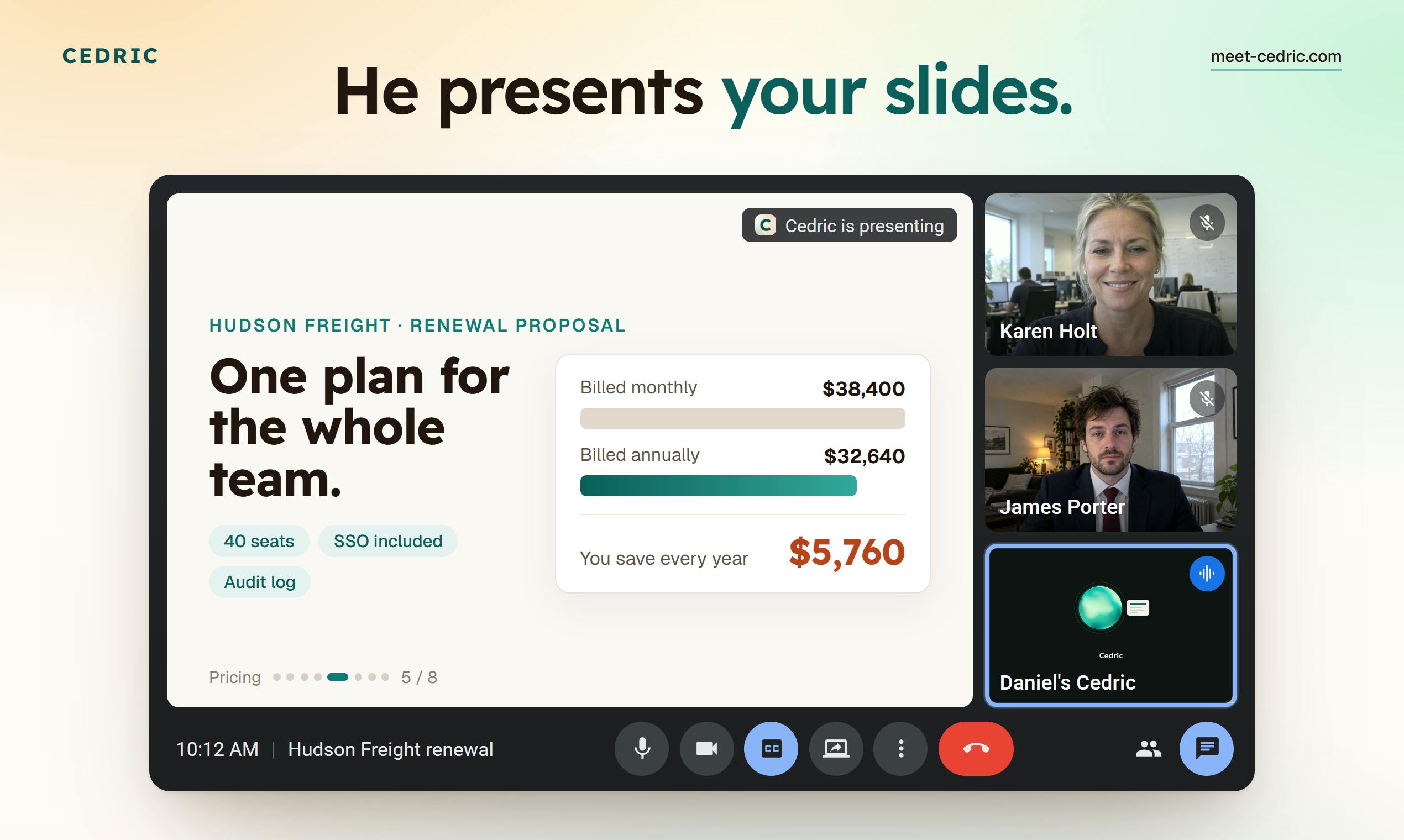
The meeting tools space has a new and interesting player. Cedric AI launched on Product Hunt with a sharply positioned product—"the first AI agent that can present slides and attend meetings on your behalf." What it's trying to solve isn't meeting notes or caption transcription, but a more radical question: Can you be absent from a meeting while someone still attends it for you?
What Cedric Actually Does for You
According to the official description, Cedric can be dispatched to your Zoom, Meet, or Teams meetings. Its core capabilities come in three layers: first, presenting slides on your behalf without you needing to share your screen; second, answering questions using real-time data from your tools; and third, generating notes and follow-up items after the meeting, which it executes once you approve them.
These three layers cover the complete chain from pre-meeting to in-meeting to post-meeting. Compared with the many AI meeting assistants on the market that only do "post-meeting summaries," Cedric moves its point of intervention earlier—into the meeting itself, and even into the meeting's hosting role. It doesn't position itself as an assistant, but as a stand-in.
Three Genuinely Differentiated Design Choices
Two Takeover Modes for Lateness and Absence
Two details in the official description deserve separate mention. One is "Join late? He catches you up"—if you join midway, Cedric is responsible for bringing you up to speed on what you missed. The other is "Can't join? He represents you"—if you can't make it at all, it attends on your behalf.
These two scenarios may look like a simple feature list, but they actually point to the same product philosophy: decoupling meeting participation rights from physical presence. In the past, you were either present or you watched the recording—there was no middle state. Cedric tries to make "partial presence" a deliverable state.
Answers Based on Real-Time Data from Your Tools
Answering questions during meetings is the hardest part of this category to get right. Cedric claims to use real-time data from your tools to answer questions, rather than relying on a static knowledge base. This determines whether it can truly hold up in sales and customer success scenarios—get a price or an inventory number wrong, and the agent's credibility drops to zero. Whether real-time integration is actually achievable and how data permissions are isolated are details you must probe when evaluating this type of product.
"Answering based on real-time data" typically relies on two mechanisms in technical implementation: one is querying business systems such as CRM, inventory, and ticketing directly through APIs or database connectors; the other is using RAG (Retrieval-Augmented Generation) to dynamically retrieve the latest records during the meeting and then hand them to a large model to organize the language. The former requires the product to support OAuth authorization and fine-grained permission control, while the latter involves the update latency of vector indexes. For enterprises, the real barrier isn't model capability but "data not leaving the boundary"—whether the agent obtains the user's own access permissions or a separate read-only account determines the magnitude of privilege escalation and leakage risks.
Post-Meeting Actions Require Your Approval
Cedric doesn't make "automatic follow-up execution" a fully automated black box; instead, it requires users to approve notes and follow-up items. This is a restrained design choice: retaining a human confirmation step when meeting content is converted into actual actions both reduces the risk of misoperation and makes the product easier to accept in enterprise environments.
"Human-in-the-loop" is a compliance design commonly adopted by current enterprise-grade AI agents. Its value isn't just preventing misoperation: in most jurisdictions, AI automatically sending external emails or modifying records may trigger data compliance and contractual liability issues. Retaining a manual confirmation step keeps the final behavior attributable to "the user's own operation," thereby avoiding legal liability caused by an agent exceeding its authority. The cost is slower response speed, and the product needs to balance "approval granularity"—item-by-item approval is safe but cumbersome, while batch approval is efficient but weakens the gatekeeping function.
What the Product Hunt Data Tells Us
In terms of launch performance, Cedric received 116 votes and 13 comments, ranking 4th for the day. Its category tags fall under Sales, Meetings, and Artificial Intelligence, indicating that its first batch of targeted users leans toward sales and customer communication scenarios rather than generalized enterprise meetings. This is a reasonable choice: sales meetings have clear PPT presentation needs, intensive data Q&A, and standard post-meeting follow-up actions—fertile ground for agent-type products to most easily prove their value.
Votes and comment volume sit in a medium-heat range, and the product is still in an early validation stage. For this type of product, early user feedback says more than vote counts—especially whether the agent performs stably in real meetings and whether attendees notice and resist it.
Product Hunt rankings are determined by a combination of same-day new votes, comment engagement, and community activity; vote count isn't an absolute metric. 116 votes is a medium-to-high exposure level, typically corresponding to hundreds to over a thousand product page visits; 13 comments better reflect the willingness of core early users to engage. For B2B tools, Product Hunt's main role is one-time customer acquisition and seed user screening rather than a long-term growth channel, so its data should be interpreted with a focus on "who is commenting"—if commenters are mostly sales or customer success practitioners, it means the product positioning has been accurately received.
Where Are the Boundaries of an Agent Attending on Your Behalf
Sending AI into the meeting room raises sharp questions beyond technology. When the other party knows the speaker opposite them is an agent rather than the person themselves, the nature of the communication changes; when the agent answers questions using real-time data, responsibility for data errors also needs to be defined in advance. Cedric partially addresses these issues with its "approval" mechanism, but attendees' right to know and the boundaries of agent behavior remain worthy of ongoing observation.
Another practical issue is integration cost. Cedric needs to connect to your meeting platform, slides, and various data tools, and the depth of integration directly determines whether it's a "usable stand-in" or a "talking player."
Who Should Try It First
If Cedric's capabilities land as described, the first beneficiaries will be roles with high meeting density, standardized presentations, and frequent data queries—such as sales representatives and customer success managers. For teams that only need meeting summaries, traditional transcription tools may still be a safer starting point; for teams hoping to outsource repetitive presentations and Q&A, agents like Cedric are worth adding to the evaluation list.
The ultimate criterion is just one: put it into a real meeting and see how long it takes attendees to realize there's no real person on the other side.
One-line Summary
Cedric AI launches an AI agent that can present slides and attend meetings on users' behalf, covering the full in-meeting and post-meeting chain.
Paragraph Summary
Cedric AI launched a sharply positioned AI meeting agent on Product Hunt, billed as "presenting slides and attending meetings for you." It can be dispatched to Zoom, Meet, or Teams meetings with three layers of capability: presenting PPT on the user's behalf, answering questions based on real-time data from the user's tools, and generating post-meeting notes and follow-up items that it executes after user approval. The article highlights three differentiated designs—takeover modes for late joiners and absentees, real-time data Q&A, and manual approval—and analyzes its 116 votes, 13 comments, and 4th-place daily ranking on Product Hunt, with first target users leaning toward sales and customer communication scenarios. It also discusses implementation challenges such as attendees' right to know, data responsibility attribution, and integration depth.
Related articles

Qwen 3.8 Beats Opus at Coding—But Can Your Mac Run It?
Open-source Qwen 3.8 beats Opus 4.6 at coding at just 18GB, but how much Mac memory do you need? 24GB crashes; 32GB is the sweet spot. Full config guide inside.

Claude Code + Agent: Building a Fully Automated AI Testing Loop
Bilibili course breakdown: how test developers can use Claude Code terminal-based Agents to build a fully automated AI testing loop. Compares permission boundaries of terminal vs. device Agents, explains why enterprise projects choose Claude Code over Open Claude-type tools, and outlines the Node.js environment setup and DeepSeek model integration path.

Working with AI Agents Requires Nerves of Steel
The more autonomous AI agents become, the heavier the user's psychological burden. Drawing from a Hacker News discussion, this article analyzes black-box anxiety, behavior drift, and monitoring fatigue in agent collaboration, and offers practical approaches like sandbox isolation, permission control, and task granularity management to reduce cognitive load.