Chatbox Open-Source AI Client: Nearly 40K Stars, All-in-One Multi-Model Chat Management
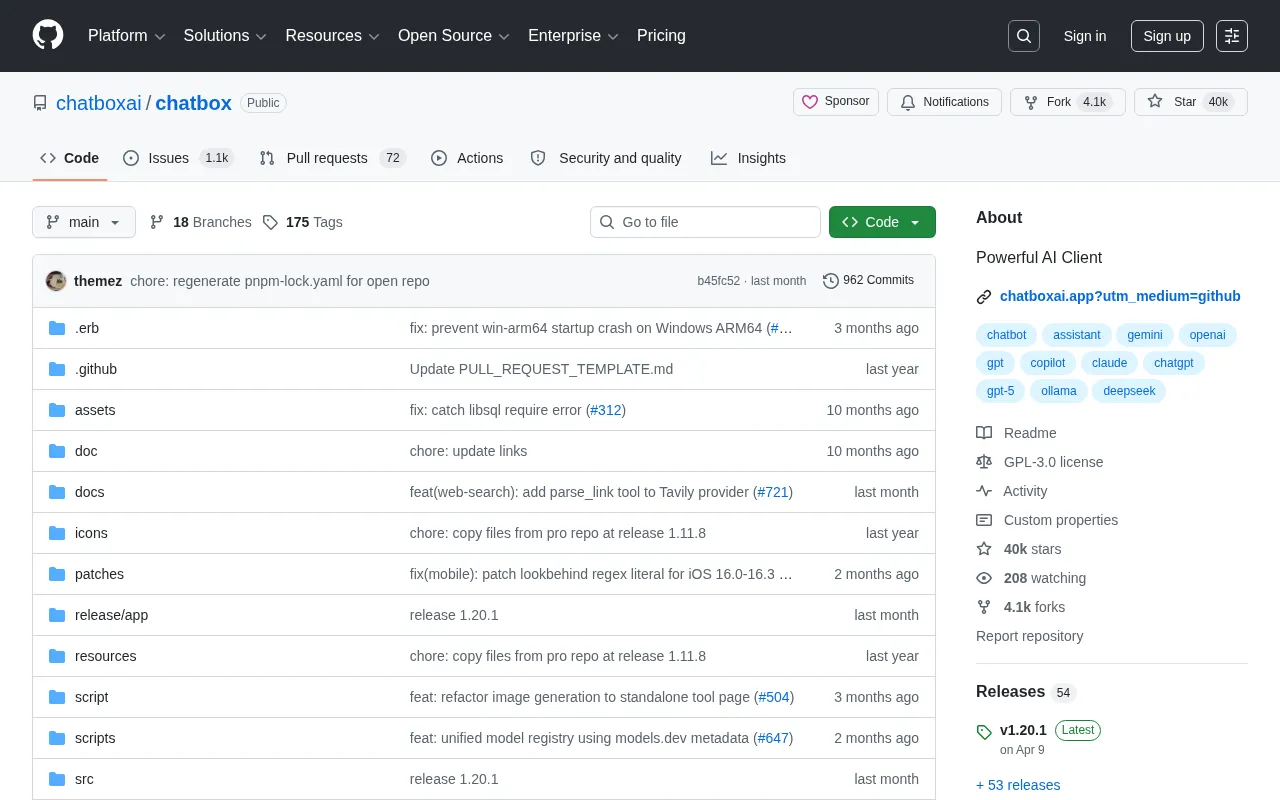
Chatbox is an open-source multi-model AI desktop client with nearly 40K GitHub Stars.
Chatbox is an open-source AI desktop client built with TypeScript and Electron, with nearly 40K GitHub Stars. It supports connecting to GPT-4, Claude, Gemini, and local models, providing a unified interface for conversation management with local data storage for privacy and cross-platform support for all three major operating systems. With its open-source strategy and active community, it serves individual users, developers, and enterprise private deployment scenarios.
Chatbox Project Overview: An Open-Source AI Client with Nearly 40K GitHub Stars
Chatbox is an open-source AI desktop client application that has accumulated nearly 40,000 Stars on GitHub, making it one of the most popular AI clients in the open-source community. GitHub Stars are one of the core metrics for measuring project popularity in the open-source ecosystem. When users Star a project, it serves as a public endorsement and bookmark. Nearly 40K Stars places it at the top tier on GitHub — for reference, fewer than 0.01% of all GitHub repositories have more than 10,000 Stars. Star count not only reflects a project's technical quality and practical value but also directly impacts its ranking in GitHub Trending and search results, creating a Matthew Effect of exposure growth. For open-source projects, a high Star count also means it's easier to attract talented contributors, gain corporate attention, and even secure commercial investment.
The project is built with TypeScript and has over 4,000 Forks, backed by an active and continuously growing developer community driving its iteration.
What Is Chatbox? An All-in-One AI Chat Management Client
Chatbox positions itself as a universal AI client. Unlike opening web-based ChatGPT or Claude directly, Chatbox provides a unified desktop interface that lets you connect to and manage multiple AI models within a single application.
In the AI application ecosystem, an AI client serves as the interaction layer between users and large language models. After ChatGPT ignited the generative AI wave in late 2022, various vendors launched their own LLM services, each with independent web interfaces and account systems. The pain point of constantly switching between multiple platforms became increasingly prominent. AI clients emerged to address this — their core value lies in aggregating scattered AI services into a unified interface while providing value-added features like conversation management, prompt templates, and data export. This category grew rapidly between 2023 and 2024, forming a complete ecosystem of both open-source and commercial products.
To put it simply: Chatbox is to AI services what Outlook is to email — you don't need to open different browser tabs for each AI service; all conversations are handled in one window.
Four Core Advantages of Chatbox
- Multi-model support: Connect to OpenAI GPT-4, Claude, Gemini, local Llama models, and other mainstream AI services
- Cross-platform compatibility: Supports Windows, macOS, and Linux
- Local data storage: All conversation records are stored on your local device, never uploaded to third-party servers, maximizing privacy protection
- Fully open-source: Code is transparent and publicly available; anyone can audit, modify, and contribute
Why Did Chatbox Earn Nearly 40K Stars?
Solving the Real Pain Point of Multi-Model Switching
With the explosive growth in the number of AI models, users face a very practical problem: different tasks often require different models. Claude works better for coding, GPT-4 is preferred for daily Q&A, and privacy-sensitive content is handled by locally deployed Llama. Opening a separate webpage for each model creates a fragmented experience.
Chatbox provides a unified entry point — after configuring API Keys for each model, you can freely switch between them in the same interface, dramatically lowering the barrier to multi-model usage. An API Key (Application Programming Interface Key) is a credential used by AI service providers to verify user identity and handle billing. When users register developer accounts on platforms like OpenAI or Anthropic, they receive a unique key string. Chatbox uses the API Keys entered by users to send requests directly to each model's backend servers and receive responses, bypassing the limitations of official web clients. The advantage of this approach is that users can precisely control call parameters (such as temperature, max_tokens, etc.) while paying based on actual token usage, which is typically more economical than subscription plans.
Among these, temperature and max_tokens are the most commonly used control parameters when calling LLM APIs. Temperature typically ranges from 0 to 2 and controls the randomness and creativity of output: lower values (e.g., 0.1) make model output more deterministic and conservative, suitable for tasks requiring precision like code generation and data extraction; higher values (e.g., 1.5) produce more diverse and creative output, ideal for brainstorming and creative writing. max_tokens limits the maximum length of a single model response — 1 token corresponds to approximately 0.75 English words or 0.5-1 Chinese characters. Properly setting these parameters not only affects output quality but directly impacts API call costs, as most providers charge based on total input and output tokens.
TypeScript Tech Stack Makes Community Contribution Easier
The project uses TypeScript as its primary development language, built on cross-platform frameworks like Electron. TypeScript is a superset of JavaScript developed by Microsoft, with static typing as its most core feature. In traditional JavaScript, variable types are determined at runtime, easily producing hard-to-trace bugs. TypeScript catches type mismatches, null reference errors, and other common issues during compilation, before code runs. For a project like Chatbox with heavy API data interactions, type definitions can clearly describe the data structures returned by each AI service, significantly reducing the probability of errors when integrating new models. Additionally, TypeScript is highly compatible with the React ecosystem, and approximately 78% of frontend developers worldwide have relevant experience, providing an extremely low barrier to entry for open-source community contributions.
Electron is an open-source framework developed by GitHub that allows developers to build desktop applications using web technologies like HTML, CSS, and JavaScript/TypeScript. Its core principle is bundling the Chromium browser engine with the Node.js runtime, enabling a single codebase to run on Windows, macOS, and Linux simultaneously. Well-known applications like VS Code, Slack, and Discord are all built on Electron. While Electron apps are often criticized for higher memory usage, the framework dramatically reduces cross-platform development costs, enabling small teams or even individual developers to quickly deliver multi-platform desktop products. The TypeScript + Electron combination allows Chatbox to achieve true cross-platform coverage while maintaining code quality.
Community-Driven Positive Flywheel
The 4,000+ Fork count indicates that a large number of developers are building on Chatbox for secondary development or submitting code. In GitHub's collaboration system, a Fork means creating a complete copy of someone else's repository under your own account, forming an independent copy. Developers can freely modify code in their forked copy and then submit changes back to the original project through Pull Requests (PRs), which are merged after maintainer review. The 4,000+ Forks mean that numerous developers are independently exploring directions for Chatbox feature expansion — some may be adapting new AI model interfaces, others optimizing UI interactions, and still others customizing for specific industry scenarios. This distributed collaboration model is the core mechanism for maintaining innovation vitality in open-source projects and the organizational foundation enabling Chatbox to quickly respond to AI industry changes.
More contributors bring richer features, richer features attract more users, and more users give back to the community — this positive cycle keeps Chatbox iterating faster than many similar projects.
Chatbox vs. Jan, TypingMind, and Other AI Clients
In the AI client space, Chatbox faces competition from multiple directions. Here's a horizontal comparison of several mainstream products:
| Product | Core Features | Positioning | Open Source |
|---|---|---|---|
| Chatbox | Multi-model access, desktop app, local data storage | Universal AI client | ✅ Open source |
| ChatGPT Official Client | Official product, complete features | OpenAI-exclusive client | ❌ Closed source |
| Jan | Focused on local model running and inference | Local AI inference tool | ✅ Open source |
| TypingMind | Feature-rich, polished interface | For advanced paying users | ❌ Closed source |
Chatbox's differentiated competitive strength lies in the combination of "open source + multi-model + ease of use." If you value privacy protection and usage flexibility, Chatbox is arguably the most worthwhile option to try right now.
Who Is Chatbox For? Three Typical Use Cases
Individual Users: Unify All Your AI Tools in One Place
- Manage API Keys for OpenAI, Claude, Gemini, and other services in a single application
- Store sensitive conversation content locally, without routing through third-party servers
- Create and reuse custom Prompt templates for noticeably improved daily efficiency
Prompts are the core medium for user interaction with large language models, and Prompt Engineering has developed into a systematic technical discipline. A well-crafted prompt can significantly improve the quality and relevance of model output. Common prompt techniques include: role-setting (e.g., "You are a senior Python developer"), few-shot learning (providing several input-output examples in the prompt), and Chain-of-Thought (requiring the model to reason step by step). Chatbox supports users in creating and saving custom prompt templates, meaning users can solidify repeatedly validated effective prompt structures and reuse them across different conversations with one click, avoiding writing from scratch every time. For users who heavily use AI, a mature prompt template library can multiply daily work efficiency several times over.
Developers: An Efficient Model Testing and Customization Platform
- Quickly compare output quality and response speed of different models on the same question
- Fork the source code for deep customization, building a personalized AI workstation
- Flexibly integrate into existing development workflows through API configuration
Enterprise Teams: A Reliable Private Deployment Solution
- Deploy a dedicated internal AI client based on open-source code
- Keep all data within the corporate intranet, fundamentally eliminating information leakage risks
- Uniformly configure model permissions and usage policies for team members
Private deployment refers to installing a software system entirely on an enterprise's own servers or intranet environment, rather than using cloud-based SaaS services. For enterprises dealing with trade secrets, customer data, or regulated industries (such as finance, healthcare, and government), private deployment is a rigid requirement for data compliance. Taking China as an example, the Data Security Law and Personal Information Protection Law impose strict restrictions on cross-border data transfer and third-party processing. Chatbox's open-source nature allows enterprises to fully audit the code logic, confirm there's no data callback behavior, and then combine it with locally deployed Llama or Qwen models to achieve a full end-to-end intranet closed loop from client to model inference, eliminating data leakage risks at the architectural level.
Conclusion: Is Chatbox Worth Using?
With nearly 40K Stars of community endorsement, Chatbox has proven the genuine demand for high-quality open-source AI clients. As competition in the AI application layer intensifies, Chatbox has established a certain community moat through its open-source strategy, multi-model support, and solid user experience.
As open-source models like Llama and Qwen continue to improve in capability, and as users increasingly prioritize data privacy, local-first AI client tools like Chatbox stand at an even greater growth inflection point. Llama is Meta's (formerly Facebook) open-source large language model series, progressing from the original Llama through Llama 2 and Llama 3, with continuously improving capabilities and parameter scales ranging from 7B to 405B. Qwen (Tongyi Qianwen) is Alibaba's open-source model series, with outstanding performance in Chinese comprehension and multimodal capabilities. Both model series support local deployment — users can run them on personal computers or private servers using inference tools like Ollama and llama.cpp without sending data to the cloud.
The large language model field is currently experiencing intense competition between open-source and closed-source camps. The closed-source camp is represented by OpenAI's GPT-4o, Anthropic's Claude 3.5 Sonnet, and Google's Gemini — these models typically lead in comprehensive benchmarks, but users can only access them through APIs or official interfaces without obtaining model weights. The open-source camp is led by Meta's Llama series and Alibaba's Qwen series, which have made astonishing progress in recent years — Llama 3.1 405B has approached GPT-4 level performance on multiple evaluations, and Qwen2.5 has even surpassed some closed-source models on Chinese tasks. The rapid catch-up of open-source models is driven by several key factors: expansion of training data scale, open sharing of training methodologies (such as RLHF and DPO), and collective community contributions in fine-tuning and alignment. This competitive landscape is extremely favorable for multi-model clients like Chatbox, as users can call closed-source APIs when they need top-tier capabilities while switching to local open-source models when prioritizing privacy or cost.
Regarding the local inference tool ecosystem, Ollama is currently the most popular local model management tool, packaging model downloading, configuration, and execution into a Docker-like streamlined command-line experience, supporting one-click pulling and running of hundreds of open-source models. llama.cpp is a C/C++ inference engine developed by Georgi Gerganov that dramatically compresses model size and memory requirements through quantization techniques (such as 4-bit quantization in GGUF format), enabling models that originally required professional GPU servers to run smoothly on consumer hardware. For example, a 7B parameter model after 4-bit quantization requires only about 4GB of memory and can run on an ordinary laptop. These tools typically start a local HTTP service endpoint compatible with the OpenAI API format — Chatbox only needs to point the API address to localhost to seamlessly connect to local models, making completely offline AI conversations possible.
Whether you're an individual user looking to unify multiple AI services or an enterprise team seeking a private deployment solution, Chatbox is worth downloading and trying out.
Related articles
 Product Reviews
The Programmer's Desk Setup Guide: Building a Workspace That Feels Like Home
Discover how programmers build productive, comfortable workspaces. From multi-monitor setups to ergonomic design, explore the desk philosophy that drives focus and flow.
 Product Reviews
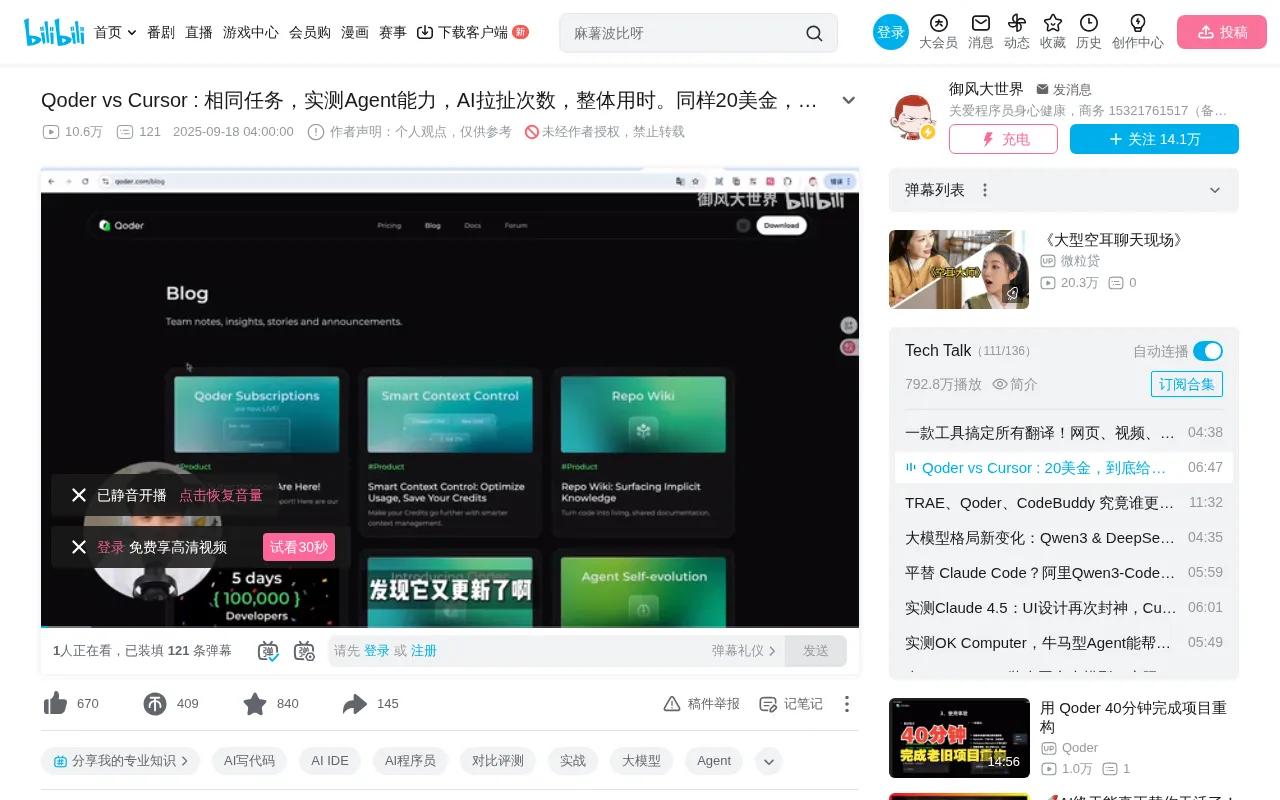
Qoder vs Cursor Real-World Comparison: Which $20/Month AI IDE Is Better?
Hands-on comparison of Qoder vs Cursor AI IDEs: Agent autonomy, human interaction count, and architecture decisions. Qoder needed only 2 interactions vs Cursor's 8.
 Product Reviews
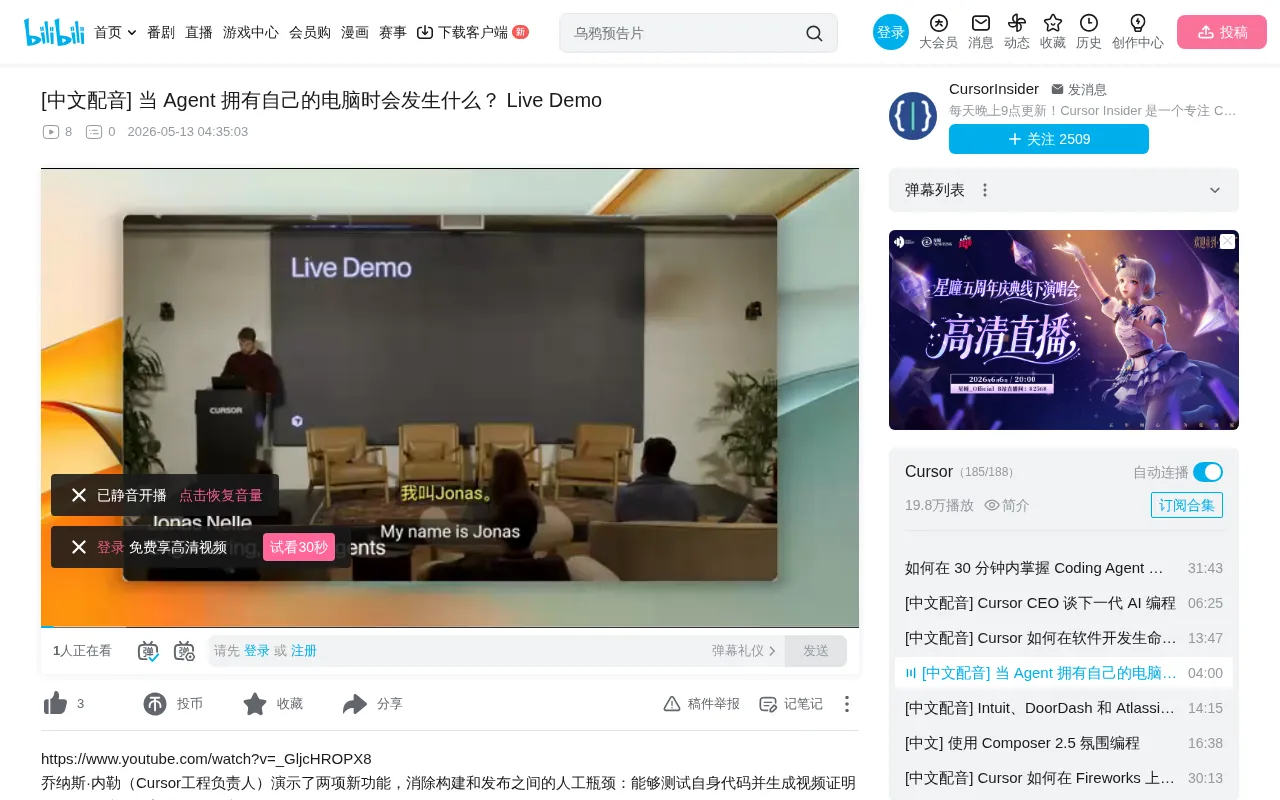
Cursor Cloud Agent Demo: Eliminating Bottlenecks Across the Entire Software Development Lifecycle
Deep analysis of Cursor's Cloud Agent demo showing how cloud VMs, automated test artifacts, and a full-chain control plane systematically eliminate human bottlenecks across the software development lifecycle.