ChatGPT 6.1 Sol Missing? Reddit User Seeks Help and Fixes

Reddit users report the ChatGPT 6.1 Sol model option has vanished, and restarting does not help; the cause is under investigation.
The article discusses a Reddit user's report that the ChatGPT 6.1 Sol model option has disappeared. The issue persists after restarting the app, and the user suspects a bug, but the post is brief and there is no official response yet. Given the limited information, the article infers three possible causes: app-side cache or data synchronization issues, server-side gradual rollout or regional restrictions, and permission changes due to account subscription or payment problems. It offers troubleshooting steps such as clearing cache, checking updates, switching networks, verifying account status, and contacting support, while noting it is unclear whether this is widespread or isolated.
Background: ChatGPT 6.1 Sol Model Option Disappears, Confusing Users
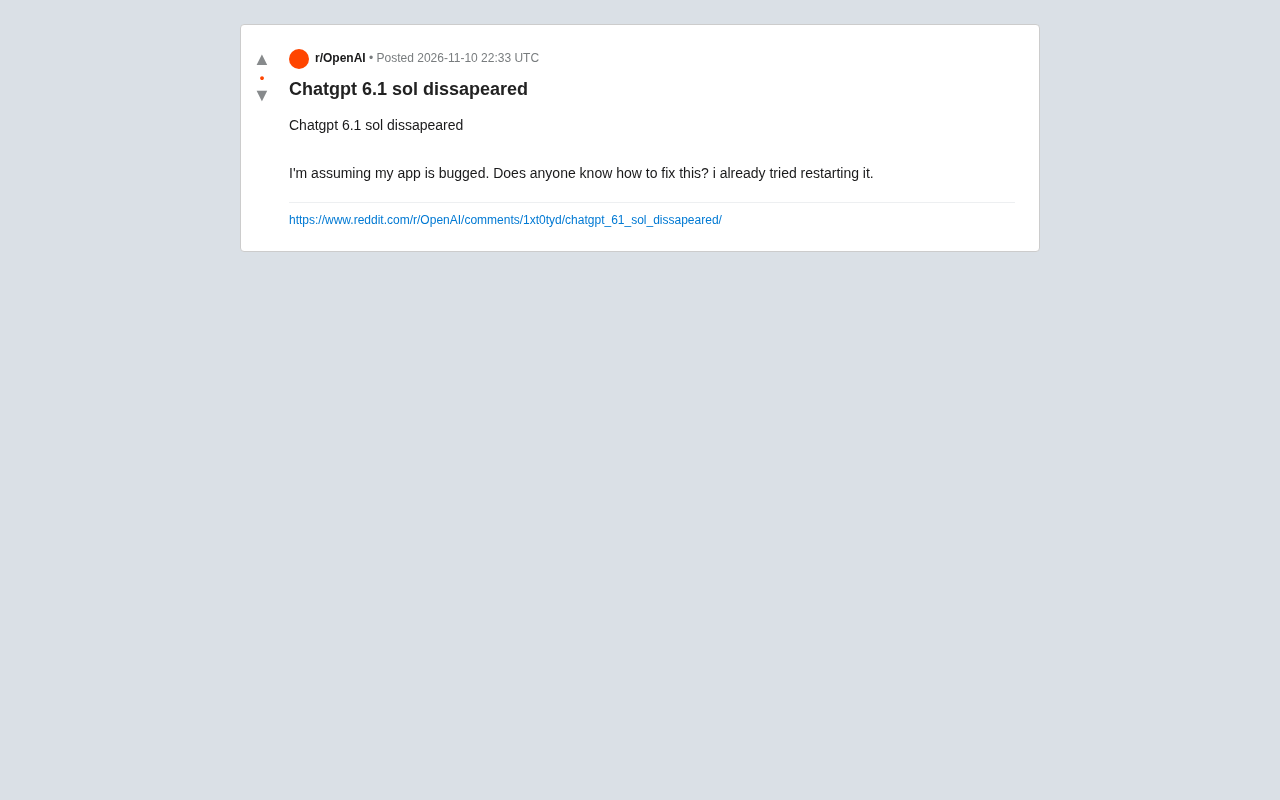
Recently, a Reddit user posted that while using the ChatGPT app, they found the ChatGPT 6.1 Sol model option had suddenly disappeared, and suspected it was an app bug. The user said they had already tried restarting the app, but the issue persisted, so they posted to ask whether others had encountered a similar situation and how to fix it.
Judging from the screenshot, the location in the UI where the model selection should normally appear seems to be missing the ChatGPT 6.1 Sol option, which directly affects the user's ability to use that specific model. At present, the post is fairly brief, and there has been no clear official response or solution.
Analysis of Possible Causes
Given the limited original information, we cannot determine the exact cause, but based on common app issues, several possibilities can be inferred:
1. App-side bug or cache issue
The user has already tried restarting the app without success, which may point to a deeper cache or data synchronization problem. Mobile apps can sometimes display abnormal interface elements because local cache has not been updated in time.
2. Server-side configuration or gradual rollout adjustments
OpenAI may be making backend adjustments to model options, such as gradual rollout, regional restrictions, or temporary maintenance. In such cases, some users will temporarily be unable to see a specific model.
Canary release is a deployment strategy that reduces rollout risk: new features or configurations are not pushed to all users at once, but first opened to a small percentage of users (such as 1% or 5%), and then gradually expanded after stability is observed. Large model products commonly use this mechanism to test new model versions, adjust default options, or validate inference costs. For users, the direct manifestation of the canary phase is that "the same app version shows different features across different accounts," which also explains why some users suddenly cannot see a certain model option. Related concepts include A/B testing and feature flags: the former is used to compare the effectiveness of different approaches, while the latter allows the server to remotely enable or disable a feature without releasing a new version. Therefore, the disappearance of a model option is not necessarily a client-side defect; it may also be caused by configuration differences delivered by the server based on account, region, or device dimensions.
3. Changes in account or subscription status
Access to certain models may be tied to the subscription plan. If the account status changes (such as subscription expiration or payment issues), the relevant options may be hidden.
Mainstream AI assistants usually adopt a permission model of tiered subscriptions + usage quotas: different plans correspond to different model access ranges, context lengths, and invocation frequencies, and some advanced models also have separate usage caps. When an account experiences subscription expiration, payment failure, refund disputes, or triggers risk-control policies, the system may temporarily revoke access to specific models, and the model options in the interface will then be hidden or grayed out without clearly indicating the reason. In addition, permissions for enterprise or team accounts are uniformly configured by administrators, and the model list members see depends on organizational policy rather than personal settings. Therefore, when troubleshooting, in addition to confirming subscription status, users should also check whether the payment method is valid, whether there is confusion from logging into multiple accounts, and whether they are in a team workspace rather than a personal space.
Fixes Users Can Try
Before official clarification is available, the following steps may help troubleshoot the issue:
- Clear app cache: Find the ChatGPT app in system settings, clear the cache, and log in again.
- Check for updates: Make sure the app is the latest version, as older versions may contain known bugs.
- Switch network environment: Try switching from Wi-Fi to mobile data, or use a VPN to test whether the issue is related to regional restrictions.
- Check account status: Confirm whether the subscription is valid and whether the payment method is working properly.
- Contact official support: If none of the above works, report the issue through the in-app help center or OpenAI support channels.
Community Discussion and Information Gaps
At present, the Reddit post does not provide more details, such as whether other users have encountered the same issue or whether it is related to a specific device or region. Therefore, we cannot determine whether this is a widespread phenomenon or an isolated case. It is advisable to monitor OpenAI's official status page or community announcements for the latest information.
Conclusion
The disappearance of ChatGPT 6.1 Sol may be caused by multiple factors, ranging from local cache issues to server-side adjustments. Users can first try routine troubleshooting steps, and if the problem persists, report it to the official team promptly. We will continue to follow the development of the incident.
One-line Summary
A Reddit user reports that the ChatGPT 6.1 Sol model option has disappeared, restarting does not help, and the cause is still unknown.
Paragraph Summary
The article focuses on a Reddit user's report that the ChatGPT 6.1 Sol model option has disappeared. The user says the issue persists after restarting the app and suspects an app bug, but the post contains limited information and there has been no official response. With limited information, the article infers three possible causes: app-side cache or data synchronization abnormalities, server-side gradual rollout or regional restrictions and other backend adjustments, and permission changes caused by account subscription status or payment issues. In response to these possibilities, the article provides troubleshooting steps such as clearing cache, checking app updates, switching network environments, verifying account status, and contacting official support, and notes that it is currently impossible to determine whether this is a widespread phenomenon or an isolated case. It recommends monitoring OpenAI's official status page and community announcements for further developments.
Related articles

Perplexity Decider Free for a Week, Plus Compute Grants and Credit Matching
Perplexity Decider V1.3 and Flash V1.3 are free on OpenRouter for a week, plus Infirst.net offers up to $10K compute grants for open-source AI projects and Cognition provides $15K Devin credits with 1:1 matching for startups.

Motorcycle Infiltration: Russia's Drone War of Attrition in Ukraine
An analysis of Russia's motorcycle infiltration tactics in Ukraine: using speed to cross drone kill zones, accepting high casualties to find gaps in Ukrainian defenses, and exploring drone suppression and two Ukrainian response paths.

200+ Model Experiments: Vision Encoder Pretraining Not Required, but Vision-Specific Parameters Are Indispensable
Meta FAIR and NYU trained 200+ MLLMs to decompose vision encoder design: encoder pretraining is optional, vision-specific parameters are essential, and the encoder need not precede the LLM. Experiments span 0.6B to 6.4B scales and 16 VQA benchmarks.