ChatGPT and Codex Merge Usage Allowances: Who Runs Out First?
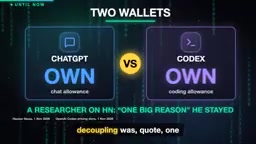
OpenAI merges ChatGPT and Codex allowances into a shared token pool—no price hike, but heavy users pay.
OpenAI will merge ChatGPT and Codex paid allowances into a single token-metered shared pool starting in December, covering Plus, Pro, and Business users, with only Instant Chat exempt. This means tokens spent coding will eat into everyday chat capacity. OpenAI hasn't published specific token allowance figures, so users can't calculate actual availability in advance. Coding tasks are allowance killers due to high output token consumption, with output priced several times higher than input. The move comes as OpenAI faces funding below expectations and revenue growth pressure—a lever to monetize heavy users without raising subscription prices. Anthropic already uses a similar shared-limit design, prompting some Claude users to consider switching providers. The article advises users to screenshot current usage, record workloads, consider buying a separate API key, and watch credit prices before December.
OpenAI is merging the paid usage allowances for ChatGPT and Codex into a single shared pool. Starting in December, Plus, Pro, and Business users will draw from one token-metered quota for both chatting and coding. That means every token you spend writing code could eat into the space you have left for everyday conversation.
Merger Details: One Wallet, Two Kinds of Consumption
According to OpenAI's help page, the core of this change is that "usage allowance will be shared across ChatGPT and Codex." Previously, ChatGPT and Codex each had their own independent allowance systems; now they are folded into the same pool. The billing unit also shifts from message counts, request counts, or hours to tokens.
The only exemption is Instant Chat—quick Q&A doesn't consume allowance. But anything that requires "thinking longer, reading files, running tools, or writing code" draws from the same bucket. When the allowance runs out, OpenAI offers three options: wait for the reset, upgrade your plan, or buy credits.
This change didn't come out of nowhere. OpenAI's Codex pricing page has long shown that ChatGPT Work and Codex share usage, and the December adjustment pulls regular ChatGPT into that pool as well. The problem is that the pool's capacity is more limited than you'd think.
The Ambiguity of Token Metering: You Can't Calculate What You Bought
OpenAI has published estimated ranges for Codex's local message counts within a five-hour window, but the differences between models are enormous. The estimates referenced in the source material for GPT 6.1, GPT 6 Astra, and GPT 6 Luna range from single digits to thousands—and that huge spread is exactly what shows that "message count" was never a reliable unit of measurement.
OpenAI itself acknowledges that model choice, context length, reasoning depth, tool calls, retrieval, and caching all affect token consumption. More importantly, output tokens are priced at several times the rate of input tokens (the credit table in the source material shows output priced at five times input), and coding tasks are precisely the high-output scenario of "write, rewrite, explain."
Fast mode consumes several times the allowance of standard mode, and Ultra fast consumes even more. These multipliers are clearly visible in the credit table, but ordinary users will struggle to translate them into day-to-day expectations.
What Is a Token?
A token is the basic unit of text that large language models process—neither a character nor a word. In English, one token roughly corresponds to 4 characters or 0.75 words, while in Chinese a single character typically maps to 1–2 tokens. When a model generates a response, both the input prompt and the output content are billed by token, and output tokens are generally priced higher than input. Coding scenarios are especially token-hungry: code must be read (input), extensively rewritten and explained (output), and the context window often contains an entire codebase or long files, so the token volume per request far exceeds everyday chat. That's why, once tokens replace "message counts," coding users will feel their allowance draining unusually fast—what they're really buying is the model's compute throughput, not the number of conversations.
Why Now? Leverage Under Financial Pressure
According to The Wall Street Journal, OpenAI has raised about $11 billion in a funding round targeting $30 billion, at a valuation of $1.25 trillion—below the $1.4 trillion it had previously pitched. The same report noted that Anthropic's quarterly revenue reached $11.6 billion, doubling in three months, while OpenAI's stood at $6.7 billion, up about 18%.
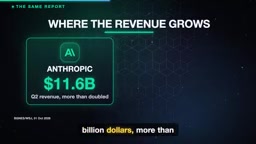
Coding agents are the fastest-growing revenue area, but they're also a "token furnace." With funding falling short of expectations and an IPO being prepared for as early as early next year, OpenAI needs a lever that doesn't raise subscription prices—and metering the resources heavy users already consume is that lever. No subscription prices change in December; what changes is how much work the same money buys, and OpenAI sets the exchange rate.
The Difference Between API Pricing and Subscription Allowances
OpenAI's API uses post-paid, pay-per-token pricing that is public and independent of ChatGPT subscriptions. Subscription plans (Plus, Pro, Business) are prepaid fixed monthly fees in exchange for an allowance pool. The two don't draw from each other: even if your subscription allowance is exhausted, you can keep calling the model as long as your API account has balance. For heavy users who need to separate coding from chatting, buying a separate API key and paying per use provides a predictable backup channel outside your subscription allowance. However, the API has no "flat monthly" concept—costs grow linearly with usage—so it suits teams with stable usage or a need for fine-grained budget control.
A Cautionary Tale: Anthropic Already Did This
The discussion on Hacker News reveals the root of users' anxiety. One commenter said that separate allowances were "a big reason I keep paying," and now they're "more willing to switch providers." Another comment pointed directly at Anthropic's current situation: "After Claude Code runs out, my more everyday usage gets cut off too."

Claude's help center does state that Claude and Claude Code limits are shared, including a five-hour session limit, a weekly limit, and separate weekly limits for certain models. OpenAI isn't inventing a punishment mechanism; it's adopting a design already used by its fastest-growing competitor—a design that's simpler to explain and cheaper to operate, but that merges all heavy users' problems into one.
There are calmer voices too. Some suggest reserving part of the allowance for ordinary chat and capping only deep research or image generation. That's a reasonable design, but OpenAI hasn't announced anything like it.
Claude and Claude Code's Shared Limit Mechanism
Anthropic applies tiered limits to paid Claude users: all usage (including web chat and Claude Code) shares a total allowance over a rolling five-hour window, plus a weekly total limit, and some high-consumption models (such as Opus) have their own separate weekly limits. This design lets the operator manage all product lines with a single unified unit of measurement, simplifying the billing system and preventing allowance arbitrage across products. The side effect is that after a user completes a large refactor in Claude Code, everyday web Q&A can get cut off as well. OpenAI's adjustment is structurally very similar, which is why "switch providers" discussions appeared on Hacker News—users fear the same resource-competition pattern recurring at both major providers.
How Users Should Respond: Four Things to Do Before December
First, screenshot your current usage page today and note what your plan actually provided before the change. Second, record your heaviest week of Codex or workload—that number now has to compete with your chatting. Third, if you pay for Pro specifically to keep coding and chatting separate, consider buying a separate API key for the coding side—OpenAI's documentation explicitly states that API token pricing is independent of subscription allowances. Fourth, watch the price of credits.
"Buying credits" is the new escape hatch, but the help page doesn't publish the specific price of ChatGPT credits.

Cheap credits would make this change just a speed bump; expensive credits would mean the subscription has quietly become a down payment. Business and Enterprise users are hit hardest: the documentation shows that Enterprise and Edu seats without flexible pricing have the same per-seat limits as Plus, while those with flexible pricing have no fixed rate limits and scale entirely on credits. Teams should prepare for a budget discussion.
The Numbers Left Unpublished Are the Key
Plus at $20 a month, Go at $8 a month, Pro starting at $100 (with $200 and $500 tiers), and Business at $20 per seat per year—none of these prices have changed. What's changed is what they buy.
But OpenAI hasn't published the token allowance figures for Plus, Pro, or Business. There are no specific numbers anywhere on the help page. You can't calculate what you bought, because the size of the bucket isn't in the documentation. It will only appear on the usage page in settings after the change takes effect, alongside your reset time.
In its article, OpenAI says "we expect most users won't need to wait for their usage to reset more often than they do now." That's a promise about typical behavior, not a number. If the number on your usage page moves faster after launch than it does now, that promise about reset frequency is the thing being broken—quietly, with no blog announcement.
The real proof that OpenAI got this right would be publishing token allowances before December and showing that a normal chat month plus a normal Codex week fits inside them. If that table appears, this is just housekeeping; if it doesn't, it's a test.
The Essential Difference Between Credits and Subscriptions
Credits are a prepaid, pay-per-use unit that users can buy in addition after their subscription allowance runs out, to keep using the service. The key difference from a subscription allowance pool is this: a subscription is a fixed monthly fee for an opaque allowance, while credits are clearly priced incremental resources. If credits are cheap, the shared-pool adjustment is just a mild speed bump; if they're expensive, the subscription fee becomes a "down payment," and heavy users' actual spending will far exceed the sticker price. OpenAI's help page currently doesn't publish the specific unit price of ChatGPT credits, which leaves users unable to assess worst-case usage costs. For Business and Enterprise customers, credits could also become an unpredictable variable in team budgets, requiring alignment with finance before the change takes effect.
Related articles

9 AI Subscription Plans Compared: The Real Cost Per 100M Tokens Revealed
Bilibili creator tests 9 AI subscription plans from Volcano, Alibaba, Tencent, Baidu, Zhipu, Xiaomi, MiniMax and more, converting them all to real cost per 100M tokens, breaking down fixed-quota vs. three-tier coefficient billing and how caching, time-of-day discounts, and window limits affect actual quota.

Vibe Coding for Beginners: Expressing Intent Instead of Handwriting Code
What is Vibe Coding? A 137-episode Bilibili course defines it: the core is expressing intent, not writing code. This article analyzes Vibe Coding's productivity logic, target audience, and entry expectations to help beginners decide if it's worth learning.

LangChain Beginner's Guide: An Agent Development Roadmap from LangGraph to Deep Agents
Clarify the encapsulation relationship among LangChain, LangGraph, and Deep Agents, and master the learning path and selection logic for agent development frameworks—suitable for beginners in large model development.