ChatGPT GIF Feature Falls Short: User Complaints and AI Video Generation Pain Points

ChatGPT's new GIF feature draws user complaints over poor cross-frame consistency, exposing AI's temporal generation shortcomings.
A three-year Plus veteran on Reddit criticized ChatGPT's newly launched GIF generation feature, pointing out its inability to loop seamlessly, frame flickering, garbled limbs, and even absurd results like "an arm turning into a cat's head." The article analyzes that these problems stem from inherent difficulties in AI video generation regarding temporal consistency, object permanence, and understanding of physical laws; current models are more like a simple temporal extension of image generation models. The post also notes that OpenAI has recently tilted resources toward Codex, causing consumer features such as voice and memory to lag in iteration and fall behind competitors like Sesame and Dessa. Users expect more reliable cross-frame consistency, true seamless looping, and multimodal integration, rather than a hastily launched half-finished product.
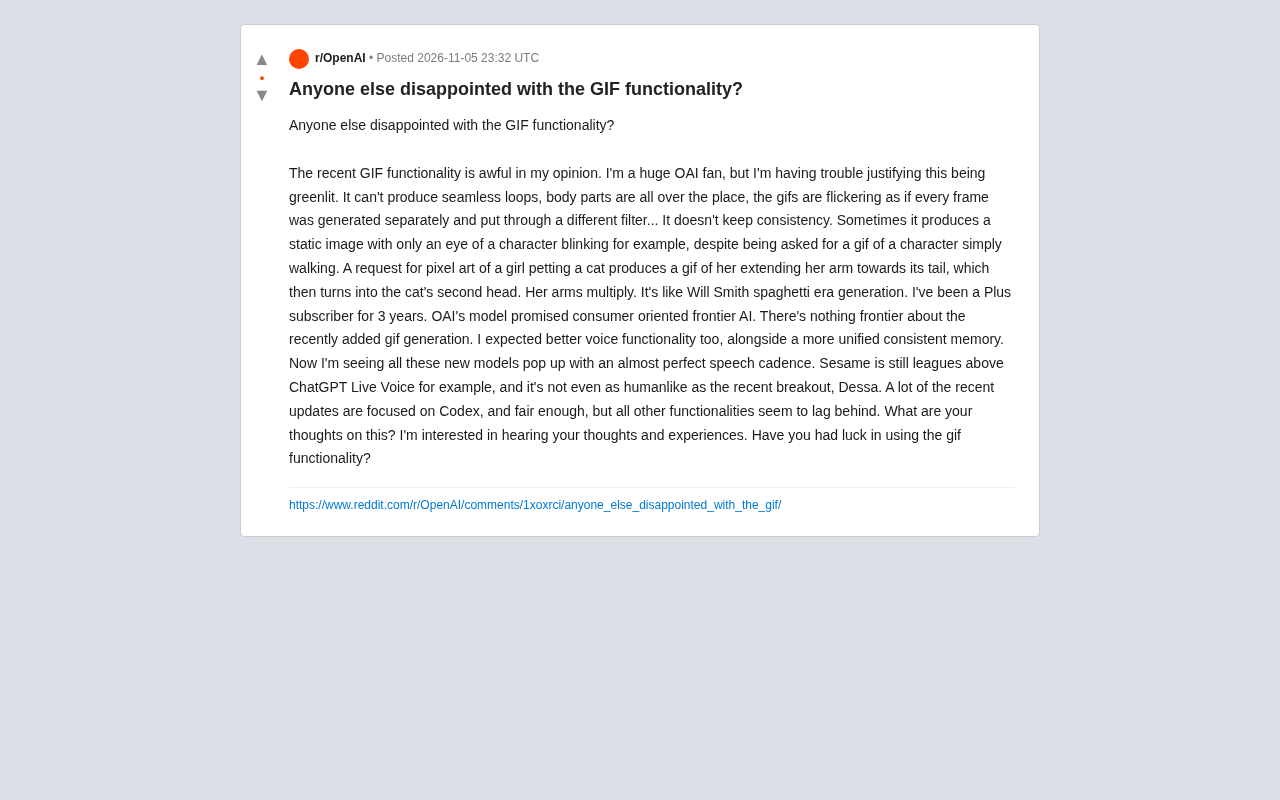
Recently, a post on Reddit by a user claiming to be a three-year Plus veteran sparked discussion: he expressed disappointment with ChatGPT's newly launched GIF generation feature, saying outright that "it's baffling that this thing passed review." From failing to generate seamless loops and garbled limbs to frame-to-frame flickering that looks like separately generated frames stitched together, and even absurd results like "asking a girl to pet a cat but generating an arm that turns into a cat's head," this user's complaints resonated with many people's experiences. Behind this lies the long-standing challenge of AI video generation (or animated image generation) in terms of consistency and temporal coherence.
User Complaints: What Exactly Is Wrong with GIF Generation?
According to the post, the problems center on several aspects. First is looping and smoothness: the generated GIFs cannot loop seamlessly, flicker noticeably during playback, and the user suspects that "each frame is generated separately and then different filters are applied." Second is body part confusion: when requesting a pixel-art girl petting a cat, the girl's arm reaching toward the cat's tail turned into the cat's second head, and the arm multiplied. Even more absurdly, sometimes when requesting a character to walk, only a static image is produced, with just one eye blinking. These phenomena point to the same root cause: the model lacks understanding of object permanence and physical laws in the temporal dimension, and cross-frame consistency is extremely poor.
The user compared the current state to the early AI video failure era of "Will Smith eating spaghetti"—a video in which the person's face merged with the noodles and became a classic meme. Clearly, in his view, OpenAI's GIF feature has not improved much over those years.
Beyond GIFs: Voice and Memory Also Falling Behind
The latter half of the post takes aim at OpenAI's overall update cadence. The author believes that many recent updates have focused on Codex (code generation), while other features seem to lag. He specifically mentioned voice: Sesame's voice rhythm is already "nearly perfect," even several steps ahead of ChatGPT Live Voice, while newcomer Dessa is superior in human voice naturalness. At the same time, he looks forward to a more unified and consistent memory system, but has not seen one yet.
This reflects a product strategy issue: when OpenAI tilts resources toward enterprise scenarios such as programming, the iteration speed of consumer-facing features inevitably makes veteran users feel a gap. This Plus user emphasized that OpenAI promised "frontier AI for consumers," but GIF generation has "no sense of frontier" at all.
Sesame is an AI company focused on conversational speech generation, known for its voice models that feature natural pauses, breathiness, and emotional rhythm, often rated in blind tests as close to human conversation. Dessa is another voice AI company with a long track record in voice cloning and synthesis, and its human voice naturalness stands out in some evaluations. The comparison between these two and ChatGPT Live Voice reflects the difference between two technical routes: "end-to-end speech dialogue models" and "traditional TTS plus pipelines." End-to-end models can better preserve prosody and emotion, but require more data and compute; in productization, they also need to balance latency, multilingual support, and safety, so the actual experience is not entirely determined by model capability.
The Technical Deep Water: Why Is GIF Generation So Hard?
The difficulty of AI-generated dynamic content lies in temporal consistency. Static image generation can optimize pixel by pixel, but video/GIF requires object position, appearance, and lighting to remain coherent between adjacent frames. Current mainstream methods usually generate keyframes first and then interpolate, or use diffusion models to model along the temporal dimension, but both tend to break down on complex actions (such as hand interactions). The user case of "arm turning into a cat's head" is exactly the model's semantic confusion between "hand" and "cat's head," compounded by insufficient cross-frame attention.
In addition, seamless looping requires the model to understand the periodicity of actions and connect the beginning and end, which remains a challenge for current models. The flickering issue may stem from inconsistent post-processing after each frame is generated independently. Although OpenAI has not disclosed technical details of the GIF feature, judging from user feedback, it most likely does not employ architecture optimizations specifically for temporal consistency, and is more like a simple temporal extension of an image generation model.
Cross-frame Attention is one of the key mechanisms by which video generation models maintain temporal consistency. When a diffusion model generates video, it needs each frame to reference the features of adjacent frames during denoising, rather than generating each frame independently. Cross-frame attention establishes inter-frame feature correlations along the temporal dimension, keeping an object's position, appearance, and texture coherent across frames. When cross-frame attention is insufficient or poorly designed, the model struggles to track the continued existence of objects, and semantic drift such as "arm multiplication" and "body part swapping" easily occurs. Many current video generation approaches stack temporal attention layers on top of spatial attention, but computational cost grows quadratically with the number of frames, so practical products often use approximations or truncation—one of the technical root causes of frequent frame flickering and object confusion.
Object Permanence was originally a concept in developmental psychology, referring to an individual's understanding that objects continue to exist even when unseen. In AI video generation, it is borrowed to describe whether the model can maintain continuous tracking of the same object as time progresses: a character who walks out of frame and returns should still be the same character; when a hand reaches toward a cat, the hand and the cat should keep their respective identities. Current generative models lack explicit object-level representations and usually only perform statistical associations at the pixel or latent space level, so when actions are complex or occlusion occurs, the model easily conflates the semantics of "hand" and "cat's head," leading to limb confusion. To truly solve this problem, the model needs some kind of intermediate representation of scene graphs or object trajectories, rather than relying solely on inter-frame pixel smoothing.
What Do Users Expect?
Judging from the general sentiment in the replies, users are not wholesale rejecting attempts at AI-generated GIFs; rather, they hope OpenAI can deliver a truly "frontier" solution. There are several implicit expectations: first, improve cross-frame consistency, especially for human limbs and object interactions; second, support truly seamless looping; third, integrate GIF generation with voice, memory, and other features to form a coherent multimodal experience. Some users also suggested that rather than hastily launching a half-finished product, it would be better to perfect the foundation model before release.
For developers, this wave of complaints also reminds us: the bar for multimodal generation is not just "can generate," but "generates reliably." With competition in the AI video track intensifying, the details of user experience will determine reputation.
Conclusion
ChatGPT's GIF feature clearly has not met user expectations and exposes AI's shortcomings in temporal generation. But from another perspective, users' harsh criticism precisely shows that their expectations of AI have moved beyond the "toy" stage and begun to be measured by practical standards. Whether OpenAI can recover its reputation in subsequent updates remains to be seen.
(This article is based on Reddit user discussion and represents only the original author's views.)
Related articles
 Tech Frontiers
Coldframe: A Honeypot Disguised as a Supermarket Freezer Controller
Coldframe is a honeypot disguised as Danfoss AK-SM 800A and Dixell XWEB freezer controllers, built as a single Python file that detects CVE-2025-41450 attempts and is identified as real devices on Shodan.
 Tech Frontiers
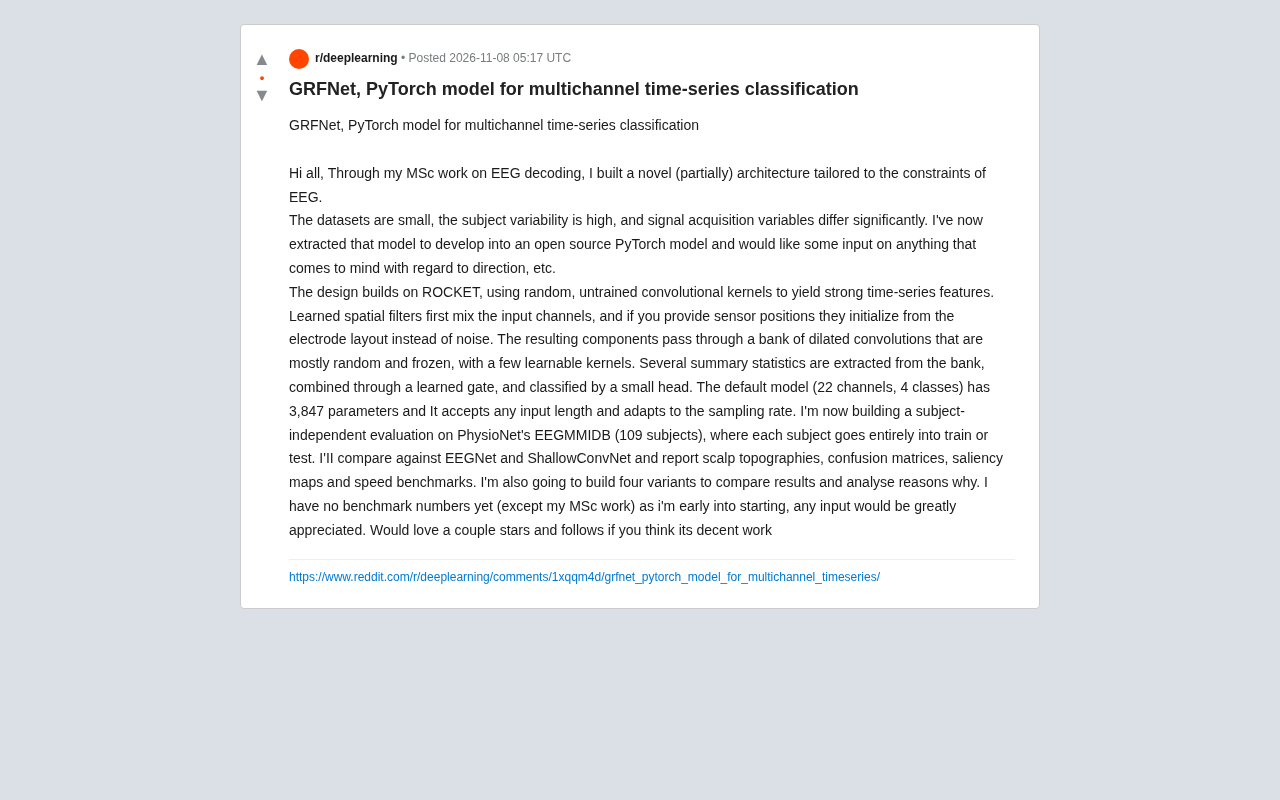
GRFNet: A Lightweight PyTorch Model Designed for Multichannel Time-Series Classification
GRFNet is a lightweight PyTorch model for multichannel time-series classification, originating from EEG decoding research. With only 3,847 parameters, it is based on the ROCKET architecture, combining random convolution kernels with learnable spatial filters, supports arbitrary input lengths, and will soon be evaluated on the PhysioNet dataset.
 Tech Frontiers
CUDA-Accelerated Rocket League Simulator: A Player-Made Hardcore Experiment
A Reddit post shows a "100% Accurate" Rocket League simulator accelerated with CUDA. We analyze its technical context, CUDA's value in game physics simulation, and the significance and limitations of such community projects.