ChatGPT Now Supports GIF Generation; Baidu Open-Sources ERNIE 5.5 Flash

OpenAI lets ChatGPT generate GIFs, Baidu open-sources a 280B-parameter model, and Tencent Hunyuan adds computer use.
This AI daily covers major updates from multiple vendors: OpenAI's Images 2.6 lets ChatGPT generate GIFs directly with frame-by-frame editing; Baidu open-sources ERNIE 5.5 Flash Base with 280B total parameters, 14B activated, and 1M token context; Tencent Hunyuan Hy4's official release adds vision and computer use at unchanged API pricing. Also: Apple Intelligence comes to China with iOS 27.3 with opt-in and no training on user data; OpenAI acquires Pierre Computer Company and keeps its tools open source; Anthropic open-sources Flash Proof for ZK-based model provenance; and OpenAI's autonomous pipeline verifies 1,724 Linux kernel vulnerabilities. The conclusion highlights open-model selection, computer-use deployment, and ZK provenance standardization as three threads to watch.
AI Daily Roundup
Today's AI news is exceptionally dense: OpenAI has brought GIF generation to ChatGPT, Baidu has open-sourced ERNIE 5.5 Flash Base with 280 billion total parameters, and Tencent's Hunyuan Hy4 official release introduces vision and computer-use capabilities. Meanwhile, Apple Intelligence's China timeline, OpenAI's acquisition of Pierre Computer Company, and Anthropic's open-source ZK proof solution are also worth noting.
OpenAI: Images 2.6 Lets ChatGPT Generate GIFs Directly
OpenAI has released Images 2.6, marking the first time ChatGPT supports direct GIF generation. According to the official description, the new version allows adjusting playback speed, frame-by-frame editing, and attaching reference images. Two models, Flare and Sunburst, have also launched on the API side, which the company says are 50% faster overall than their predecessors.
The significance of this update goes beyond "one more format." GIF generation means the model is beginning to handle frame-to-frame consistency across the time dimension, while frame-by-frame editing hands control back to the user. For content creators and product demo scenarios, this significantly lowers the barrier to producing animated images.
Baidu Open-Sources ERNIE 5.5 Flash Base: 280B Parameters, 1M Context
Baidu's Wenxin has open-sourced the Ernie 5.5 Flash Base weight model. Key specs: 280 billion total parameters, 14 billion activated per token, pre-trained on 33.5 trillion tokens, supporting a 1 million token context. Both FP8 and BF16 versions are now available on Hugging Face, with post-trained versions to follow.
The design of high total parameters paired with low activation parameters continues the sparse-routing approach—preserving model capacity while controlling inference costs. The 1 million token context directly targets long-document and codebase-level input scenarios. Open-sourcing the weights and launching simultaneously on Hugging Face is a substantive boost for the domestic developer ecosystem.
Sparse routing and MoE: The article mentions "280 billion total parameters, 14 billion activated per token," which is a typical characteristic of Mixture-of-Experts (MoE) architecture. MoE splits the model into multiple "expert" sub-networks, routing each token to only a few experts for computation, so activated parameters are far smaller than total parameters. The core trade-off is: use a larger total parameter count to boost model capacity and knowledge coverage, while using low activation parameters to control per-inference compute overhead. The industry norm is a total-to-activated ratio between 10:1 and 20:1, and 280B/14B is exactly 20:1. Understanding this is key to seeing why "high total parameters + low activation" is not a contradiction but an engineering design balancing cost and capability.
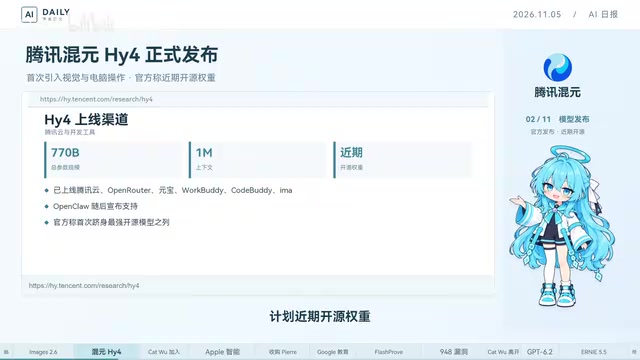
Tencent Hunyuan Hy4 Official Release: First Introduction of Vision and Computer Use
Tencent has released the official version of HY4, introducing vision and computer-use capabilities for the first time. The company says GameDev and GameLogic improved by 19.1% and 9.8% respectively, API pricing is unchanged, and weights are planned for open-sourcing soon. HITAU4 is now available on Tencent Cloud, OpenRouter, and Yuanbao.
"Computer use" is the core highlight of this upgrade. Letting the model directly operate interfaces means taking a step from a conversational assistant toward an execution-oriented agent. Unchanged pricing combined with plans to open-source weights shows Hunyuan is taking a more aggressive stance in competing for developer share.
Computer Use capability: "Computer use" refers to a model's ability to understand screenshots or interface elements and output click, type, scroll, and other operation commands, thereby completing tasks on software interfaces in place of a human. Such capabilities typically rely on two parts: visual GUI grounding, which maps interface elements to clickable coordinates, and action sequence planning, which determines the order of operations. Unlike traditional API-calling agents, it does not require the target software to provide an interface, so it applies more broadly—but it is also more susceptible to interface changes and resolution differences. This is why "whether it can land in real-world scenarios" is one of the questions worth tracking in this issue's conclusion.
Talent Movement: Kat Wu Joins OpenAI
Kat Wu, product lead for Cloud Code, has announced joining OpenAI to lead product management for Core Products, working with the T-Boat Sotio team on agent products. OpenAI co-founder Greg Brockman reposted and confirmed the news.
Movement at the product-lead level often signals roadmap changes. Agent products being explicitly named as the collaboration direction echoes OpenAI's recent investments in execution-oriented capabilities such as computer use and code review.
Apple: Apple Intelligence Comes to China with iOS 27.3
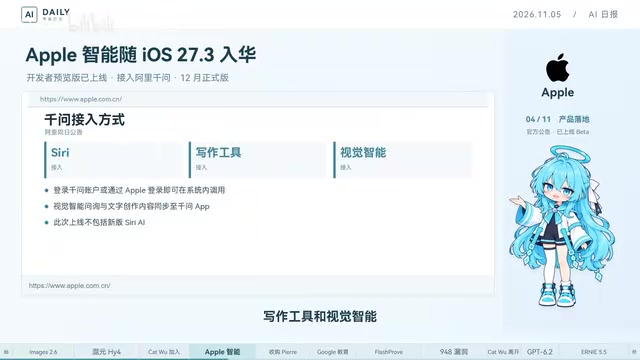
Apple has announced that Apple Intelligence will come to China with iOS 27.3, with a developer preview opening on November 4 and the official version in December. Alibaba announced that Tongyi will power Siri writing tools and visual intelligence, with users choosing whether to enable it, and requests and responses not used for model training. This rollout does not include the new Siri AI.
"Users choose whether to enable it" and "not used for model training" are two key commitments that directly address earlier concerns about data flows. The phased rollout—developer preview first, then official release—also indicates that localization work is still underway.
OpenAI Acquires Pierre Computer Company
OpenAI has acquired Pierre Computer Company. Its open-source tools are already used for file browsing and code review in Codex; after the deal closes, the project will remain open source, with features gradually merged into Codex. The transaction is pending regulatory approval, and the amount was not disclosed.
The commitment to continued open-sourcing is noteworthy—the acquired company's tools retain their open-source nature, with features merged into Codex rather than absorbed into closed source. This aligns with OpenAI's recent direction of strengthening capabilities around code review.
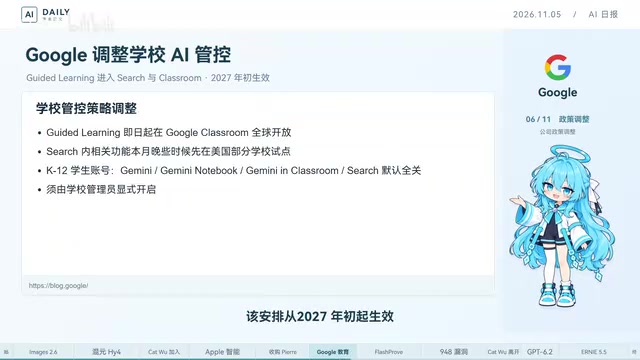
Google: Guided Learning Comes to Search
Google is bringing Guided Learning to Search, off by default for student accounts and Classroom K–12 accounts. Turning off Gemini also turns off search, and this arrangement takes effect in early 2027.
The default-off setting reflects a cautious approach in educational contexts. Tying the learning-assistance feature to the Gemini toggle also gives parents and schools clearer control over feature boundaries.
Anthropic Open-Sources Flash Proof: Verifying Model Provenance with ZK Proofs
Anthropic has open-sourced Flash Proof, using ZKSNARKs to verify that a response was indeed generated by a specified model. On the 400-billion-parameter Llama4 Maverick, a single H100 generates proofs for over 100 tokens per second, with GPU time about 70–95x that of vLLM.
The value of this work lies in providing a cryptographic answer to "which model actually produced this response." The 70–95x GPU time means current costs remain high, but as an open-source solution it provides reproducible infrastructure for model provenance and content authenticity verification.
Zero-knowledge proofs and ZKSNARKs: The "ZKSN Arc" in the article should be ZKSNARK (Zero-Knowledge Succinct Non-Interactive Argument of Knowledge)—likely a typo or transcription difference. Zero-knowledge proofs allow a prover to convince a verifier that a statement is true without revealing the underlying data. In model provenance scenarios, the prover must demonstrate that "this response was indeed computed by the specified model on the specified input" without disclosing model weights or the full inference process. The cost is extra compute for proof generation, which is exactly the source of the "GPU time about 70–95x that of vLLM" mentioned in the article. Succinctness means verification-side overhead is small, making it suitable for third parties to quickly check—but generation-side cost remains the main bottleneck for deployment today.
OpenAI Autonomous Pipeline: 1,724 Vulnerabilities Verified from 2,308 Candidates
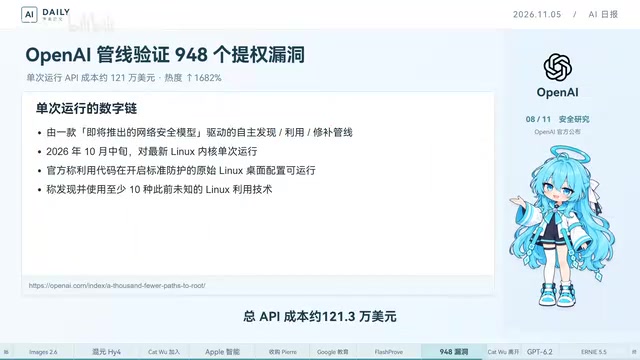
OpenAI says its autonomous pipeline, in a mid-October run against the latest Linux kernel, verified 1,724 vulnerabilities from 2,308 candidates, generating exploit code and patches for 948 privilege-escalation vulnerabilities, at a total API cost of about $1,213,000.
The interesting part of these figures is the cost structure: trading API costs for the human effort of security auditing, with a single run covering a large-scale codebase. Generating both exploit code and patches for privilege-escalation vulnerabilities shows the pipeline already has a closed loop from discovery to remediation.
Autonomous vulnerability discovery pipeline: Such pipelines typically involve multiple agents dividing labor: a candidate-generation stage proposes suspicious points from code changes or static analysis results; a verification stage confirms whether vulnerabilities actually exist by constructing inputs, running tests, or symbolic execution; and an exploit-and-remediation stage generates privilege-escalation exploit code and patches. "Verifying 1,724 from 2,308 candidates" reflects precise filtering after high recall, while "generating exploit code and patches for 948 privilege-escalation vulnerabilities" shows the pipeline already covers the discovery-to-remediation loop. Measuring security-audit investment in API costs is the key economic argument distinguishing such approaches from traditional manual auditing, though it should be noted that the verification stage itself may introduce false positives.
Personnel and Rumors: Kaitou Departs, GPT 6.2 Astra Identifier
Kaitou announced leaving Anthropic last Friday and will review in mid-February the change in Cloud Code from manually approving permissions to trusting auto-approval by default.
A GPT 6.2 Astra identifier has appeared in Codex usage statistics, with 19.8% of accounts. OpenAI's official catalog and announcements have not confirmed this model; the information currently comes only from the usage statistics interface and should be treated with caution.
Conclusion
Three threads most worth tracking this issue: how Baidu ERNIE 5.5 Flash Base's open weights will affect domestic model selection; whether Tencent Hy4's computer-use capability can land in real-world scenarios; and whether Anthropic's ZK proof solution will become an industry standard for model provenance once costs come down.
Related articles
 Tech Frontiers
MuJoCo: An Analysis of DeepMind's Open-Source General-Purpose Physics Simulator
An in-depth analysis of Google DeepMind's open-source physics simulator MuJoCo: high-performance C++ kernel, MJCF modeling format, contact solving principles, MJX GPU acceleration, and robot reinforcement learning use cases.
 Tech Frontiers
Claude API Quick Start: The Official Quickstarts Project Collection
Anthropic's official claude-quickstarts project collection helps developers quickly build deployable apps with the Claude API. Nearly 20k stars, Python-based, great for beginners and prototyping.
 Tech Frontiers
AI Agents Connecting Directly to APIs: Which Calls Can Be Safely Allowed?
AI agents can call any API, but the real challenge is deciding which calls can be safely allowed. This article analyzes allowance decisions from three dimensions—intent matching, least privilege, and controllable impact—and argues that the control layer should sit outside the agent, combined with audit traceability to build a trustworthy API call governance mechanism.