Claude Code Multi-Session Upgrade, Copilot Multi-Model Collaboration, Step 5 Weights Released

AI Daily: Coding and document tools move toward multi-session, multi-model collaboration; multiple models open weights with varying licenses and deployment thresholds.
This AI Daily rounds up several technical developments. Claude Code desktop supports multi-session parallelism, saving folders, SSH hosts, and cloud as environments for quick launch, with side tasks handled in separate tabs. GitHub Copilot's Hydra Fusion drafts with a medium-reasoning model, reviews with a high-intensity reasoning model, and uses tools to check files; it remains in research preview with separate billing. Google Deep Review audits complex documents through segmentation, parallel Agent verification, and cross-chapter consistency checks, free for two files per week but retaining files for one year. Several OpenAI GPT-4 series APIs will close on January 14, 2027, with fine-tuned versions closing the same day and migration to GPT-6 Luna recommended. StepFun Step 5 Preview and Ant Link 3.1 Flash open weights with 600B/27B and 560B/25B total/activated parameters respectively, with differing licenses and deployment thresholds. There is also news of Skywork's game generation framework and the Apple Intelligence China beta.
Today's AI Roundup: Dense Updates from Coding Tools to Model Ecosystem
This edition of the AI Daily covers progress across developer tools, model collaboration, document review, API lifecycle, and open weights. Claude Code's desktop multi-session capability, GitHub Copilot's multi-model fusion, Google's Deep Review, OpenAI's API retirement plan, StepFun's Step 5 Preview weights, Ant's Link 3.1 Flash, and Skywork's game generation framework make up today's notable technical developments.
Claude Code: Desktop Multi-Session Interface
Claude Code's desktop app has upgraded to a multi-session interface. Recent folders, SSH hosts, and the cloud can now be saved as environments to quickly launch tasks. Multiple parallel tasks each open their own independent session and report results back to the main session when complete. Side questions can also be handled in separate tabs while the main task continues without interruption.
The practical significance of this change is that developers can manage "exploratory tasks" and "mainline tasks" separately. In the past, repeatedly switching context within a single session could easily cause the model to lose focus; now, with tabs and a main-sub session structure, parallel progress on complex engineering becomes more controllable. For teams that need to handle multiple repositories or remote hosts simultaneously, the environment-saving feature also reduces the cost of repeated configuration.
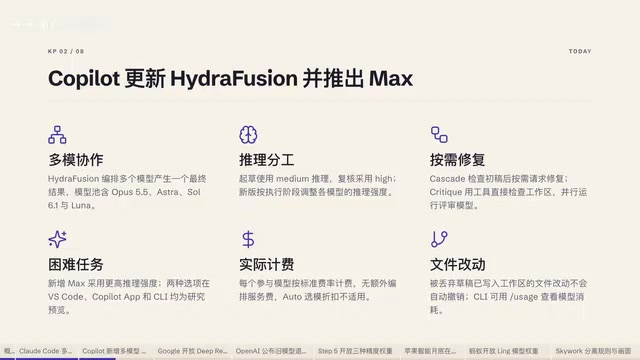
Copilot Hydra Fusion: Multiple Models Collaborate on a Final Result
GitHub Copilot's Hydra Fusion lets multiple models collaborate to produce a single final result. The updated flow is: a medium-reasoning model drafts, a high-intensity reasoning model reviews and uses tools to check actual files, and lightweight-enhanced Max targets more complex tasks. Both modes are still in research preview, and participating models are billed separately.
One detail to note: file changes left behind by discarded drafts are not automatically reverted. This means that while multi-model collaboration improves result quality, developers need to clean up intermediate artifacts themselves. From a billing perspective, multi-model involvement also means a more complex cost structure, which teams should factor in when evaluating whether to enable it.
Common patterns of multi-model collaboration (model fusion/cascading)
The description for Hydra Fusion—"a medium-reasoning model drafts, a high-intensity reasoning model reviews and uses tools to check actual files"—is a typical pattern of model cascading and multi-agent collaboration: using low-cost models for high-token-volume initial drafting, and high-capability models for review and error correction, thereby balancing quality and cost. The key design points of such architectures are: how artifacts are passed and rolled back between drafting and review, whether tool calls are based on actual file state (rather than model memory), and how each participating model is billed. The mentioned issue that "discarding a draft does not automatically revert file changes" is precisely a manifestation of missing state management in the cascading flow; in practice, version control or isolated workspaces are needed as a safeguard.
Google Deep Review: Logic and Fact Verification for Complex Documents
Google has made Deep Review public for checking the logic and factual basis of complex documents. Its flow is: first segment and allocate computation, then have different Agents verify in parallel, and finally check cross-chapter consistency. Two PDFs or plain text files can be checked free each week, and high-volume usage can connect to your own Gemini API. Uploaded files are not used for training, but are retained for one year for users to view in the interface.
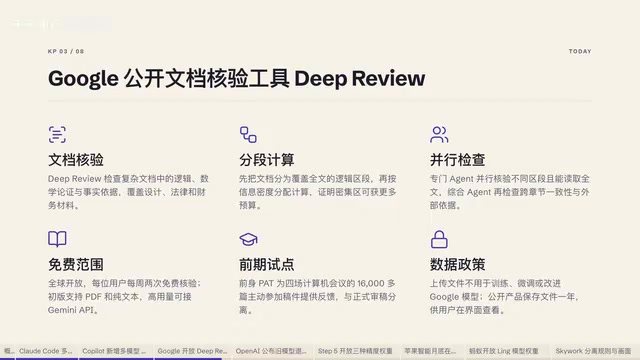
Cross-chapter consistency is an easily overlooked aspect of long-document review. Manual review often catches single-sentence errors but struggles to track contradictions across sections. Deep Review hands this step to parallel Agents plus a final consistency check, targeting a real pain point. However, the one-year file retention policy means users handling sensitive documents should confirm compliance requirements in advance.
OpenAI API Retirement Timeline
OpenAI has announced that several GPT-4 series APIs will be shut down on January 14, 2027, including specified GPT-4O and GPT-4.1 snapshots, with fine-tuned versions closing on the same day. The recommended replacement is GPT-6 Luna. These APIs are currently still in the deprecation transition period. Additionally, GPT-5.5 has exited ChatGPT, while the Codex API for GPT account login is unaffected.
For teams still calling old snapshots in production, the transition period is the migration window. The same-day closure of fine-tuned versions deserves special attention, since migrating fine-tuned models is usually more time-consuming than general models.
API snapshots, deprecation transition periods, and fine-tuned model migration
OpenAI's "snapshot" refers to a fixed model version with a date identifier, such as specific snapshots of GPT-4O and GPT-4.1. APIs point to specific snapshots rather than "the latest model" over the long term to ensure reproducible behavior; once a snapshot is retired, callers must explicitly switch to a new model. The deprecation transition period is the official migration window, during which old snapshots remain usable but no longer receive updates. The same-day closure of fine-tuned versions is especially tricky: migrating a fine-tuned model is not just changing the model name—it requires re-preparing training data on the new base, re-running fine-tuning, and re-evaluating results, typically taking weeks. Therefore, for production systems, teams should inventory call lists early, establish model version and evaluation baselines, and incorporate migration into regular release processes rather than waiting until the deadline approaches.
StepFun Step 5 Preview Weights Released
StepFun today released the weights of Step 5 Preview, a multimodal model for coding and professional work with 600 billion total parameters, 27 billion activated per pass, a shared input/output window of about 1 million tokens, and FP8 deployment starting from 4 B300 or 8 H200 GPUs, with additional VRAM reserved for context. Uses such as commercial integration by hardware vendors require separate authorization under the license.
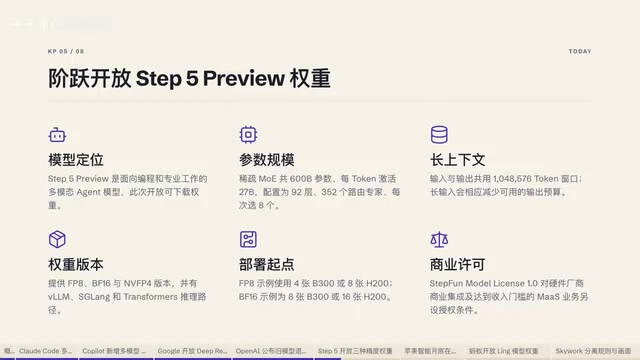
A million-token window combined with FP8 deployment points to long-context professional workloads. The starting configuration of 4 B300 or 8 H200 GPUs indicates that its target users are enterprises and integrators with some compute foundation, not individual developers. Commercial integration requiring separate authorization also shows that open weights do not equal unconditional commercial use.
Mixture-of-Experts (MoE) architecture and "total parameters/activated parameters"
The "600 billion total parameters, 27 billion activated per pass" of StepFun Step 5 Preview and the "560 billion total parameters, 25 billion activated parameters" of Ant Link 3.1 Flash both describe the Mixture-of-Experts (MoE) architecture. In MoE, the model consists of multiple "expert" subnetworks plus a routing network; for each input token, the router selects only a few experts to participate in computation. Thus the total parameter count determines the model's "knowledge capacity," while the activated parameters actually involved in each computation determine inference compute cost. This is why these two models have total parameters in the hundreds of billions yet inference overhead close to that of dense models with tens of billions of parameters. Understanding this distinction is necessary to correctly interpret the subsequent deployment thresholds: VRAM must hold all weights (total parameters), while compute throughput depends on the activated portion.
FP8 deployment and VRAM estimation
The article mentions that Step 5 Preview's "FP8 deployment can start from 4 B300 or 8 H200 GPUs, with additional VRAM reserved for context." FP8 is an 8-bit floating-point low-precision format that can halve weight VRAM usage compared with BF16/FP16, and is a commonly used quantization deployment method for large model inference today. Roughly estimating at about 1 byte per parameter for FP8, 600 billion parameters of weights require approximately 600GB of VRAM; adding KV Cache (which grows linearly with context length) and runtime overhead is what necessitates multi-GPU configurations. This explains why a million-token window must reserve VRAM separately, and also shows that the deployment threshold for such models is determined primarily by VRAM capacity rather than peak compute.
Ant Link 3.1 Flash: Hybrid Attention Architecture
Ant has released the weights of Link 3.1 Flash, which uses a hybrid architecture of linear and full attention. The model card lists 560 billion total parameters and 25 billion activated parameters, with the license marked as MIT. The model card states a 1 million context, while the current configuration and deployment documentation say 256K has been verified; deployment includes 8 H200 or 4 GB300 GPUs, with additional speculative decoding support.
The MIT license is a relatively permissive choice among open-weight releases, and combined with the hybrid attention architecture, Link 3.1 Flash is positioned to balance efficient inference and long context. The discrepancy in context length between the model card and the deployment documentation (1 million vs. 256K) is worth noting: the former is a capability description, the latter is a verified configuration, and actual deployment should follow the documentation.
Linear attention and hybrid attention architectures
The "hybrid architecture of linear and full attention" adopted by Link 3.1 Flash targets the problem that standard Transformer attention's compute and VRAM overhead grow quadratically with sequence length in long contexts. Linear attention approximates softmax attention with decomposable kernel functions, reducing complexity to linear in sequence length, but loses some precise retrieval capability; full (softmax) attention preserves precise long-range dependency modeling. Hybrid architectures alternate the two across layers or heads, using a small number of full attention layers to ensure key information retrieval and linear attention layers to amortize long-sequence costs. This is one of the mainstream routes for current long-context models to compromise between "capability" and "efficiency," and also explains why the million-level context claimed on the model card requires separate verification in the deployment documentation—the actual effective length of long context often depends on the combined effect of architecture and inference configuration.
MIT license and the boundaries of open weights
"Open weights" and "open source" are not synonymous. Open weights means model parameters can be downloaded, but the scope of use is defined by the license: MIT is a permissive license that allows commercial use, modification, and redistribution with only copyright notice retention; licenses like Step 5 Preview's "commercial integration requires separate authorization" are restricted open. When selecting models, one should distinguish among three dimensions: weight availability, commercial authorization scope, and redistribution conditions—they directly determine whether a model can be embedded in products or provided as a service.
Skywork Matrix Game 4.0: Separation of Rules and Visuals
Skywork has released Matrix Game 4.0, which separates game rules from AI visuals. The game engine manages physics, controls, and state, while the video model renders simplified visuals into detailed visuals. This release opens the inference code and browser demo for three scenarios, with two presets using different deployment methods.
The idea of separating rules from rendering reduces the burden on video models in game generation: state and physics are handled by a deterministic engine, and visuals are completed by a generative model. This is more controllable and easier to debug than having a single model generate an entire game end-to-end.
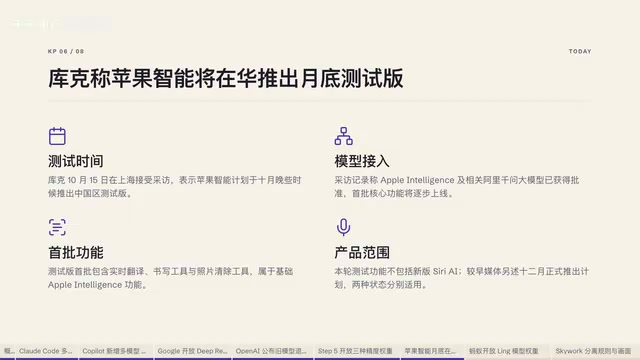
Apple Intelligence China Beta
Speaking in Shanghai, Cook said Apple Intelligence will launch a China beta in late October, initially including real-time translation, writing, and photo cleanup, integrated with Alibaba's Qwen model. The new Siri AI is not part of this batch. The end-of-month beta also does not equal a full official launch.
The boundaries of this news need to be clear: the beta covers limited features, Siri's AI upgrade has a separate timeline, and the beta scope differs from the official launch scope. For readers following the pace of on-device AI rollout, this is a variable worth tracking.
Summary
Today's updates present two main threads: first, coding and document tools are evolving toward multi-session, multi-model collaboration, emphasizing parallelism and review; second, model weights continue to open up, but license terms and deployment thresholds vary. When selecting models, developers should consider not only parameters and context but also billing methods, license scope, and verified configurations.
Related articles

Diving into PostgreSQL Internals: A Free, Open-Source Guide to Database Principles
*The Internals of PostgreSQL* is a free online book covering process architecture, storage layout, query processing, MVCC concurrency control, and WAL logging—ideal for DBAs and backend engineers who want to understand database internals.

Hinton Warns Again: We Might Be Better Off Without AI
Geoffrey Hinton's remark that we might be better off without AI sparks Hacker News debate. This article analyzes the two layers of meaning, the shift in tech community attitudes, and counterarguments questioning the "better off" baseline—plus what it means for AI practitioners.

Why The Legend of Zelda: Ocarina of Time Never Fades
Why is The Legend of Zelda: Ocarina of Time still a classic after all these years? This article analyzes its paradigm revolution from 2D to 3D, its relationship with Breath of the Wild, and why its design philosophy remains timeless.