Claude Code v2.1.316 Update Analysis: Enterprise Gateway and Multiple Stability Fixes
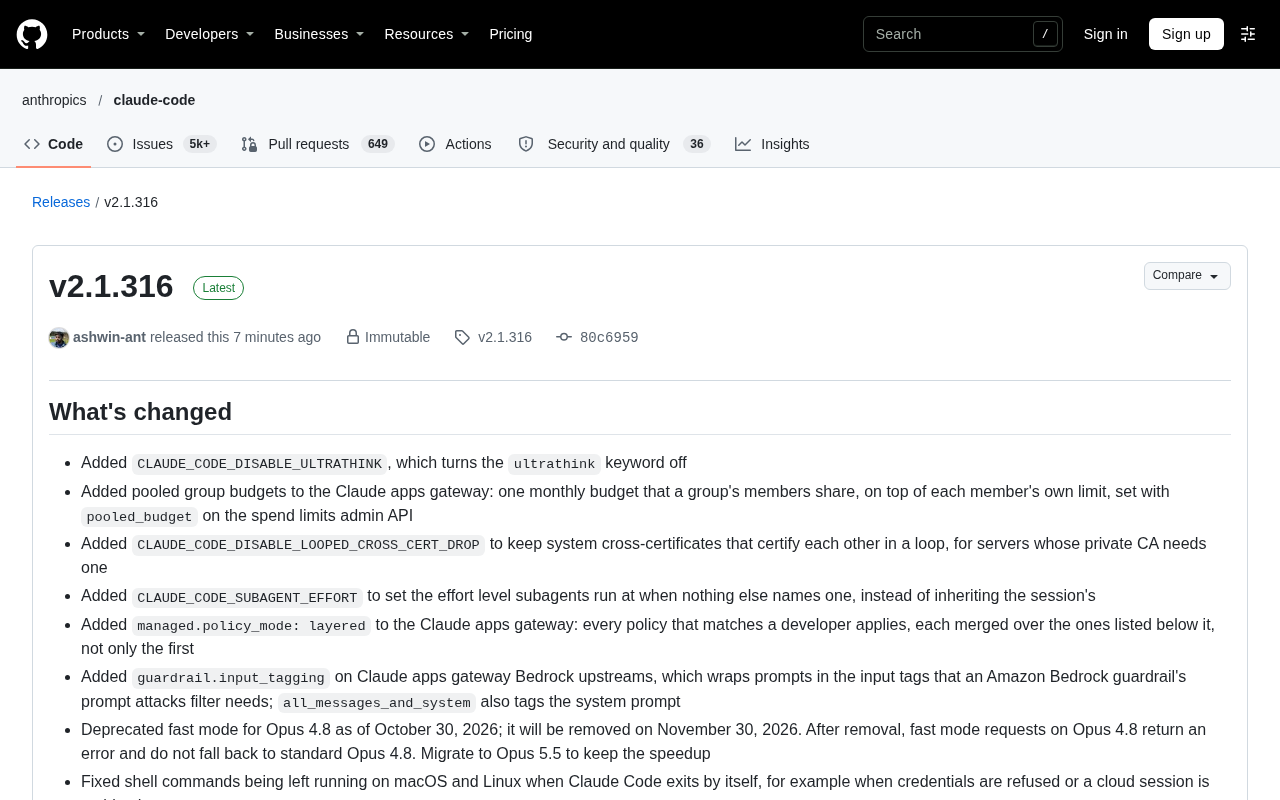
Claude Code v2.1.316 strengthens enterprise gateway budgets and policy governance, and concentrates dozens of stability fixes.
Claude Code released v2.1.316 without disruptive features, focusing on dense patches for enterprise gateway, multi-agent collaboration, and cross-platform stability. The gateway adds pooled group budgets and layered policies, plus Bedrock guardrail input tagging and clearer SSL certificate error messages. Subagents gain the CLAUDE_CODE_SUBAGENT_EFFORT variable for finer effort control, while Opus 4.8 fast mode is deprecated and will be removed on November 30, requiring migration to Opus 5.5. Fixes span shell command residue, Bash aliases, PowerShell hooks, model fallback, session recovery, hanging network requests, model allowlist validation, cloud session form cards, and Slack participation. The overall signal is Claude Code evolving from a personal coding assistant toward team-level infrastructure.
Claude Code v2.1.316 Update Analysis: Enterprise Gateway and Multiple Stability Fixes
Anthropic has pushed the v2.1.316 update for Claude Code. This release doesn't introduce disruptive features, but it makes dense patches across enterprise gateway, multi-agent collaboration, and cross-platform stability, covering dozens of additions, fixes, and improvements. For teams incorporating Claude Code into their daily development workflow, several changes deserve close attention.

Enterprise Gateway Capabilities Enhanced
This update significantly strengthens support for enterprise use cases. Claude apps gateway adds pooled group budgets: on top of each member's own quota, a monthly budget shared by group members can be set, configured via the pooled_budget field of the spending limit management API. This provides more granular control for organizations that need to account for AI coding costs by team.
The gateway also adds a managed.policy_mode: layered policy mode. Previously only the first matching policy might take effect; now all policies matching the developer's identity are stacked and merged in sequence, with later policies overriding earlier settings, significantly improving the flexibility of policy orchestration.
For Amazon Bedrock upstreams, a new guardrail.input_tagging configuration is added, which can wrap prompts in the input tags required by Bedrock guardrails' prompt attacks filter; the all_messages_and_system option also tags the system prompt. SSL certificate error messages are also improved, pointing out possible causes such as missing intermediate certificates and offering remediation suggestions.
Claude apps gateway is a gateway-layer component Anthropic offers for enterprise deployments, sitting between clients and model upstreams (such as Anthropic API, Amazon Bedrock, Vertex AI), responsible for unified authentication, policy distribution, model access allowlists, and cost accounting. It enables enterprises to centrally control which models are available, which requests are blocked, and how costs are attributed to teams or projects, without modifying each developer's local configuration. For organizations using managed settings, the gateway is the enforcement point where policies actually take effect, so the changes around budgets, policy merging, and model allowlists in this release have a larger real-world impact than they appear.
Finer-Grained Subagent and Effort Control
Multi-agent collaboration is an important capability of Claude Code. This release adds the CLAUDE_CODE_SUBAGENT_EFFORT environment variable, allowing the effort level for subagent execution to be set when no other specification is given, rather than simply inheriting the session's settings. Combined with the VSCode extension's ultrathink now running at xhigh effort and displaying a rainbow effect, the effort control chain is more complete.
Another notable change: fast mode for Opus 4.8 is deprecated as of October 30 and will be removed on November 30. After removal, fast mode requests to Opus 4.8 will error out directly rather than falling back to standard mode; the official recommendation is to migrate to Opus 5.5 to retain the speed advantage. Teams using older models need to plan their upgrade path in advance.
Effort level refers to the reasoning/thinking budget tier a model invests before generating a response; higher tiers mean the model spends more time and tokens on complex tasks, typically yielding better output quality at the cost of higher cost and latency. In Claude Code, different entry points can specify effort, such as session-level settings or specific trigger words. The newly introduced CLAUDE_CODE_SUBAGENT_EFFORT matters because subagents often handle relatively mechanical tasks like retrieval and batch modifications; if they all inherited the main session's high effort setting, it would cause unnecessary overhead. Setting a separate default allows the main session and subtasks to each use the appropriate tier.
Concentrated Cross-Platform Stability Fixes
The bulk of the release notes are various bug fixes, covering the CLI, VSCode extension, cloud sessions, and Slack integration.
Terminal and Shell level: Fixed an issue where shell commands left running on macOS and Linux when Claude Code exits on its own; fixed aliases with newline values in the Bash tool and function names starting with a hyphen being corrupted or lost; fixed an anomaly where Bash scripts stopped after executing the first command when SHELLOPTS was exported; fixed PowerShell hooks failing to block with exit code 2 under certain command prefixes.
Model and session level: Fixed an issue on Vertex AI and Amazon Bedrock where sonnet, opus, and haiku errored mid-session instead of switching to an older model when the new model was not yet available; fixed a rare case where the plan was not restored when resuming a session; fixed an issue where a subagent inheriting the parent's model incorrectly switched to the main model when woken by a background task.
Network security and authentication: Fixed some network requests hanging when compressed responses were truncated or corrupted; the gateway now checks whether every model mentioned in a request is within lists such as availableModels, returning 400 with the field indicated when a blocked model is hit; claude auth login no longer refuses to run when managed settings require gateway use, but instead shows the gateway login entry in the terminal.
SHELLOPTS is a built-in read-only variable in Bash that reflects the set of options currently enabled in the shell (such as errexit, pipefail). When it is exported to a child process environment, some Bash versions re-parse the variable during startup; if it contains incompatible or invalid option combinations, the script may exit abnormally after executing the first command. This fix targets exactly this kind of hidden failure caused by environment inheritance—it typically only reproduces under specific shell versions and specific export combinations, making it costly to troubleshoot, a classic "long-tail stability" issue.
Cloud Session and Slack Experience Improvements
On the cloud session side, a new form card is added, allowing form requests initiated by MCP servers to be filled out or rejected by users rather than being silently canceled; a "Catching up…" status line is added when switching back to a cloud session or Remote Control session; enterprise members can now add and remove network keys in their own cloud environments instead of only viewing them.
How Claude Tag participates in Slack has also been adjusted: the original "auto-reply" toggle in channels is changed to a "How Claude participates" option on the Configure page. Fixes also address issues such as Claude refusing to edit a canvas after it is shared to another channel, and unanswered replies in Slack Connect threads when not marked.
Impact on Developers
This update sends a clear signal: Claude Code is evolving from a personal coding assistant toward team-level infrastructure. Changes like pooled budgets, layered policies, and managed settings taking effect without approval are all driven by enterprise governance needs; while the many fixes at the shell, network, and session-recovery levels are filling in long-tail stability gaps.
For everyday users, the most direct action is to check whether they still rely on Opus 4.8 fast mode and complete the migration before the deadline. For team administrators, it's worth evaluating whether the new layered policies and pooled budgets can simplify existing permission and cost management workflows.
One-line Summary
Claude Code v2.1.316 strengthens enterprise gateway budgets and policy governance, and concentrates dozens of stability fixes.
Paragraph Summary
Claude Code released v2.1.316, without disruptive features, focusing on dense patches for enterprise gateway, multi-agent collaboration, and cross-platform stability. The gateway adds pooled group budgets and managed.policy_mode: layered policies, and supports Bedrock guardrail input tagging and clearer SSL certificate error messages. On the subagent side, the new CLAUDE_CODE_SUBAGENT_EFFORT environment variable enables finer effort control; meanwhile Opus 4.8 fast mode is deprecated and will be removed on November 30, requiring migration to Opus 5.5. Fixes cover residual shell commands, Bash aliases and PowerShell hooks, Vertex AI and Bedrock model fallback, session recovery, hanging network requests and model allowlist validation, as well as cloud session form cards and Slack participation. The overall signal is that Claude Code is evolving from a personal coding assistant toward team-level infrastructure.
Related articles

Anthropic IPO Explained: Fuel for the AI Boom or the Spark for a Bubble?
Anthropic files for an IPO under ticker ANT. Breaking down the prospectus: 80% of revenue from usage-based pricing, $72B of an $80.7B net loss being non-cash charges, 900% net revenue retention, and how past IPOs like SpaceX performed on day one and over three years — answering the AI bubble question.

Will AI Kill the Research Paper? Mathematicians Offer a New Answer
Mathematicians on the Lex Fridman podcast discuss whether AI will kill research papers—from journal review pressure to Lean formal verification, GitHub open source fatigue to Mathlib's crowdsourcing model, exploring the evolution of academic contributions and the future of mathematical knowledge verification.

Enterprise LLM Development: From RAG to Multi-Agent in Practice
A course breakdown of enterprise LLM application development: from prompt engineering and RAG to multi-agent engineering practice and FDE project delivery, helping developers understand why Agent technology is a key focus for enterprise deployment and learn systematically to avoid detours.