Claude Duet Proactive Agent Launches, OpenAI Discovers Decade-Old PHP Vulnerability
Anthropic opens proactive agent Claude Duet, OpenAI and Wiz disclose a 14-year-old PHP core flaw, and AI proves the KLS conjecture.
The article rounds up several major AI industry developments in a single day. Anthropic opened a research preview of Claude Duet, a proactive agent powered by Opus 5.5 that flags items, keeps working after the user leaves, and confirms before acting on the user's behalf; it is limited to US Pro and Max users and doesn't count against weekly quota. On security, OpenAI and Wiz independently discovered PHP2 Shell, a PHP core memory safety flaw enabling unauthenticated remote code execution and affecting every PHP version of the past decade; patches were released October 21. Recursive also released local coding model Flint, a Microsoft Research team proved the 1995 KLS conjecture, and Wiz disclosed a malicious LiteLLM version uploaded to PyPI. The article notes that proactive agents and security offense-defense are accelerating in tandem, with permission boundaries and patch deployment as the key issues today.
Claude Duet Proactive Agent Launches, OpenAI Discovers Decade-Old PHP Vulnerability
The AI industry released a dense cluster of major developments in a single day: Anthropic opened a research preview of its proactive agent Claude Duet, OpenAI partnered with Wiz to disclose a PHP core vulnerability with an extremely broad impact, and AI notched a conjecture in mathematics that had been unresolved for nearly three decades. These events point respectively to the agent interaction paradigm, software supply chain security, and AI-assisted research—each worth unpacking in turn.
Claude Duet: When AI Starts Reaching Out to You
According to reports from the Bilibili AI news channel, Anthropic officially announced the research preview of Claude Duet, a new application that lets Claude work as a proactive agent. Its behavior model differs fundamentally from existing conversational products: it proactively flags items that need attention, completes tasks the user assigns, continues working after the user leaves, and confirms with the user before acting on their behalf.
Duet is powered by Opus 5.5, and the company emphasizes that this gives it solid judgment—the ability to distinguish which matters require user handling, which aren't urgent, and when it should check in with the user first. On the memory and tools front, Duet carries over the memories, skills, and connected apps already in the user's Claude account, requiring almost no additional configuration.
The product is currently an early research preview, available through a waitlist to Pro and Max subscribers in the United States, with the Pro tier at $20. Interestingly, Duet doesn't consume the weekly usage quota—an appealing detail for heavy users.
The community's jokes are also entertaining: will a Personal Agent that proactively reaches out even turn account suspension notices into AI voice announcements? Behind the joke lies a real question—once agents gain the power to act proactively, permission boundaries, confirmation mechanisms, and explainability will become the keys to whether the product can be trusted. Duet's requirement to confirm before acting is a direct response to that concern.
OpenAI and Wiz Team Up: A PHP Vulnerability Dormant for 14 Years
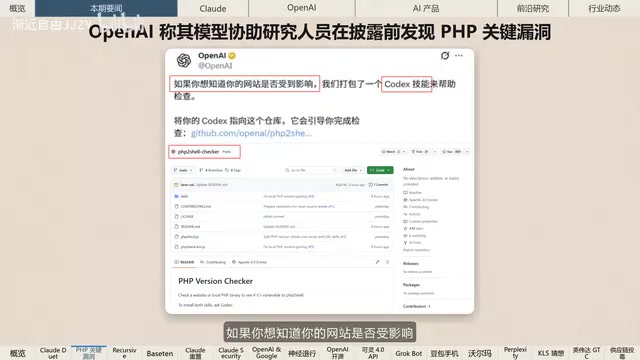
According to public information from OpenAI and Wiz Research, the GPT-5.6 series models, under the Patch the Planet initiative, helped researcher Calif discover a severe vulnerability in PHP core. Wiz independently discovered and reported the related vulnerability as well, naming it PHP2 Shell.
Two independent sources cross-validating the same set of vulnerabilities significantly raises the credibility of this disclosure. Both descriptions point to multiple memory safety vulnerabilities in the PHP core engine that can lead to unauthenticated remote code execution and memory leaks. The impact scope is striking: it traces back at least to PHP 5.4, every PHP version released in the past 10 years is affected by at least one of them, and the vulnerabilities have existed for 14 years. Wiz Research calls it one of the most severe vulnerabilities in software history.
The remediation process is likewise a model of multi-party collaboration. Over the past two months, OpenAI led an alliance of maintainers, researchers, and security vendors to complete fixes before public disclosure, involving major changes to the PHP engine. PHP maintainers released patches on October 21.
Ordinary developers can use the Codex skill PHP2 Shell Checker to check whether their sites are affected. OpenAI has pledged subsidies to support resource-constrained defenders, open-source maintainers, and critical infrastructure. Given PHP's ubiquity in website tech stacks, the speed of patch deployment will directly determine the actual risk exposure.
The PHP core engine has long been implemented in C, with memory management relying on reference counting and manual allocation and deallocation. Memory safety vulnerabilities typically include out-of-bounds reads and writes, use-after-free, and double free, which attackers can exploit to overwrite critical data structures and hijack program execution flow. PHP runs in a short-lived "request-response" lifecycle, so once a vulnerability is triggered during request parsing, an attacker can execute arbitrary code on the server without any credentials—a severity level close to maximum. PHP 5.4 was released in 2012, meaning this code has persisted in large numbers of legacy systems still online, and the PHP ecosystem's willingness to upgrade is generally low—the root reason this vulnerability stayed dormant for 14 years yet has an extremely broad impact.
Local Coding Models and Open-Source Decision Models Arrive in Force
Recursive released its first model, Flint, built by the automated research system Eureka Machine and positioned as a fast local coding model. According to official figures, Flint approaches the performance of Qwen 3.8 27B while being 3-6x faster; on agentic coding benchmarks such as SWE Bench Pro, VR Verified, and Terminal Bench 2.1, it is the best-performing MoE model under 50B in its class, with speeds up to twice those of peers. It reaches 125+ tokens per second on a MacBook Pro and 150+ tokens per second on RTX Spark.
Basic Research Lab released the open-source decision models Mammoth E27B and Elephant E9B, post-trained on 6.21 million decision samples based on Qwen 3.5-27B and 3.5-9B. They are free to use for one week on the Base Saturn Model API, with zero data retention by default.
AI Proves the KLS Conjecture: A New Landmark in Mathematics
A team at Microsoft Research proved the Kannan-Lovasz-Simonovits conjecture, proposed in 1995. The result shows that the gap between the optimal hyperplane cut and arbitrary-shape cuts for log-concave distributions does not grow with dimension and is bounded by a universal constant.
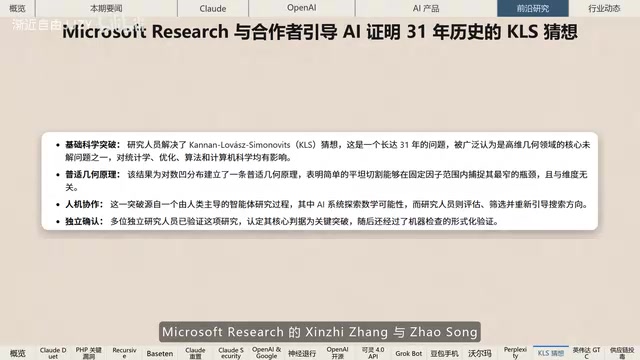
The significance of this result is that it turns a long-dormant theoretical question into a citable quantitative conclusion, with potential impact on algorithm design and high-dimensional geometry research. AI-assisted mathematical proof has made repeated progress in recent years, but results genuinely accepted by the academic community remain scarce; if the proof of the KLS conjecture passes peer review, it will be a landmark case for AI for Science.
The KLS conjecture originates from algorithmic research on computing the volume of convex bodies in computer science. The core question is: for a "log-concave" high-dimensional distribution, when a plane cuts it in two, can one find a cut that balances the volumes of the two halves as evenly as possible, and is this degree of balance independent of the shape of the cutting surface? The conjecture asserts that there is a universal upper bound on the gap between the optimal hyperplane cut and arbitrary-shape cuts that does not grow with dimension. This property directly relates to the complexity of sampling, integration, and volume estimation algorithms in high-dimensional spaces; if the gap exploded with dimension, many algorithms would lose their theoretical guarantees. Thus the proof of this conjecture is not only a geometric result but also provides a dependable quantitative tool for high-dimensional algorithm design.
Ecosystem Moves: Security, Cloud, and Multimodal Capabilities
On the security side, Wiz disclosed that on October 21 a malicious version, LiteLLM 1.107.0, was uploaded to PyPI, with related GHCR and Docker Hub image tags also compromised; these were subsequently quarantined and removed. The most recent secure version is 1.106.2. This is a reminder for teams to pin versions and verify sources across the dependency chain.
Claude Security now continuously follows code repositories as code changes, tracks discovered issues through to remediation, learns from context supplied by the team, and connects tools via API and MCP. It is available in public beta to Claude Enterprise customers.
On cloud and model distribution, OpenAI and Google Cloud reached a partnership to bring frontier models and Codex agent workflows into Google Cloud's Model Garden. Customers can purchase through the Marketplace and offset costs with GCP spending commitments. Google Cloud becomes the only major cloud provider offering Gemini, Claude, and OpenAI models simultaneously on a single platform.
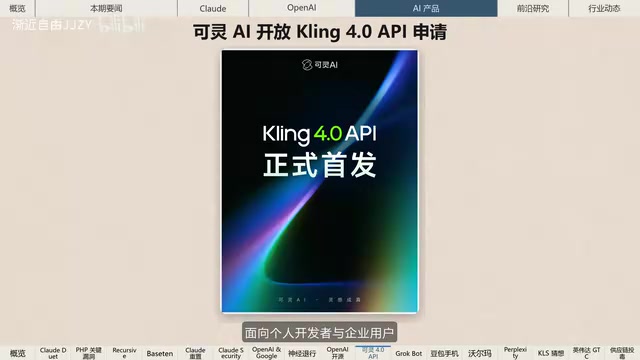
The application layer is equally busy: the Kling 4.0 API opened applications and is already live on Runway, with new Max or Team subscribers getting 3 days of unlimited access; Morphic integrates Kling 4.0; Grok Bot can directly generate daily reports, financial metrics, PRDs, UXR summaries, and research reports, with support for collaborative page editing and real-time updates; the Doubao phone assistant updated its list of apps it refuses to operate, restricting agent capabilities for financial apps such as banking, trusts, payments, and credit; Walmart launched a free agent gateway, a new MCP server that lets vetted AI agents access the platform to check inventory and place orders on users' behalf.
On NVIDIA's side, Jensen Huang said at GTC Berlin that all telecom operators will provide AI compute in the future, that telecom base stations are expected to evolve into distributed AI networks, and he reiterated the AI five-layer cake theory. NVIDIA also announced partnerships with multiple supply chain partners to expand substrate, advanced packaging, testing, and optical engine capacity, with substrate capacity to increase 2.5x over the next three years.
LiteLLM is a widely used open-source library for calling multiple LLM APIs through a unified interface, often deployed as a proxy layer between applications and model providers. Because it sits in the middle of the call chain, once malicious code is injected, attackers can intercept API keys, conversation content, and request metadata. In this incident, the attacker expanded the impact by publishing malicious version 1.107.0 and simultaneously poisoning container image tags—a typical software supply chain attack. Key defenses include: pinning dependencies to exact versions, enabling hash verification, avoiding pulling images with floating tags, and manually reviewing dependency updates in CI/CD.
Observation: Proactive Agents and Security Offense-Defense Are Accelerating in Tandem
Taken together, two main threads stand out clearly. One is agents moving from passive response to proactive action: Claude Duet, Walmart's agent gateway, and Doubao's financial app restriction list are all essentially answering the same question—how far should permissions go when AI acts on a user's behalf. The other is that the pace of security offense and defense is being accelerated by AI on both sides: OpenAI uses models to find vulnerabilities, Wiz independently verifies, and malicious LiteLLM packages are quickly quarantined—both attackers and defenders are using AI to compress response times.
For developers, the most practical short-term actions are two: confirm whether the PHP patch has been deployed, and check the dependency chain for suspicious versions. For product teams, the emergence of proactive agents like Duet means interaction design needs to rethink confirmation flows and exception notification mechanisms.
Related articles

Gemini 4 Carbon Tops Global Rankings as AI Productivity and Open-Source Ecosystems Surge
Google DeepMind's Gemini 4 Carbon tops global benchmarks, built for complex agents and system security. ByteDance launches Doubao Work integrated with Feishu, Anthropic's AI autonomously breaches 5 system-level attack chains, and ModelBest and Fudan open-source on-device multimodal and image generation models.

Overseas Creator Breaks Down N8n AI Agent Business Playbook: From Tooling to Monetization
An overseas creator breaks down the N8n AI agent business playbook: comparing Zapier, Make, and N8n, detailing four monetizable automation categories—lead capture, WhatsApp follow-up, booking, and content pipelines—plus agency pricing and a sales playbook.

Empacer: The Voice-First AI Assistant for Small Business Owners That Topped Product Hunt
Empacer is a voice-first AI assistant for small business owners: three-question setup, voice requests turned into customer replies, social posts, and invoices—all owner-approved. It won #1 Product of the Day on Product Hunt with 231 upvotes and 47 comments.