Claude Duet Research Preview Launches, Fable 5.5 Release Imminent | AI Daily

AI shifts from answering questions to getting things done, with permission boundaries and model-form divergence as two major trends.
Anthropic opens the Claude Duet research preview, where tasks can continue running in the cloud but irreversible actions like sending messages, making payments, and deleting require user approval; Fable 5.5 is about to launch, with beta feedback focused on intent understanding and style alignment but lacking reproducible evaluations; three OpenAI models enter Google Cloud Model Garden, with data staying within customer boundaries and not used for training; Ant Digital's LingDT makes decisions directly among given options and is claimed to save over 90% of tokens; China Telecom open-sources the Xingchen intent model, already deployed in customer service and smart speakers; ElevenLabs opens real-time speech translation in more than 90 languages to enterprises. Overall, agent permission design is becoming part of product definition, and model forms are diverging between general conversation and specialized decision-making.
Anthropic has opened a research preview of Claude Duet, OpenAI has integrated three models into Google Cloud, Ant Digital Technologies and China Telecom have each open-sourced an intent/decision model, and ElevenLabs has opened real-time speech translation to enterprise customers. Taken together, today's news points in the same direction: AI is shifting from "answering questions" to "getting things done for you"—and it's getting better at knowing where the boundaries lie.
Claude Duet: Keeps Running in the Cloud, Waits for Your Nod on Key Actions
The Claude Duet research preview that Anthropic opened this time is aimed squarely at the "proactive assistant" category—tools like MUSE and DOTS that have sparked discussion recently. According to Bilibili's AI Daily, Duet's approach is to first identify the tasks that need handling that day; after you close the app, the tasks keep running in the cloud, so you don't have to keep a window open and watch.
More importantly, the permission design: when it needs to send a message, make a payment, or delete something, it stops and waits for your approval.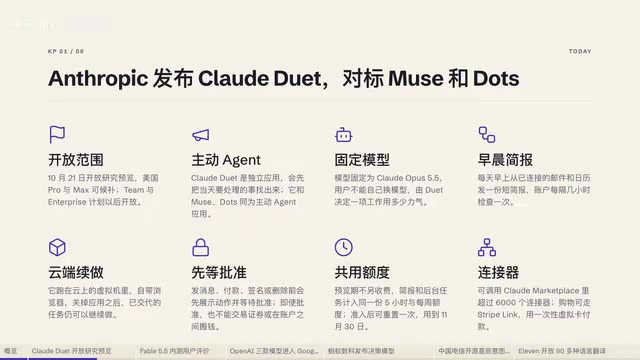
This detail deserves separate mention. The biggest controversy around proactive agents has never been whether they're capable enough, but what they can do when you're not present. By singling out "irreversible actions" for human confirmation, Duet effectively draws a line between capability and controllability: routine retrieval, organization, and follow-up can be delegated, but anything involving money or external communication must come back to a human. Defining this boundary at the research preview stage is far smarter than patching in permissions after the fact.
Proactive Agent differs fundamentally from traditional conversational AI: the latter requires users to initiate requests turn by turn, while the former can autonomously perceive its environment, break down goals, and continuously execute tasks—even if the user closes the app. MUSE, DOTS, and Claude Duet all belong to this paradigm. Enabling this capability depends on persistent cloud execution environments, task state management, and tool-calling orchestration. The core risk lies in "irreversible operations"—once an agent sends a message, completes a payment, or deletes data without supervision, errors cannot be rolled back. As a result, the industry is gradually reaching a consensus: automate reversible read operations, and introduce human-in-the-loop confirmation for irreversible write operations. This is both a safety boundary and a key dividing line in product design.
Fable 5.5 Release Imminent, Beta Feedback Centers on "Understanding Intent"
Another closely watched item is that Fable 5.5 is about to be released, and beta users have already tried it. From the feedback that has leaked, evaluations center on two points: it's almost capable of anything, and it has a very strong grasp of intent and taste.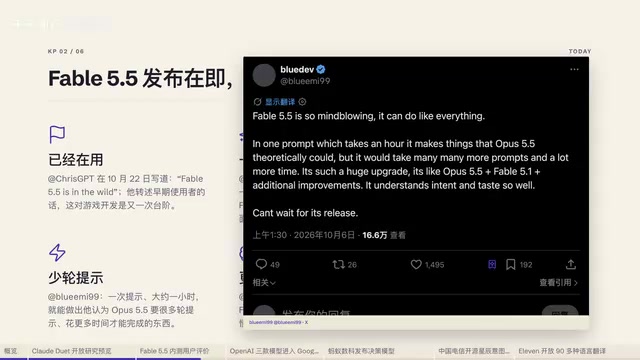
The phrase "understands taste" is unusual in model evaluations, but it points to a real shift—users' expectations of models have moved from "getting the right answer" to "answering the way I want." Behind this is improved intent understanding and style alignment, and it's the actual battleground for this generation of model competition. However, for now there are only subjective impressions from beta users, with no reproducible evaluation data; actual performance after the official release still needs to be observed.
Three OpenAI Models Enter Google Cloud Model Garden
Three OpenAI models are now available in Google Cloud Model Garden. Starting today, developers can connect this season's Codex to Google Cloud, with prompts and outputs staying within the customer-specified data boundary and not used to train models.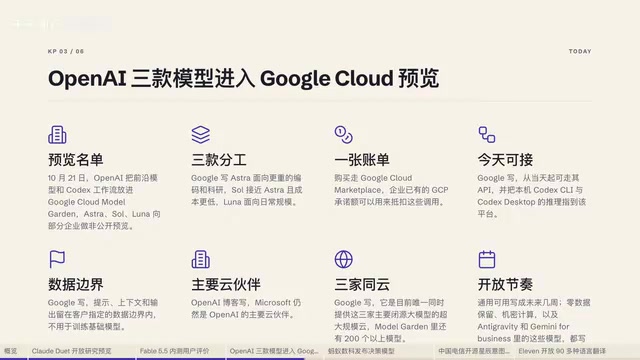
Cross-cloud deployment matters more to enterprises than to individual developers. Data not leaving the boundary and not being used for training are almost hard requirements when enterprises procure AI services. By placing its models on a competitor's cloud marketplace, OpenAI shows that competition at the model layer has spread from "who is stronger" to "who is easier to plug into existing infrastructure."
Google Cloud Model Garden is a model catalog and hosting service on Google Cloud where enterprises can discover, deploy, and call models from Google and third parties on the same platform. For model providers, joining means reaching enterprise customers who have already built infrastructure on Google Cloud, without requiring customers to migrate cloud environments. When procuring AI, enterprises typically require data residency and that customer data not be used to train models—both points are especially sensitive in multi-cloud deployment scenarios. OpenAI models entering a competitor's cloud marketplace reflects that the focus of competition at the model layer is shifting from benchmark scores to distribution channels and integration convenience—that is, "who is easier to plug into an enterprise's existing tech stack."
Ant Digital Technologies' LingDT: Skipping "Writing a Paragraph First"
The decision model LingDT released by Ant Digital Technologies takes a somewhat different approach from general-purpose large models. It judges directly among given options, skipping the step of first writing a passage of text and then parsing it; multiple items in a single sentence can be selected at once and then scheduled according to dependencies; the company claims that the same task can use more than 90% fewer tokens.
If the 90%-plus token savings hold up, it means order-of-magnitude changes in both cost and latency. The applicability of such "direct decision" models is narrower than general conversation, but in structured scenarios such as risk control, scheduling, and ticket dispatch, the efficiency advantage will be very obvious.
The difference between decision models and generative conversational models lies in the output space: general-purpose large models use natural language tokens as the unit of output, requiring them to first generate a passage of text and then have external logic parse the choices within it; decision models instead perform classification/ranking directly on a set of candidate actions or options, and the output is the structured decision result. This eliminates the encoding/decoding overhead of natural language and can significantly reduce token consumption and inference latency in tasks with limited options and clear dependencies (such as risk-control rule hits, ticket dispatch, and scheduling). The cost is a narrower scope—it is not good at open-ended generation, requires a predefined action space, and has limited generalization ability for unseen options.
China Telecom Open-Sources Xingchen Intent Model
China Telecom has open-sourced the Xingchen intent model. Give it a sentence and the fields to fill in, and it generates a result that can be passed downstream directly. Telecom customer service and smart speakers are already using it to recognize intent.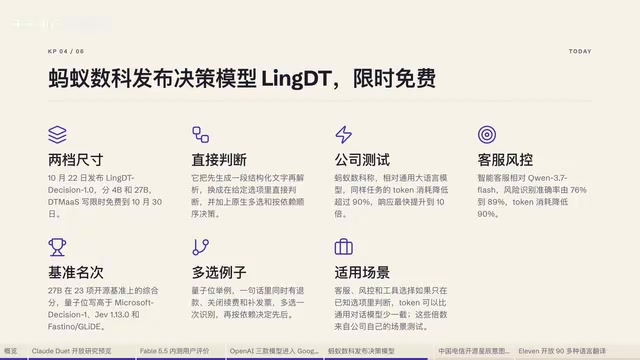
Intent recognition is the most tedious and most fundamental layer in dialogue systems, and for a long time companies have treated it as an internal asset not open to the public. By open-sourcing this layer, backed by validation in existing customer service scenarios, the operator offers a practical starting point for small teams building vertical applications—no need to label an intent system from scratch.
Intent Detection is the first layer of a dialogue system: mapping a user's utterance to a predefined intent category (such as "check balance" or "change plan") and extracting slot fields (slot filling) for downstream business systems to execute directly. It is usually implemented with classification models or sequence labeling models and requires large amounts of labeled data. For a long time it has been maintained internally by each company and not made public, because the intent system itself reflects business understanding. By open-sourcing this layer, the operator is effectively opening up intent classification capabilities validated in real customer service scenarios; small teams can adapt them to their domain on this basis without having to build a labeling system and train a classifier from scratch.
ElevenLabs Opens Real-Time Speech Translation
ElevenLabs has opened real-time speech translation to enterprise customers: each side speaks their own language and hears the other side's language as speech, covering more than 90 languages, with automatic detection of which language the other party is speaking.
The automatic language recognition feature looks minor, but in practice it determines whether the product can be used in real meetings—no one is going to manually select a language before speaking. With coverage of 90 languages plus real-time output, cross-border e-commerce, international customer service, and remote collaboration are the most direct use cases.
The Common Thread Across These Items
Putting today's items together reveals two trends. First, agent permission design is becoming part of product definition; Duet's "wait for approval on key actions" and OpenAI's "data does not leave the boundary" are essentially the same kind of question: what AI can do, and under what conditions. Second, model forms are diverging; decision models like LingDT that skip the natural language intermediate layer are taking a different path from general conversational models, and the efficiency advantage of the former on specific tasks may force more teams to reconsider their architecture choices.
The actual performance of Fable 5.5, the practical usability of the Duet research preview, and other details remain to be verified later.
Related articles

Why Does Self-Play AI Always Get Crushed by Cheap Units? An RTS Developer's Account of the Dilemma
An independent developer trained an RTS commander AI with pure self-play, only to find it dominated historical versions but was crushed by human players using cheap tier-1 units. This article analyzes the causes of self-play strategy collapse, explores solutions such as exploiters, diversity rewards, and reward design, and introduces the open Bot Kit and AI league plan.
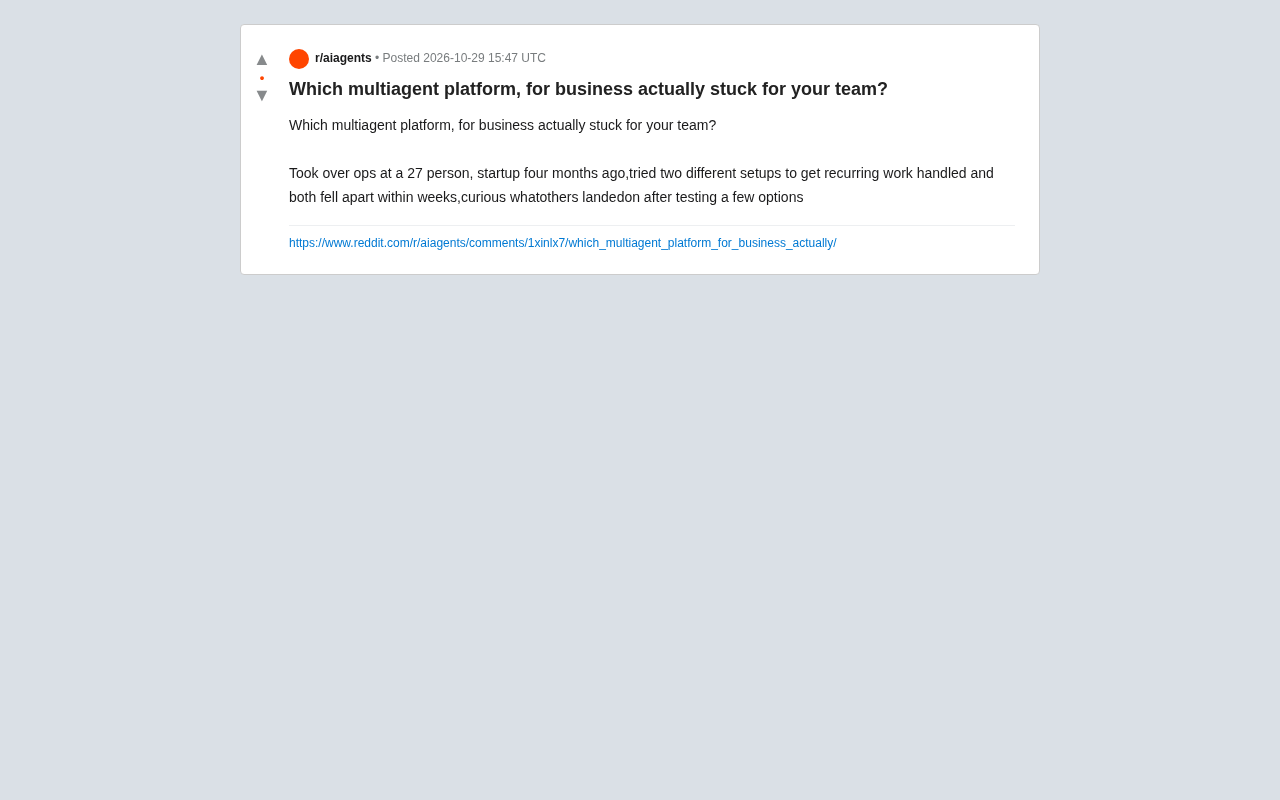
Which Multi-Agent Platform Wins? A Small Team's Battle Scars and Selection Considerations
A 27-person startup's ops lead tried two multi-agent platforms in four months and both failed. This article analyzes why small-team deployments break down, and offers selection guidance on integration depth, observability, and progressive rollout.

Thrive Holdings Takes ADT Private in $7.6 Billion Deal
Thrive Holdings acquires ADT for $7.6 billion in an all-cash take-private deal expected to close in Q1 2027. Analysis of the deal structure, ADT's asset value, and impact on the smart home security industry.