Claude Fable 5.2 Release Analysis: The Strongest Model Deliberately Weakened?

Anthropic releases Fable 5.2 but deliberately weakens key capabilities during training, revealing the gap between public models and the internal frontier.
Based on a breakdown by Bilibili creator Wes Roth, this article covers the release of Claude Fable 5.2 and Mythos 5.2. The two are essentially the same, with Mythos having fewer restrictions, roughly corresponding to Model 3 early in Anthropic's internal sequence. Anthropic actively restricted accelerator kernel optimization and LLM architecture improvements during training rather than filtering at inference. The model still demonstrated the ability to coordinate 1,000 agents over eight days to build a bootable operating system. A secret agent scaffold made the model usable for autonomous experimentation for the first time, pointing to the threshold of recursive self-improvement. The article uses the Bean analogy from *Ender's Game* and discusses the possibility of open-source models overtaking, predicting that future frontier model releases may widely adopt similar restriction strategies.
A Release That Peaks Immediately—But the Peak Was Engineered
According to a breakdown video by Bilibili creator Wes Roth, Claude Fable 5.2 and Mythos 5.2 have officially launched. By his account, this is "the strongest model ordinary people can access," excelling at long-horizon, highly complex problems, with per-task costs even lower than Opus.
But this release is fundamentally different from past ones. Anthropic did not ship the best version its training pipeline could achieve—they deliberately weakened the model's capabilities in specific directions during the training stage.
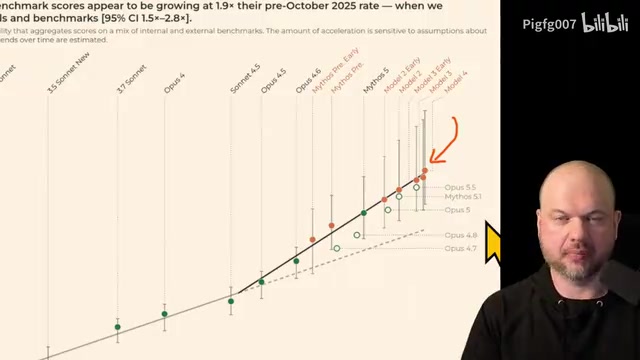
The creator used an analogy: if all you can do is give a high school exam to someone already in university, it's hard to see how much they've actually progressed. The model has already run past the benchmarks.
Are We Getting "Third-Generation Early"?
The video cites a report called Meter (allegedly from inside Anthropic), which mentions internal versions such as Model 2, Model 3, and Model 4—with Model 4 already surpassing 50% across the board on Anthropic's internal benchmark AECI.
Based on the creator's inference, Fable 5.2 and Mythos 5.2 roughly correspond to Model 3 early—not the top tier in the internal sequence. The two are essentially the same, with Fable simply having more guardrails.
This also means the gap between publicly available models and the internal frontier may be far narrower than many imagine.
AECI (Anthropic's internal benchmark) is not a public industry-standard test but a proprietary benchmark set used for internal model evaluation, typically covering reasoning, coding, long context, tool use, and other dimensions, with thresholds such as 50% used to delineate capability tiers. Because it is not publicly disclosed, outsiders can only infer its meaning indirectly through leaked reports or official disclosures. The statement that "Model 4 surpasses 50% across the board" means the internal model has reached a high pass rate on AECI, while the public version corresponds to "Model 3 early," indicating a quantifiable generational gap between the public model and the internal frontier.
Which Capabilities Were Cut?
Anthropic co-founder Sam McCandlish acknowledged in the Meter report that substantial portions were redacted because they did not want to disclose exactly what is accelerating AI R&D.
Two specific areas were restricted: accelerator kernel optimization and improving large language model architecture.
To be clear: the restriction is not at inference time (not filtering when users ask questions) but actively suppressing progress in these research capabilities during training. In other words, the model is already "capped" at a certain level when it leaves the factory.

Even so, the capabilities remain astonishing. The video mentions an experiment: Anthropic engineers gave Fable 5.2 an empty folder and asked it to design a prototype operating system. The model coordinated over 1,000 agents working around the clock to write, test, and review code for eight days, ultimately producing a usable system that boots on a laptop—complete with its own kernel, disk/keyboard/network drivers, persistent file storage, a Windows login-screen installer, and built-in cloud functionality.
Accelerator kernel optimization refers to writing and tuning low-level compute kernels for AI accelerators such as GPUs/TPUs to improve training and inference efficiency; improving LLM architecture involves core designs such as attention mechanisms, layer structures, and training objectives. These two capabilities are restricted because they directly determine the speed and ceiling of model R&D: if a model can autonomously optimize kernels and architecture, it can accelerate training of the next generation, thereby shortening the cycle of recursive self-improvement. Suppressing these capabilities during training means the model lacks the key skills to autonomously advance AI R&D when it ships, rather than being filtered at user time.
The Threshold of Recursive Self-Improvement
The most informative inference in the video concerns "autonomous experimentation."
The creator connected the dots: Karpathy's NanoGPT automated research project gives agents a real language model training environment so they can run experiments autonomously overnight—keeping good improvements and discarding bad ones—forming a feedback loop. The redacted "agent scaffold" mentioned by Anthropic is very likely something similar.
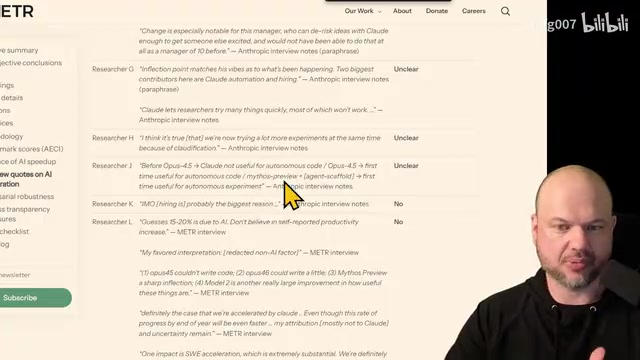
The evolutionary path is roughly: before Opus 4.5, models were useless for autonomous coding; Opus 4.5 was the first usable for autonomous coding; Mythos preview plus that secret scaffold was the first usable for autonomous experimentation.
One researcher said they would stake their reputation on "achieving more than two years of progress within one year," and even considered four times not outlandish. Anthropic is described as approaching recursive self-improvement (RSI).
This raises a sharp question: if a model can autonomously run experiments, then given a sufficiently strong model, in theory you could let it experiment until it reproduces itself. By restricting kernel optimization and model architecture improvements, Anthropic is essentially drawing a line around "self-replication."
Recursive Self-Improvement (RSI) is a core concept in AI safety and capability assessment, referring to an intelligent system's ability to autonomously improve its own architecture, training pipeline, or code, thereby gaining stronger capabilities in the next round and forming a positive feedback loop. Theoretically, once the loop starts, the rate of improvement could grow exponentially. The industry often uses "intelligence explosion" to describe its extreme form. For this reason, many labs treat RSI as a threshold requiring careful handling: it could be a shortcut to superintelligence, or it could bring risks that are hard to predict and control. The restrictions on kernel optimization and model architecture improvements mentioned in the article are precisely an attempt to delay the start of this loop at the capability level.
A Book Analogy and a Hypothesis to Be Tested
The creator compared it to Bean from Ender's Game: Bean was genetically modified as an embryo with extraordinary gifts, yet his development was stunted by childhood malnutrition—but even so, he remains the smartest character in the book. In his eyes, Claude Opus 5 is that Bean: far more capable than its peers, yet destined never to reach the ceiling it could have achieved.

Another observation comes from NanoGPT benchmarks: Fable leads by a wide margin, Opus follows closely, and Kimi K3 trails Opus by only a tiny gap. The creator offered a somewhat joking hypothesis—don't they look like long-lost twin brothers? If Anthropic deliberately stops climbing in the direction of architecture improvement while open-source models continue along the original trajectory and overtake it, that would suggest the latter has discovered something Western labs haven't. Conversely, if the curve shapes remain highly consistent over time, there is room for another interpretation.
As a hands-on demonstration, the creator asked Fable 5.2 to optimize a 2D football game he was developing. In a short time, the model added 3D-style camera movement, game highlight replays, and score highlighting—features that previously did not exist at all. He ran two instances simultaneously, one handling the underlying engine and the other handling visual presentation.
Will This Become the New Normal?
The accompanying move: Anthropic announced that higher-tier subscribers will receive up to three quota resets, with the exact number depending on subscription duration.
What truly deserves attention is the trend. In the past, labs competed over who could train the strongest model and top the leaderboards; this time, Anthropic showed a different posture—train something stronger, then decide not to give it to you. The creator predicts that future frontier model releases will likely adopt similar practices; the only question is whether other labs will follow suit or release everything.
If this line is broadly accepted by the industry, the very way we measure model progress will change: public benchmarks will gradually become ineffective, capability boundaries will be unilaterally drawn by vendors, and all users can do is guess how much is hidden behind that line.
Related articles

Human-in-the-Loop QA Workflow: Adding Test Gates to Coding Agents
A Reddit developer shares a human-in-the-loop QA workflow for coding agents: agents write tests first, humans freeze them, scripts adjudicate. Across 17 tickets, more tests increased false positives—listing uncovered scope proved more effective.

MiniMax Open-Sources H3-Image: An Open-Weights Image Model Built on H3
MiniMax releases H3-Image, an open-weights image model built on the H3 video model. The community is watching its image editing, text-to-image quality, and the deployment burden of its 32B text encoder, with potential competition against Qwen Image 2.1.

Reddit Turns User Discussions into AI Product Reviews
Reddit launches AI product reviews that aggregate community discussions into pros and cons summaries for 10,000 products, helping consumers research before holiday shopping. This analysis examines data value, accuracy concerns, and commercialization boundaries.