Claude Hits Its Limit? Friday Work Keeps Your AI Agents Picking Up the Baton

Friday Work lets AI agents relay tasks when one runs out of quota, enabling multi-agent collaboration.
Friday Work is an open-source tool that earned 77 upvotes on Product Hunt, designed to solve the problem of AI coding assistants like Claude hitting usage limits midway through long tasks. Its core mechanism is agent relay: when one agent exhausts its quota, another takes over with the prior context and progress, messaging each other directly instead of requiring manual copy-paste. Aimed at developers, it can be extended by the community to support more agents.
When Claude Runs Out of Steam, What Happens to Your Task?
AI coding assistants are now part of everyday development, yet they keep landing developers in an awkward spot: you hand Claude a long task, it hits its usage limit halfway through, and the work grinds to a halt. You end up manually copying the progress and switching to another tool to keep going. That fragmented experience is exactly what Friday Work sets out to fix.
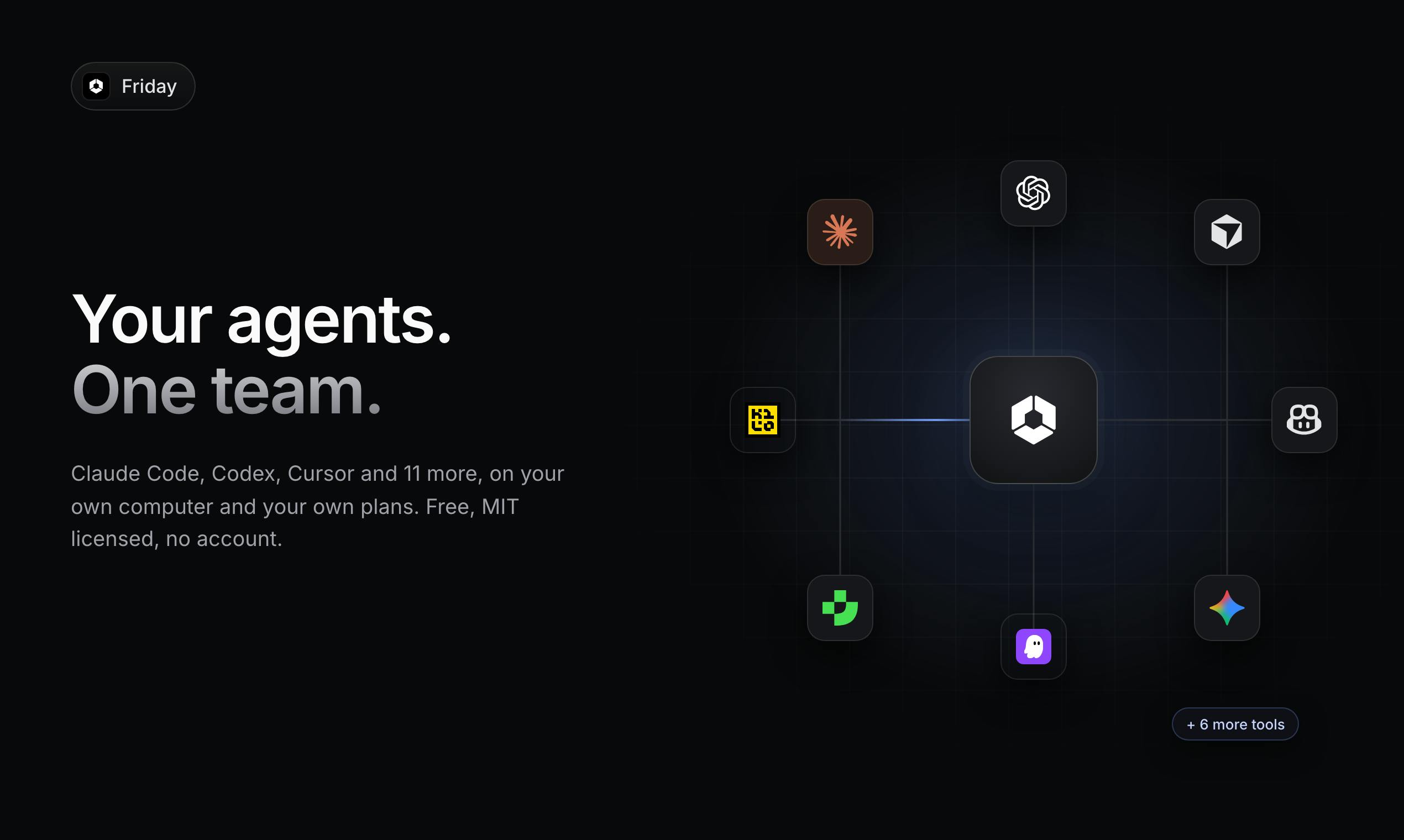
On Product Hunt, a tool called Friday Work picked up 77 upvotes and ranked 12th for the day. Its tagline goes straight for the pain point: "When Claude hits its limit, your task keeps going."
Not Just Parallel — Genuine Collaboration
Plenty of tools already let you run multiple AI agents at once, but they tend to operate in silos. Friday Work's twist is that it turns agents into a relay team.
According to the official description, when Claude exhausts its quota mid-task, another agent you're already using takes over the work in progress and carries the earlier progress with it. That means no re-explaining the context and no manually shuttling code around. More importantly, agents can message each other directly instead of making you copy-paste between terminals.
This design elevates multi-agent collaboration from "parallel execution" to "collaborative work." For long-running development tasks with many steps, that seamless handoff can meaningfully cut the productivity lost to interruptions.
Context Handoff is the technical core of how Friday Work pulls off agent relay. When Claude is interrupted by a quota limit, the next agent needs enough information to continue seamlessly — conversation history, generated code, tool-call records, and current task state. In conventional setups, that information is scattered across terminal sessions and has to be copied by hand or shared via files. Friday Work uses inter-agent messaging to pass this context to the receiving agent in a structured way, so it doesn't have to re-learn the task background. The process resembles a checkpoint mechanism in distributed systems, except that in the AI agent context it also has to preserve the semantic consistency of natural-language context, so the receiving agent doesn't drift from the original goal due to a misunderstanding.
Open Source and Developer-Friendly
Friday Work is categorized on Product Hunt under Productivity, Open Source, Developer Tools, and GitHub. That suggests it's aimed at technical users, with open code that developers can modify and extend themselves.
According to the maker info, the project is led by Arun Dass. Details are still limited, but the open-source nature means the community can contribute plugins that adapt it to more AI agents, further extending its relay capabilities.
Product Hunt is a platform for launching and discovering tech products, ranking new releases daily based on user upvotes. A result of 77 upvotes and 12th place for the day represents moderate-to-decent early attention for a freshly launched open-source tool, but the low comment count suggests users haven't yet put it through its paces or discussed it much. Being categorized under Productivity, Open Source, Developer Tools, and GitHub on Product Hunt means the target audience is technical developers rather than mainstream consumers. The open-source nature (typically meaning code hosted on GitHub under a permissive license) lets the community inspect implementation details, submit adapter plugins, or fix issues — which matters a great deal for a multi-agent collaboration tool, since different AI agents vary widely in their APIs and behavior, and community contributions can speed up the adaptation process.
A New Approach to Multi-Agent Collaboration
Usage limits on AI agents are a real, everyday problem for developers. Friday Work's "relay" model is essentially a fault-tolerance and load-balancing mechanism: treat different agents as interchangeable compute resources and maintain task continuity through messaging and shared state.
This idea resembles task migration in distributed systems, but in the AI agent context it also has to handle context understanding, tool-call state, and other special challenges. Whether Friday Work can make these details smooth will determine how it actually feels in practice.
The tool has only just launched, with just 7 comments so far, so its real-world performance is still waiting on more users to verify. But its arrival at least shows that the developer community has started thinking seriously about how to make multiple AI agents genuinely "cooperate" rather than simply stacking them up.
AI agent usage limits typically refer to caps on API calls, token consumption, or concurrent requests. For Claude, for example, the limits may come from a subscription plan's daily message quota or an API rate limit. When an agent runs a long task, these limits can cause it to fail partway through. The traditional response is to manually switch tools or wait for the quota to reset, whereas Friday Work's relay model treats multiple agents as interchangeable compute resources and spreads the load using a load-balancing approach. That said, different agents vary in context window size, tool-calling ability, and response style, and a relay has to accommodate those differences — otherwise the receiving agent may be unable to make sense of the prior tool-call state.
An Open-Source Rising Star Worth Watching
For developers who regularly use AI coding assistants like Claude, Friday Work offers a solution worth trying. Its core value is reducing manual intervention by automating the handoff between AI agents.
If you're interested in multi-agent collaboration, or you're tired of constantly running into usage limits, keep an eye on this open-source project. As more developers join in and provide feedback, Friday Work may grow into an indispensable part of AI workflows.
One-line Summary
Friday Work lets AI agents pick up the baton when one runs out of quota, enabling true multi-agent collaboration.
Paragraph Summary
Friday Work is an open-source tool that earned 77 upvotes on Product Hunt, designed to solve the problem of AI coding assistants like Claude hitting usage limits midway through long tasks. Its core mechanism is agent relay: when one agent exhausts its quota, another takes over the task along with the prior context and progress. The tool supports direct messaging between agents, sparing developers manual copy-pasting. As an open-source project aimed at developers, it lets the community extend it to support more AI agents. The article frames this model as a shift in multi-agent collaboration from parallel execution to relay-based teamwork, bringing fault tolerance and load balancing to AI workflows — though its real-world experience still needs more user validation.
Related articles

9 AI Subscription Plans Compared: The Real Cost Per 100M Tokens Revealed
Bilibili creator tests 9 AI subscription plans from Volcano, Alibaba, Tencent, Baidu, Zhipu, Xiaomi, MiniMax and more, converting them all to real cost per 100M tokens, breaking down fixed-quota vs. three-tier coefficient billing and how caching, time-of-day discounts, and window limits affect actual quota.

Vibe Coding for Beginners: Expressing Intent Instead of Handwriting Code
What is Vibe Coding? A 137-episode Bilibili course defines it: the core is expressing intent, not writing code. This article analyzes Vibe Coding's productivity logic, target audience, and entry expectations to help beginners decide if it's worth learning.

LangChain Beginner's Guide: An Agent Development Roadmap from LangGraph to Deep Agents
Clarify the encapsulation relationship among LangChain, LangGraph, and Deep Agents, and master the learning path and selection logic for agent development frameworks—suitable for beginners in large model development.