Claude Max "20x Usage" Promise Questioned by Judge, Subscription Fees May Carry Misleading Risks
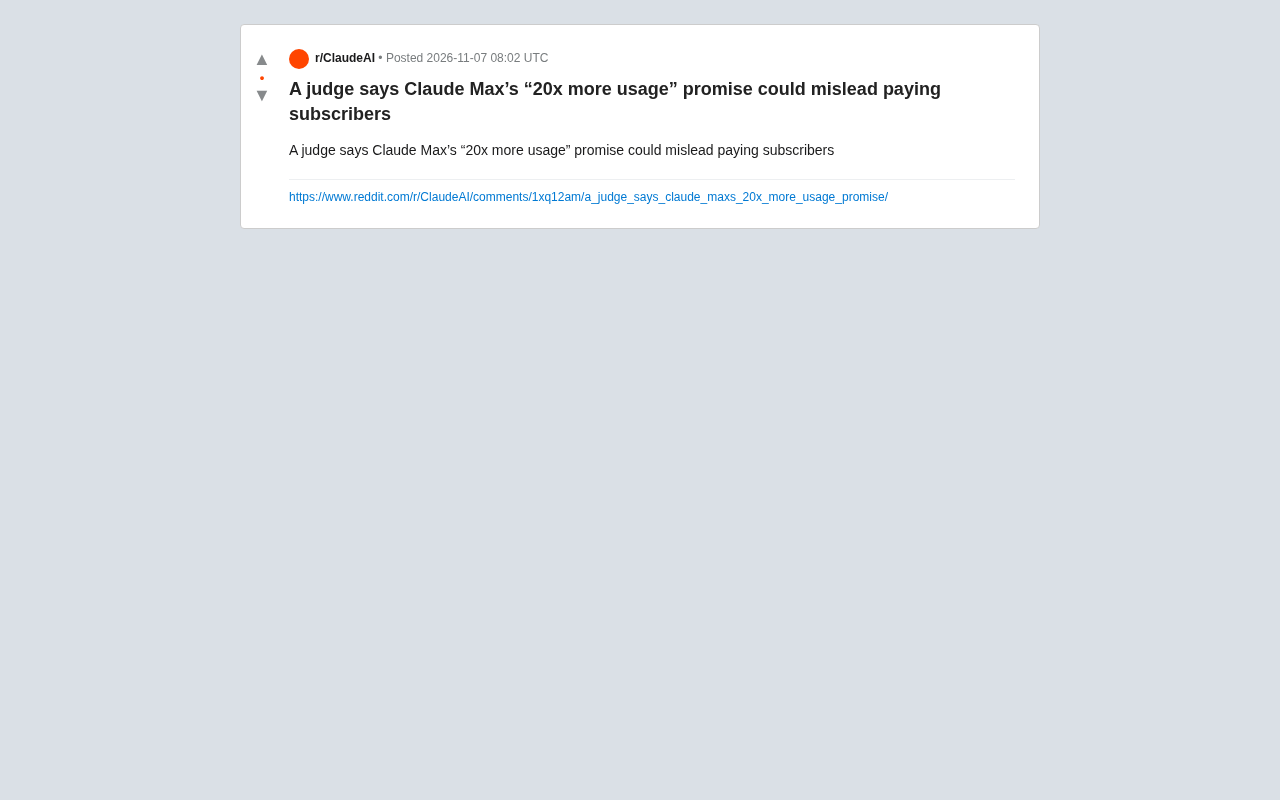
A judge questions whether Claude Max's "20x usage" claim may mislead paying users, sparking discussion on usage transparency in AI subscriptions.
The article examines the controversy sparked by Anthropic's Claude Max subscription service and its "20x more usage" claim. According to Reddit discussions, a judge questioned whether this multiple-based wording may mislead paying users, focusing on the lack of a clear comparison benchmark for "20x" and the absence of clarification about comparison targets and applicable conditions. The article notes that subscription-based AI services commonly face usage ambiguity, as usage is affected by factors such as model version, concurrent requests, context length, and peak hours, making it difficult for users to estimate accurately before purchase. It draws two implications: paying users should carefully read usage-limit explanations in the terms of service rather than relying only on marketing multiples; and regulators may pay increasing attention to the accuracy of AI marketing language, requiring providers to balance user attraction with information transparency. Anthropic has not yet responded publicly.
Claude Max "20x Usage" Promise Questioned by Judge, Subscription Fees May Carry Misleading Risks
A Controversy Over "Usage Promises"
According to discussions in the Reddit community, a judge has raised questions about the "20x more usage" claim promoted by Anthropic's Claude Max subscription service, suggesting that this wording may mislead paying users. The news quickly sparked discussion among developers and AI user communities, with the focus squarely on the long-standing issue of "usage ambiguity" in AI subscription services.
The judge's questioning is not without basis. As a premium subscription plan launched by Anthropic for heavy users, one of Claude Max's core selling points is that it provides several times more usage quota than the free version or lower-tier subscriptions. However, how the "20x" claim is defined in actual implementation, what benchmark it is calculated against, and whether it can be fulfilled in all scenarios have always lacked clear public understanding.
What Exactly Does "20x" Mean?
Ambiguous Comparison Benchmark
"20x more usage" is a typical relative promotional phrase. It neither specifies whether the comparison target is the free version, the Pro version, or the number of calls under a particular model, nor explains whether this multiple still holds during peak hours, across different models, or across different feature modules. For ordinary consumers, such wording is very easily understood as "you can get 20 times the regular usage under any circumstances."
The judge's questioning points precisely to this gray area: when marketing language uses eye-catching multiple-based promises while the actual terms of service leave ample room for interpretation, paying users may make purchase decisions under information asymmetry.
"Usage" in AI subscription services is not a single dimension; it usually involves multiple metrics such as time-based quotas, message counts, context window length, concurrent requests, and model access permissions. When vendors summarize this as "20x," it often actually holds only in one dimension or against one benchmark model, while the multiple may shrink significantly in other dimensions. Understanding this helps users judge the match between promotional numbers and their own usage scenarios: heavy long-context users and high-frequency short-Q&A users may have very different perceptions of "usage."
The Common Dilemma of Subscription-Based AI Services
The Claude Max controversy is not an isolated case. Current mainstream AI service providers generally adopt subscription models, and usage limits are often tied to factors such as model version, concurrent requests, and context length. Before purchasing, users find it difficult to accurately estimate their actual usage, and "multiple" advertising further amplifies this uncertainty.
From an industry perspective, such controversies reflect a core contradiction faced by AI services in the process of commercialization: they need intuitive numbers to attract users to subscribe, yet it is difficult to use simple numbers to accurately describe complex technical resource allocation.
In AI services, "usage" is essentially the allocation of scarce computing resources rather than an infinitely replicable commodity. Inference costs rise nonlinearly with model scale, context length, and request frequency, and computing shortages during peak hours force them to dynamically adjust limits. Therefore, "unlimited" or "multiple" promises under subscription models are usually constrained by flexible clauses such as Fair Use Policies, and vendors reserve the right to throttle or rate-limit when resources are tight. This is precisely the deep technical reason for the gap between "multiple" advertising and actual experience.
Implications for Users and the Industry
Paying Users Need to Pay Attention to Actual Terms
For users considering subscribing to Claude Max, the judge's questioning is a reminder: before paying, they should carefully read the specific explanations of usage limits in the terms of service rather than relying only on multiple-based promises on marketing pages. Actual available usage may differ significantly depending on model, time period, and usage pattern.
Regulatory Signals Deserve Attention
The judge's questioning of the "20x more usage" wording also sounds an alarm for marketing compliance in the AI industry. As the scale of AI subscription services expands, regulators' attention to the accuracy of promotional language may continue to rise. When formulating marketing strategies, service providers need to find a safer balance between attracting users and maintaining information transparency.
At present, the controversy is still in the discussion stage, and Anthropic has not yet made a public response to the judge's specific questions. Subsequent developments warrant continued attention.
Background Supplement
Reference Case: Regulatory Precedents for "Unlimited" Advertising
In the software and internet services sector, regulation and litigation around absolute terms such as "unlimited" and "multiple" are not uncommon. Consumer protection agencies in many countries have required vendors to disclose reasonable restrictions in relation to claims such as "unlimited data" and "unlimited storage." The core principle is: when marketing language may cause ordinary consumers to form reasonable expectations beyond the actual service, vendors have an obligation to explain the restrictions in a prominent manner. The "20x usage" controversy in AI subscription services can be understood within this context; the key is not whether the number is precise, but whether the advertising is sufficient to avoid systematic misunderstanding among consumers.
Related articles
 Tech Frontiers
MuJoCo: An Analysis of DeepMind's Open-Source General-Purpose Physics Simulator
An in-depth analysis of Google DeepMind's open-source physics simulator MuJoCo: high-performance C++ kernel, MJCF modeling format, contact solving principles, MJX GPU acceleration, and robot reinforcement learning use cases.
 Tech Frontiers
Claude API Quick Start: The Official Quickstarts Project Collection
Anthropic's official claude-quickstarts project collection helps developers quickly build deployable apps with the Claude API. Nearly 20k stars, Python-based, great for beginners and prototyping.
 Tech Frontiers
AI Agents Connecting Directly to APIs: Which Calls Can Be Safely Allowed?
AI agents can call any API, but the real challenge is deciding which calls can be safely allowed. This article analyzes allowance decisions from three dimensions—intent matching, least privilege, and controllable impact—and argues that the control layer should sit outside the agent, combined with audit traceability to build a trustworthy API call governance mechanism.