Claude Pro Is Cheaper in India via Apple App Store Subscription

Indian users found that subscribing to Claude Pro via the App Store is cheaper than on the official website, sparking discussion about channel pricing and subscription strategy.
Starting from a Reddit user's sharing, the article notes that Claude Pro in India costs only ₹2,000 per month via Apple App Store subscription, compared with ₹2,400 on the official website — saving ₹400 per month. The author analyzes that the price gap may stem from regional pricing strategies, tax handling, and unsynchronized promotions, and emphasizes that this phenomenon is not unique to Claude; mainstream AI subscription services such as ChatGPT Plus and Gemini Advanced may also have similar differences. It also warns of the hidden costs of in-app purchase channels, such as limited subscription management, the need to cancel and resubscribe when switching channels, and possible differences in functionality and invoices. Finally, it advises users to compare tax-inclusive prices before subscribing and to make decisions based on management convenience and long-term usage habits.
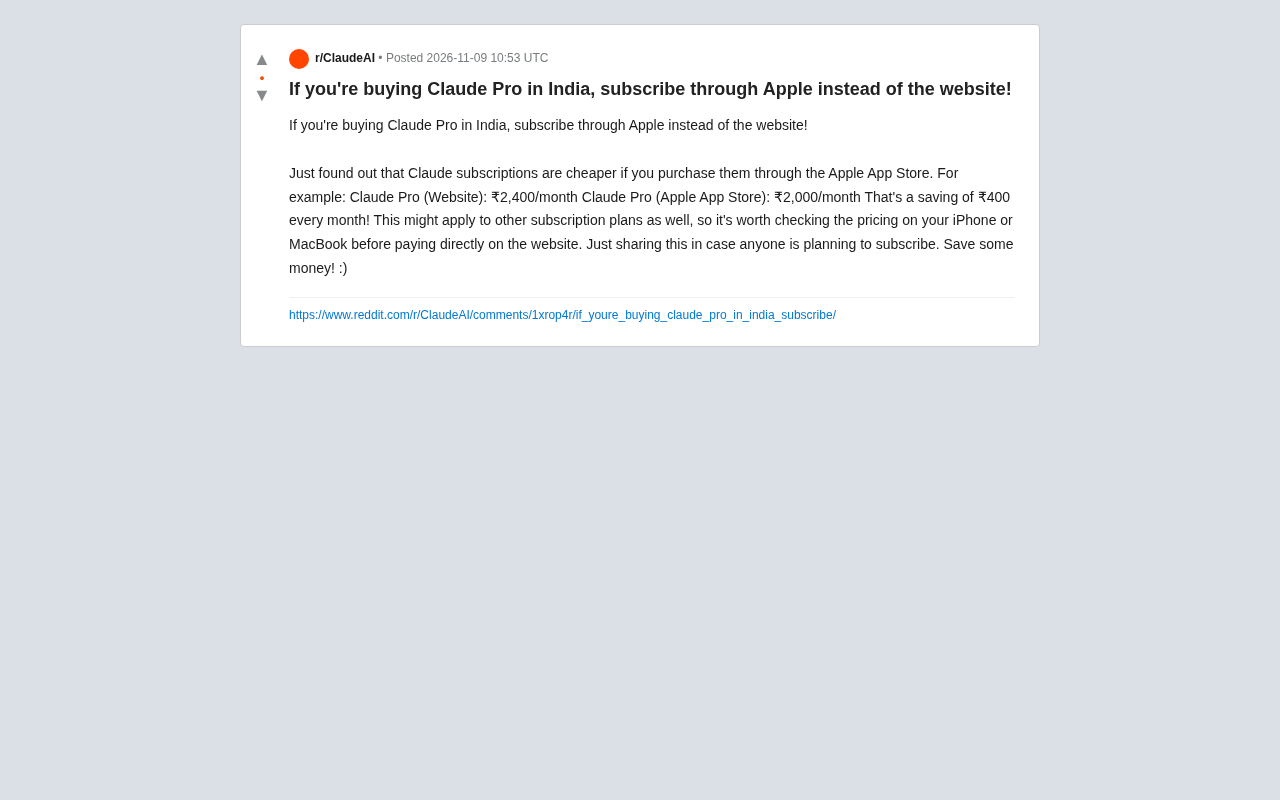
In India, users subscribing to Claude Pro recently discovered a money-saving trick: subscribing through Apple's App Store in-app purchase costs less than subscribing directly on the official website. According to data shared by a Reddit user, the official Claude Pro subscription price is ₹2,400 per month, while subscribing through the Apple App Store costs only ₹2,000 — saving ₹400 per month. This price gap has sparked considerable discussion and prompted a fresh look at how users choose channels for subscription services.
Where the price gap comes from: the hidden logic of channel pricing
Price differences for the same service across different channels are not unique to Claude. Apple charges a commission on App Store in-app purchases (typically 15%–30%), and common sense suggests that developers, in order to cover this cost, would tend to set higher prices for in-app purchases. But in reality the opposite has happened — the App Store turns out to be cheaper.
Several factors may be at play. First, differences in regional pricing strategy: Anthropic may use a direct USD conversion for its official website pricing, while the App Store's India region pricing references Apple's localized pricing system, which is more sensitive to purchasing power parity. Second, promotions are not synchronized: Apple sometimes participates in or drives regional price adjustments, while official website prices may not be updated in step. Third, there are differences in how taxes are handled: different channels may handle India's Goods and Services Tax (GST) differently in terms of tax-inclusive pricing, resulting in different final listed prices shown to users.
According to a note from the original Reddit poster, this price gap "may also apply to other subscription plans," so it is worth comparing prices on an iPhone or MacBook before deciding which payment channel to use.
Purchasing power parity (PPP) is a key concept for understanding regional pricing differences. It measures the actual purchasing power of different countries' currencies rather than a simple exchange-rate conversion. For example, at the exchange rate, 1 USD converts to about 83 Indian rupees, but the same 1 USD can buy different amounts of goods and services in the US and India. When setting regional prices, Apple's and Google's app stores typically reference purchasing power parity data published by institutions such as the World Bank, adjusting price tiers to levels acceptable to local users. Many international SaaS official websites, however, simply price in USD and then convert, ignoring this difference — with the result that official website prices may be higher than the localized pricing in app stores.
Goods and Services Tax (GST) is an indirect tax implemented in India starting in 2017, replacing the previous complicated state-level taxes. Digital services typically fall under an 18% tax rate, but different channels may handle tax-inclusive listed prices differently: some channels include GST in the listed price, while others add it only at checkout. This can create a discrepancy between the "listed price" users see and the actual amount paid — a detail that must be noted when comparing prices across channels.
Not just for Claude: the habit of comparing prices before subscribing is worth cultivating
The value of this lesson is not limited to Claude Pro alone. Today's mainstream AI subscription services — whether ChatGPT Plus, Gemini Advanced, or Perplexity Pro — typically offer both direct purchase on the official website and in-app purchase through mobile apps. Prices are consistent across the two channels in most markets, but differences may appear in some regional markets.
Take the Indian market: both Apple's and Google's app stores have mature localized pricing mechanisms that adjust price tiers according to local consumption levels. Many international SaaS products, however, price directly in USD on their official websites and then convert to local currency at exchange rates — and the converted result may not align with platform pricing. For price-sensitive users, spending a few minutes comparing the mobile subscription page with the official website could save an ongoing expense.
The hidden costs of in-app purchase channels: the trade-off between convenience and flexibility
Choosing an App Store subscription is not entirely without cost. Subscriptions made through Apple in-app purchase must be managed and canceled in iOS Settings or the App Store account, and cannot be managed directly from the account panel on Claude's official website. If you are used to managing all subscriptions centrally on the web, this can be inconvenient.
Another easily overlooked issue is subscription migration. If you first subscribe through the official website and later want to switch to the App Store channel, you usually cannot "transfer" directly — you need to cancel the original subscription first, wait until the current billing cycle ends, and then resubscribe through the new channel. There may be a gap in service during this process, and for annual subscribers the switching cost is even higher.
In addition, in-app purchase versions of some services differ slightly in functionality from official website versions, such as how invoices are issued and enterprise account management capabilities. For individual users, these differences usually have little impact, but if you need to seek reimbursement in the name of a company, it is worth confirming in advance whether the in-app purchase channel can provide the required documentation.
How to decide which channel is better for you
The most direct approach is to compare the final tax-inclusive prices of the two channels at the same time and under the same account status. Open the subscription page in the Claude app on an iPhone and note the displayed price; then log in to the Claude official website in a browser to check the subscription price. Subtracting the two gives you the conclusion.
If a price difference does exist and matters to you, you also need to consider long-term factors: do you value the price advantage more, or the convenience of subscription management? Are you likely to switch phone platforms in the near future (for example, from iPhone to Android)? If you switch platforms, migrating an App Store subscription will be more troublesome.
This Reddit user's sharing provides a concrete, verifiable money-saving idea, but the final decision should still be based on personal usage habits. Before subscribing to any AI service, spending two extra minutes comparing prices has become a consumption habit worth cultivating.
Reference: A Reddit user's sharing about the Claude Pro India region subscription price difference (including a price comparison screenshot).
Related articles

Hermes Agent in Depth: From Deployment to Skills, MCP, and Hooks
A complete walkthrough of Hermes Agent based on a YouTube deep-dive: VPS deployment, soul.md and user.md memory layering, auto-generated skills, MCP and connectors for Notion, multiple profiles and sub-agent delegation, gateway and shell hooks, and voice call configuration essentials.

Codependency in Addiction: Let Go of the Rope So the Other Person Can Move Toward Recovery
Stanford addiction expert Dr. Anna Lembke explains how codependency sustains addiction: when families stop over-intervening, attend Al-Anon, and let go, addicted individuals are more likely to recover.

Where Does Autonomous Driving Training Data Come From? Cosmo 3 Uses Scene Graphs to Generate Multi-Sensor Data
Cosmo 3 offers a generative solution for autonomous driving training data: controlled generation via world scene graphs, synchronized RGB and LiDAR output, and continuous generation for closed-loop simulation, now open for developer trials.