Claude's "Dreaming" Memory Mechanism: How It Learns from Experience
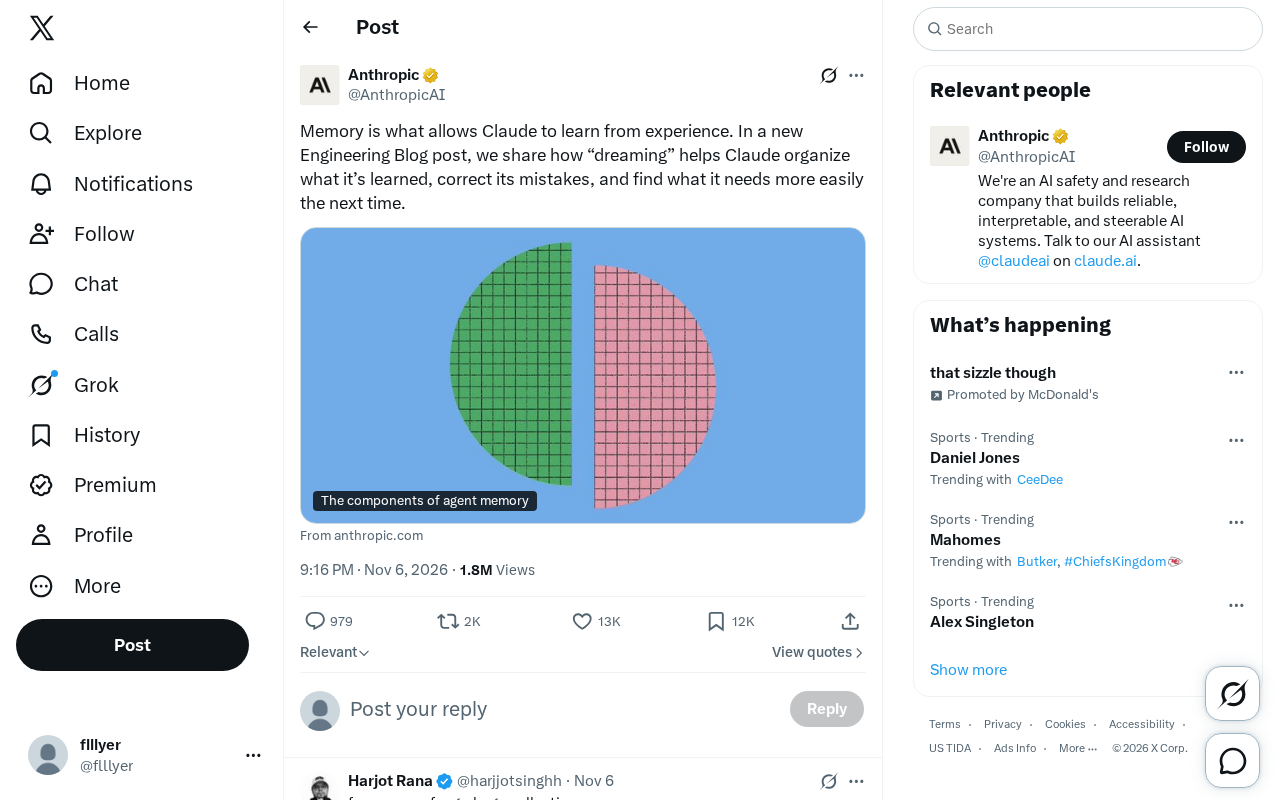
Anthropic reveals Claude's "dreaming" memory mechanism, which organizes and corrects offline to consolidate experience.
Anthropic disclosed Claude's "dreaming" memory mechanism in an engineering blog. Its core is to organize, correct, and optimize retrieval of memory fragments gained from interactions during an offline phase, simulating memory consolidation during human sleep. The article breaks down the mechanism's three target actions and notes that error correction is the hardest part of a memory system, requiring the model to have some self-evaluation capacity rather than relying on explicit user corrections. For developers and users, this means AI may be able to handle cross-session continuity tasks, but opaque consolidation rules also raise concerns about predictability and privacy governance. From an industry perspective, memory is becoming a new direction of competition for large models, with Anthropic choosing to work at the cognitive architecture level rather than simply expanding the context window or relying on parameter fine-tuning. Current official disclosures remain conceptual, lacking quantitative data and implementation details, and actual results await product validation.
Introduction: Memory Lets AI Truly "Learn" from Experience
Anthropic disclosed a key design of Claude's memory system in an engineering blog post: the "dreaming" mechanism. According to its official tweet, memory is the foundation that lets Claude learn from experience, while "dreaming" helps it organize what it has learned, correct mistakes, and find the information it needs more easily next time. This approach is not simply caching or retrieval augmentation—it attempts to simulate the memory consolidation process that occurs during human sleep, allowing the model to reorganize experience during an offline phase.
Behind this design lies a core question: large model parameters are static, so how can a model internalize experience gained from interactions without retraining, and make subsequent calls more efficient? Anthropic's answer points to a structured memory management pipeline, with "dreaming" as its scheduling component.
What the "Dreaming" Mechanism Actually Does
Based on the official description, three actions can be identified: organizing what has been learned, correcting mistakes, and improving retrieval efficiency. This means Claude does not passively store every conversation; instead, during some "sleep" phase it reorganizes memory fragments—similar to how humans convert short-term memory into long-term memory during sleep while discarding contradictory or low-value information.
The value of this mechanism lies in solving the problem of "fragmented experience." If the model simply piled every interaction into a memory store as-is, retrieval would face excessive noise and conflicting similar fragments. "Dreaming" amounts to a background cleanup that keeps the memory store at a usable density and consistency. Anthropic has not disclosed implementation details (such as trigger frequency or consolidation algorithms), but given the positioning of the engineering blog, this is more likely a practical system design than a purely theoretical concept.
Memory consolidation is a term from cognitive science referring to the process by which newly formed, unstable memory traces become more stable and durable over time. During human sleep, interactions between the hippocampus and neocortex replay the day's experiences, gradually integrating short-term memories into long-term memory networks while selectively strengthening and weakening them. Anthropic's use of this metaphor implies that "dreaming" is not simple data compression or deduplication, but an offline process involving selective reorganization and weight adjustment. Like biological memory consolidation, it must decide, within a limited compute budget, which memory fragments are worth keeping and which should be merged or discarded—precisely the most challenging part of the engineering implementation.
Why "Correcting Mistakes" Is the Hard Part of a Memory System
In a memory system, error correction is harder than storage. The model needs to identify errors in past memories and decide whether to overwrite, amend, or annotate them. If the correction logic is too aggressive, valuable historical context may be lost; if too conservative, errors will continue to contaminate subsequent reasoning.
Anthropic lists "correcting mistakes" as one of the core goals of "dreaming," implying that the mechanism has some capacity for self-evaluation—re-examining memory content during offline consolidation rather than relying on explicit user corrections. If true, this is significant for long-horizon tasks (such as project collaboration spanning several days): the model can "reflect" on the day's work overnight and fix misjudgments. However, official materials do not currently provide correction accuracy rates or specific examples, so this part remains a black box.
Retrieval-augmented generation (RAG) is a common approach for giving large models access to external knowledge: before inference, the system retrieves relevant fragments from an external knowledge base and inserts them into the context window for the model to reference. RAG's limitation is that the knowledge base is typically static, lacking automatic error correction and reorganization once written, so erroneous entries continue to be retrieved. Anthropic's "dreaming" mechanism contrasts with RAG in its positioning—rather than passively retrieving existing entries, it actively performs offline consolidation and correction of memory content. Understanding this distinction helps clarify the value boundary of the mechanism: RAG addresses "what is known," while memory consolidation addresses "how to become more accurate and consistent over time."
What It Means for Developers and Users
From a product perspective, the memory mechanism directly determines whether Claude can handle cross-session continuity tasks. Without reliable memory, every conversation starts from scratch; with "dreaming"-style consolidation, the model can remember user preferences, project context, and prior conclusions.
For developers, this means the focus of prompt engineering may partially shift: rather than repeating context in every conversation, one can rely on the memory system to retain key information. But this also introduces new uncertainty—when the consolidation rules are opaque, what the model "remembers and forgets" is hard to predict. Anthropic's choice to disclose this mechanism in an engineering blog is itself a step toward transparency, but actual behavior still needs to be verified through real-world use.
Cross-session continuity tasks refer to scenarios where a model needs to maintain contextual consistency across multiple independent conversations, such as project collaboration lasting several weeks, long-term personal assistants, or customer support ticket tracking. The key challenge in such tasks is that each session's context window is independent, and the model cannot naturally inherit the state of the previous conversation. A reliable external memory system must solve three problems: writing (which information is worth storing), retrieval (when to bring back which fragments), and freshness (how to handle outdated information). The organization and correction steps of the "dreaming" mechanism are engineering responses to the latter two problems.
Industry Perspective: Memory Is Becoming the Next Battleground for Large Models
The name "dreaming" carries an obvious metaphorical flavor, but behind it is an industry-wide challenge: how to let models keep evolving without frequent retraining. Retrieval augmentation, external memory stores, and parameter-efficient fine-tuning are all different paths, and Anthropic has chosen to work on the organization and consolidation of memory—an approach oriented toward "cognitive architecture" rather than simply expanding the context window.
If this direction matures, it could change the shape of AI applications: assistants would no longer be single-session tools but long-term partners that accumulate experience over time. Of course, memory also raises privacy and controllability concerns—users need to know what the model remembers and be able to manage those memories. Whether Anthropic's blog addresses these governance details deserves follow-up attention.
Parameter-efficient fine-tuning (PEFT) is a class of techniques that adapt a model to new tasks by updating only a small number of parameters, with representative methods including LoRA and adapter layers. It represents another path to "letting models keep evolving": absorbing new knowledge through small weight updates rather than relying on an external memory store. Compared with PEFT, a memory system does not change model parameters and therefore does not introduce catastrophic forgetting risk, but it is constrained by the context window and retrieval quality; PEFT can change model behavior more deeply but requires additional training pipelines and data management. Anthropic's choice to focus on the memory organization stage is essentially pursuing experience accumulation without changing parameters—complementing rather than replacing PEFT.
Conclusion
Claude's "dreaming" mechanism is an interesting attempt at memory system design: chaining "organize—correct—retrieve" into a closed loop so that experience truly settles into capability. Currently available information remains conceptual, lacking quantitative data and implementation details, but its engineering approach offers peers a framework worth discussing. The memory competition has only just begun; what comes next is how this mechanism performs in actual products.
Related articles

Microsoft WebIQ: Verifiable Real-Time Web Grounding for AI Agents
Microsoft WebIQ gives AI Agents real-time, citable web grounding across web, news, images, videos, and Places—164ms P95 latency, 50% fewer tokens, Scopes source control, and MCP integration.

Augmentable Gaussian Splatting: Building Photorealistic Simulation Environments for Robot Training
Team combines Gaussian Splatting with meshes to build photorealistic robot simulation environments, integrating MuJoCo Warp physics and Franka Panda for augmentable, relightable real-site simulation.

Gemini 4 Carbon Released: The Leap from Gemini 3 to Gemini 4 in Under a Year
Google releases Gemini 4 Carbon, less than a year after Gemini 3. In the official demo, Carbon reverse-engineered the Theme Park binary, added a new DeepMind-themed ride, and ported it to the web in one shot.