Claude Services Experience Widespread Errors: Official Investigation Underway
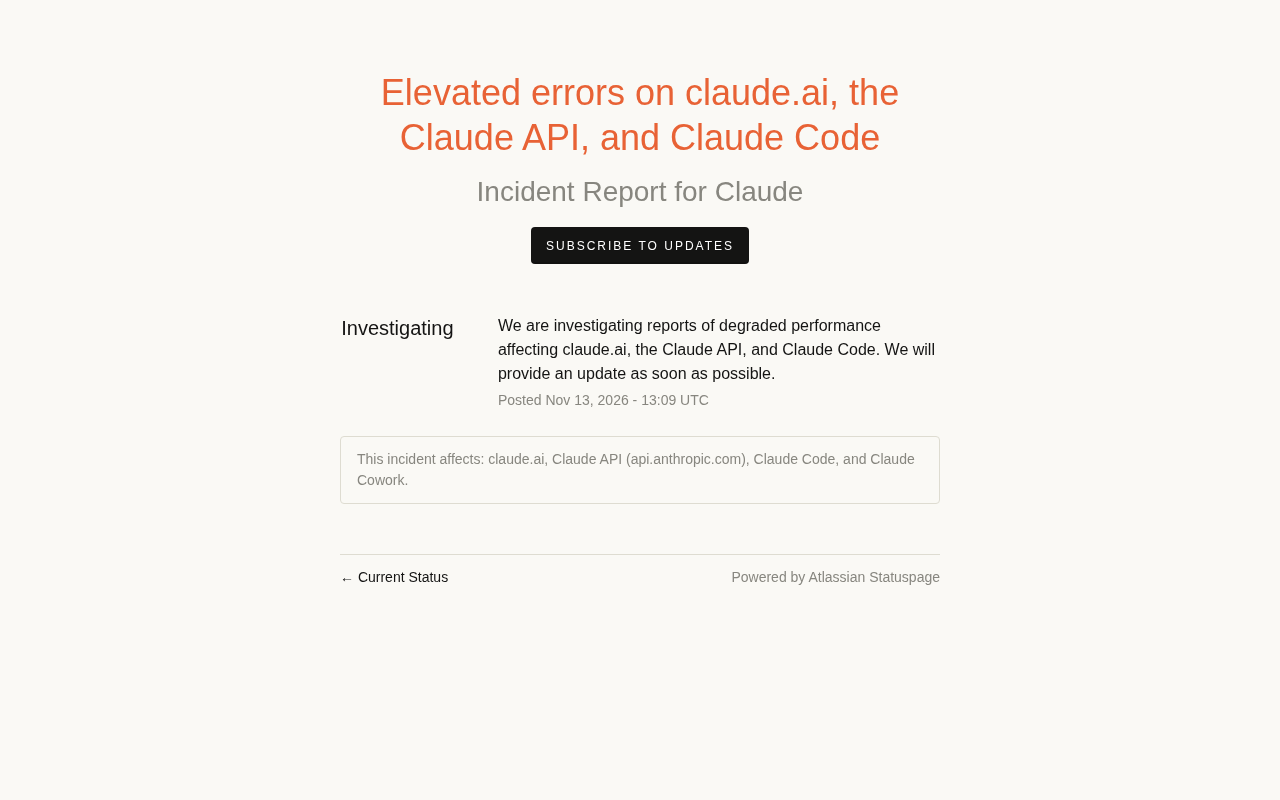
All three major Claude entry points are experiencing degraded performance; Anthropic has confirmed and is investigating.
Anthropic's claude.ai web interface, Claude API, and Claude Code all experienced rising error rates and degraded performance simultaneously. The official status page posted an Investigating-level update at 13:09 UTC, confirming reports had been received and an investigation was underway, but did not specify the exact nature of the errors or provide a root cause or fix timeline. Since the three entry points cover general users, developers, and coding scenarios respectively, the impact is broad: API issues may directly render dependent applications unavailable, while Claude Code issues affect users who are actively coding. The article advises users to save important session content, add retry and fallback logic to API calls, and watch for official recovery notices, noting that this is likely an infrastructure-level anomaly with the specific faulty component still awaiting official explanation.
Claude users may have noticed that error rates have risen simultaneously across three entry points: claude.ai, the Claude API, and Claude Code. According to the latest update on the official status page, Anthropic has confirmed it has received related reports and is investigating the cause of the performance degradation.
Three entry points affected simultaneously — the scope is notable
This is not an issue with a single product. According to the status page description, claude.ai (the web interface), the Claude API (the developer interface), and Claude Code (the coding assistant tool) are all experiencing "degraded performance." Together, these three entry points cover general users, developers, and coding scenarios, meaning the impact is quite broad.
For developers who rely on the API to build applications, rising error rates can directly render services unavailable; and issues with Claude Code affect users who are actively using it for coding work. The official designation is currently at the "Investigating" stage, with no specific cause of the error or timeline for a fix provided yet.
Official status: investigating, no root cause yet
The status page shows that Anthropic posted an Investigating-level update at 13:09 UTC, using the wording "We are investigating reports of degraded performance" and promising further information as soon as possible. This information is limited — it does not specify what the errors look like (timeouts, 5xx errors, or slower responses), nor does it point to any potential cause.
From the pace of incident response, Investigating is typically the earliest stage, followed in sequence by Identified, Monitoring, and Resolved. Users watching for service recovery can keep refreshing the status page for the latest updates.
The status page tier system: Status pages for mainstream cloud services and SaaS products typically use a standardized incident lifecycle labeling scheme. Investigating means an anomaly has been confirmed and the team has begun locating the problem; Identified means the root cause or faulty component has been confirmed; Monitoring means remediation measures have been deployed and metrics are being observed for recovery; and Resolved means the service has returned to normal and the incident is closed. Some status pages also label impact levels in parallel (such as Degraded Performance, Partial Outage, Major Outage) to distinguish "slow" from "unavailable." Therefore, seeing Investigating usually means the incident is still in its early stages and subsequent updates may be spaced farther apart; once it moves to Monitoring, recovery time can often be estimated.
Practical advice for users
Until the official conclusion is available, if you are relying on Claude for work, consider a few temporary measures: save important content from your current sessions and avoid critical operations while the service is unstable; API users can add retry logic and fallback plans to their code; Claude Code users can watch official channels for recovery notices and switch to local tools for urgent tasks if necessary.
At present, this appears to be a typical infrastructure-level anomaly. Whether the fault lies in the model inference service, the gateway, or another component will require further official explanation.
API retries and fallbacks: When facing rising error rates, a common engineering practice is "exponential backoff" — wait a short time before retrying after the first failure, multiply the wait time with each subsequent failure, and add random jitter to prevent a large number of clients from retrying at the same moment and creating a second wave of impact. It is also important to distinguish error types: 429 (rate limiting) and 5xx (server errors) are suitable for retries, while retrying 400-class parameter errors is meaningless. Fallback plans include switching to a backup model or backup provider, returning cached results, gracefully degrading non-critical features, and adding a circuit breaker at the entry point to fail fast rather than continue accumulating requests when the error rate exceeds a threshold.
One-line Summary
All three major Claude entry points are experiencing degraded performance; Anthropic has confirmed and is investigating.
Paragraph Summary
Anthropic's claude.ai web interface, Claude API, and Claude Code all experienced rising error rates and degraded performance simultaneously. The official status page posted an Investigating-level update at 13:09 UTC, confirming that reports had been received and an investigation was underway, but it did not specify the exact nature of the errors or provide a root cause or fix timeline. Since the three entry points cover general users, developers, and coding scenarios respectively, the impact is broad: API issues may directly render dependent applications unavailable, while Claude Code issues affect users who are actively coding. The article advises users to save important session content, add retry and fallback logic to API calls, and watch for official recovery notices, and notes that this is likely an infrastructure-level anomaly, with the specific faulty component still awaiting official explanation.
Related articles
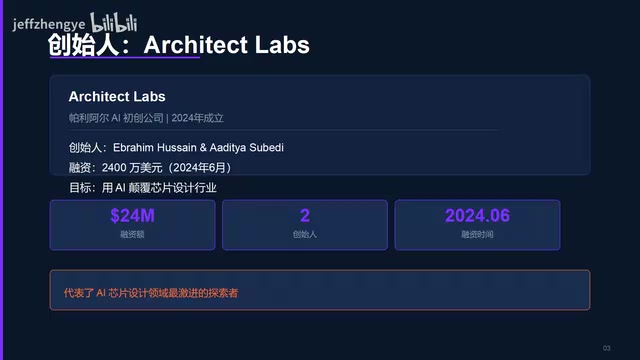
AI Independently Designs CPU Architecture 'Frostbite': 4.59x Energy Efficiency Boost
AI independently designed the complete CPU architecture Frostbite, achieving 4.59x better energy efficiency and 8.77x better performance per unit area. This article analyzes Architect Labs' technical path, five-step design flow, foreign media commentary, and current limitations, exploring the potential impact of AI chip design on Intel, AMD, and the RISC-V ecosystem.

Meta's Your Algorithm: Reshaping Recommendation Ranking with Natural Language
Meta reveals technical details of Facebook's "Your Algorithm": users describe interests in natural language, and the system uses LLM validation, 4-channel retrieval, layered filtering, and a fine-tuned LLM re-ranker to turn preferences into Feed and Reels ranking signals.

Huawei Found Liable for Trade Secret Theft: A New Legal Flashpoint in US-China Tech Rivalry
A jury found Huawei liable for stealing US trade secrets involving T-Mobile and Cisco source code. This analysis examines the legal, business, and geopolitical implications and compliance lessons for Chinese tech firms.