Claude Sonnet 5.5 Error Spike Triggers Urgent Official Investigation

Claude Sonnet 5.5 error rates spiked abnormally; officials have identified the issue but no recovery time given.
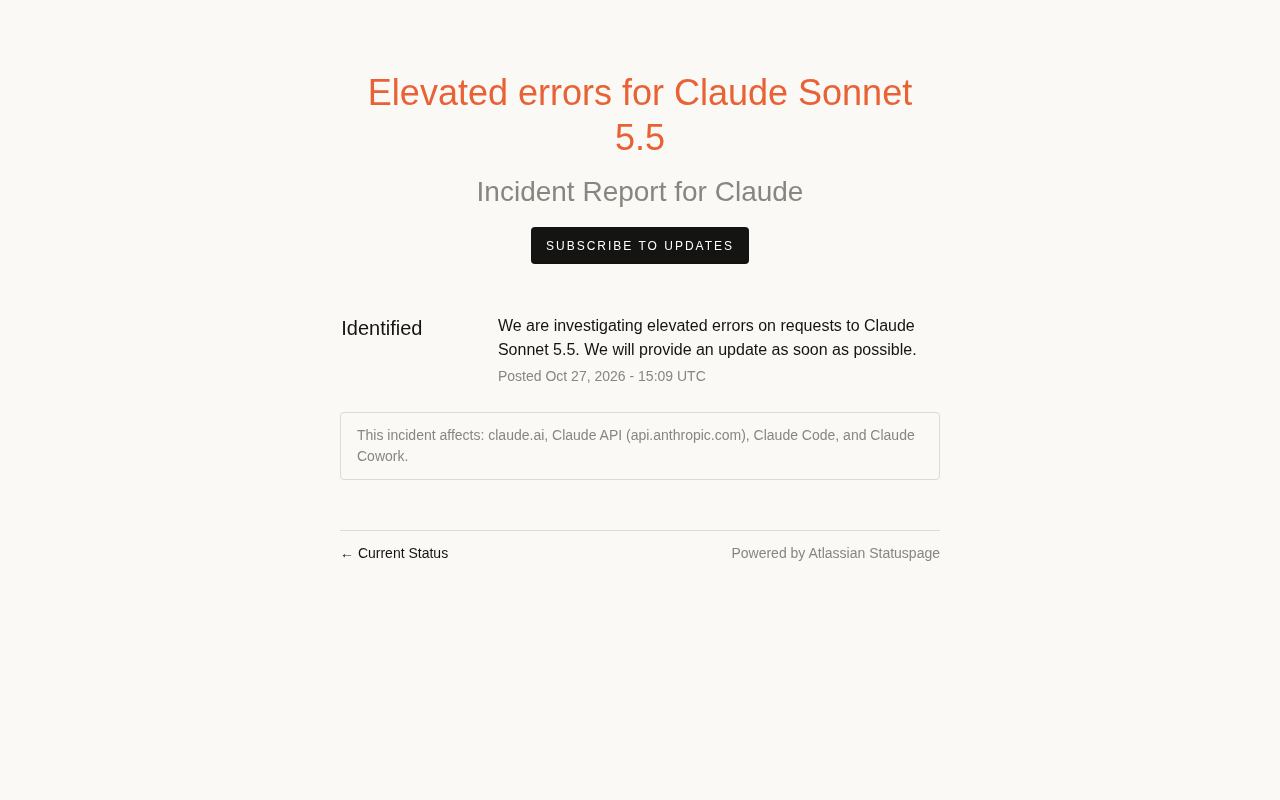
The Claude Sonnet 5.5 model experienced an abnormal increase in request error rates. The official status page marked the incident as "Identified" at 15:09 UTC on October 27, meaning the engineering team has found the direction of the problem and begun fixing it, but no estimated recovery time has been announced. The status page describes "elevated errors" rather than a complete outage, meaning some requests still succeed but the failure rate is significantly higher than normal; for high-frequency call scenarios, this elevation gets amplified into user-perceivable outages. Affected groups include not only early adopters but also teams that have integrated the model into production products. The article recommends enabling model fallback or backup routing, adding exponential backoff retry logic on the client side, and monitoring error rate curves to determine the impact scope before further official updates.
Incident Overview
According to the official status page, the Claude Sonnet 5.5 model has experienced an abnormal increase in request error rates, which has been confirmed and is under investigation. The status update was posted at 15:09 UTC on October 27 and marked as "Identified," meaning the engineering team has found the direction of the problem and begun fixing it, but no estimated recovery time has been provided yet.
For developers relying on this model for production calls, such errors typically manifest as API returning 5xx status codes or timeouts, directly affecting the availability of downstream applications.
Status Page Severity Levels: Status pages of major cloud services and AI API providers usually adopt a standardized set of status labels to describe incident progress. The common sequence is: Investigating (just confirmed anomaly, cause still unknown), Identified (root cause or affected component found), Monitoring (fix deployed and being observed), Resolved (incident closed). There are also descriptive labels such as Scheduled Maintenance and Degraded Performance. Understanding this grading matters because the transition from Investigating to Identified is often the most time-consuming phase, while entering Monitoring usually means the service has largely recovered and the remaining work is just confirming stability. Therefore, seeing the current status as Identified indicates the fix has not yet been deployed, and worst-case contingency plans are still needed.
Causes of 5xx Status Codes and Timeouts: 5xx belongs to the server error category, indicating the request reached the service provider but could not be processed correctly, fundamentally different from 4xx (client errors such as invalid parameters or authentication failures). In LLM API scenarios, 502/503 usually correspond to gateway backend unavailability or overload, 504 to inference queue timeout, and 500 mostly to internal exceptions. Since large model inference takes considerable time, a client-side read timeout set too short can also manifest as timeout errors, easily confused with genuine service failures. The way to distinguish them is to observe whether errors disappear quickly with retries: errors caused by server overload tend to be random, while timeout configuration issues reproduce consistently on specific long prompts.
Practical Impact on Developers
The Claude Sonnet series has long been the workhorse model for many AI applications, balancing performance and cost. This error surge occurred on Sonnet 5.5, affecting not only early adopters but also teams that have integrated the model into production products.
Judging from the status page wording, the scope is described as "elevated errors" rather than a complete outage—this usually means some requests still succeed, but the failure rate is significantly higher than normal. For high-frequency call scenarios, the elevated failure rate gets amplified into user-perceivable outages.
Recommendations
Before further official updates, consider the following temporary measures: enable model fallback or backup routing to switch critical requests to other available models; add exponential backoff retry logic on the client side to avoid exposing instantaneous failures directly to end users; and monitor your own error rate curves to determine whether the impact is concentrated in specific regions or call patterns.
Officials stated they will provide updates as soon as possible. It is advisable to watch for subsequent status changes on the status page—transitioning from "Identified" to "Monitoring" or "Resolved" usually means the fix has been deployed and is in the observation period.
Exponential Backoff and Jitter: Exponential backoff means retry intervals grow exponentially (e.g., 1s, 2s, 4s, 8s...), with a maximum retry count and cap interval set to avoid dense retries further aggravating pressure when the server is already overloaded. Exponential backoff alone can still cause "thundering herd" problems: a large number of clients retry simultaneously at the moment of recovery, creating new traffic spikes. Therefore, adding random jitter to the backoff time to spread out client retry moments is the industry-recommended practice. For LLM calls, error types should also be distinguished: 5xx and timeouts are worth retrying, while retrying 400-class errors is usually meaningless; also note that retrying requests with side effects (such as billed long-text generation) may cause duplicate charges, so idempotency keys or request deduplication should be designed in.
Multi-Model Abstraction Layer and Fallback Routing: Model fallback presupposes abstracting model calls out of business logic into a unified invocation interface layer, so switching models requires only configuration changes rather than code changes. Common practices include: defining primary and backup models for each task, with automatic switching based on error rate or latency thresholds; designing compatibility in prompt and output parsing, since different models follow format instructions to varying degrees, which may affect structured output after switching; and logging fallback markers for later analysis of quality differences in affected requests. It should be noted that fallback is not free—backup models may differ in capability, context length, and cost structure, and fallback strategies should be validated through stress testing before launch, not first enabled when an incident occurs.
Summary
This incident is another reminder: single-model dependency carries availability risks. Multi-model abstraction layers, timeout and retry strategies, and status page subscriptions should become standard for production-grade AI applications.
One-line Summary
Claude Sonnet 5.5 error rates spiked abnormally; officials have identified the issue but no recovery time given.
Paragraph Summary
The Claude Sonnet 5.5 model experienced an abnormal increase in request error rates. The official status page marked the incident as "Identified" at 15:09 UTC on October 27, meaning the engineering team has found the direction of the problem and begun fixing it, but no estimated recovery time has been announced. The status page describes "elevated errors" rather than a complete outage, meaning some requests still succeed but the failure rate is significantly higher than normal; for high-frequency call scenarios, this elevation gets amplified into user-perceivable outages. Affected groups include not only early adopters but also teams that have integrated the model into production products. The article recommends enabling model fallback or backup routing, adding exponential backoff retry logic on the client side, and monitoring error rate curves to determine the impact scope before further official updates, while noting that multi-model abstraction layers, timeout and retry strategies, and status page subscriptions should become standard for production-grade AI applications.
Related articles

The Truth Behind Titanic's Sinking: Key Decisions and Communication Failures in the National Geographic Documentary
National Geographic's The Unsinkable Ship uses survivor testimony to reconstruct Titanic's fatal decisions—from the missing MSG telegram prefix and the broken boiler-room-to-bridge link to how 'unsinkable' thinking delayed damage control and evacuation.

74M-Parameter Open-Source Model Partially Outperforms Jev AI in Testing
Fastino AI's Glider 2.5 models, with just 74M–300M parameters, reportedly outperform Jev AI in some guardrail benchmarks per YouTube testing, run on consumer hardware, and even play Doom. We analyze small models' competitiveness and deployment value on specific tasks.

Gemini 4 Argon Hands-On: Aggressive Pricing, 3D Capabilities Need Coaching
Gemini 4 Argon hands-on: limited-time $2/$10 pricing, million-token output, strong 3D and reverse-engineering work, but weak front-end aesthetics and zero-shot ability need coaching.