Cline Desktop v0.0.50 Update: Model Catalog Overhaul and Reasoning Control Fixes

Cline Desktop v0.0.50 fixes the reasoning parameter pipeline and overhauls the model catalog, adding 94 providers.
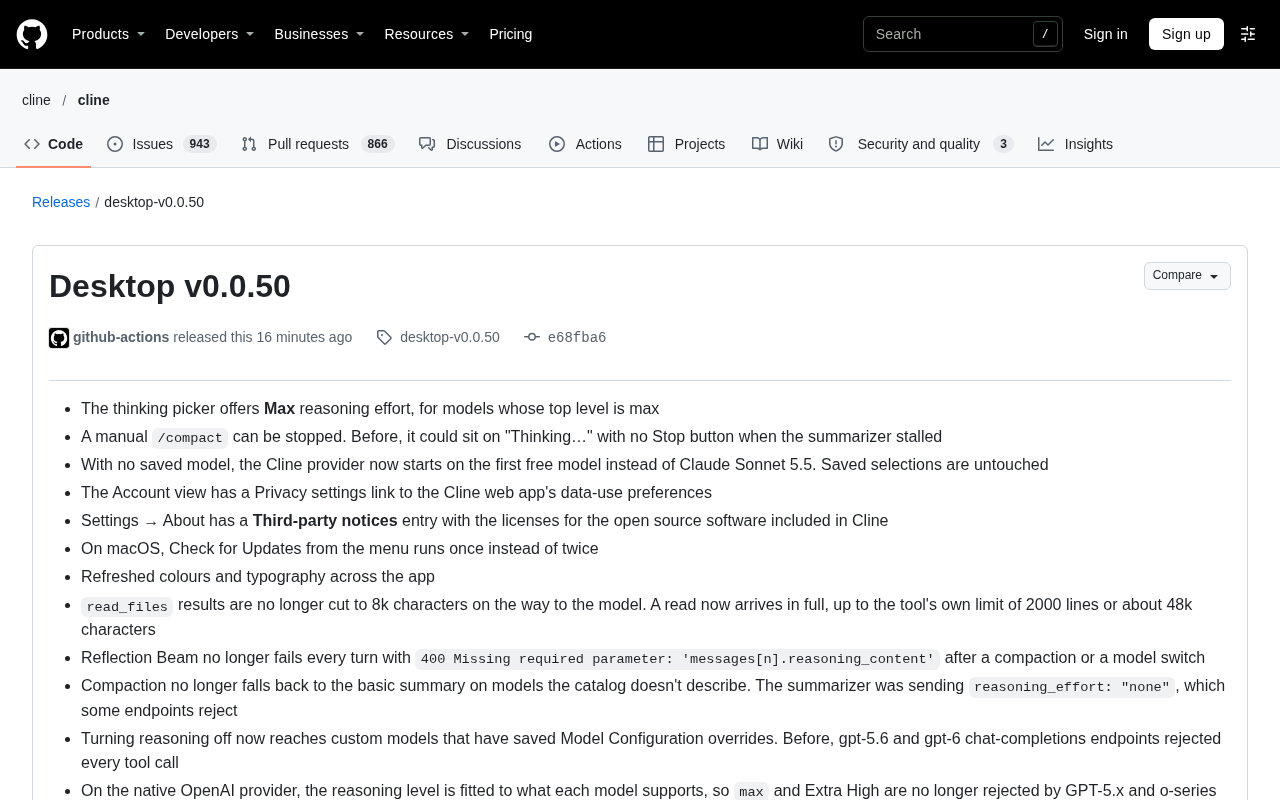
Cline Desktop v0.0.50 is primarily a fix-focused release with a catalog overhaul on the side. On the reasoning pipeline, the thinking picker adds Max reasoning effort and manual /compact can be aborted; it also fixes Reflection Beam's per-turn 400 errors, the compaction flow mistakenly sending reasoning_effort: "none" and being rejected by endpoints, custom models' disable-reasoning setting not taking effect, and GPT-5.x and o-series rejecting the max tier on the native OpenAI provider, along with correcting LiteLLM's misuse of max_tokens. On the reading side, read_files results are no longer truncated to 8k characters, with limits raised to 2000 lines or about 48k characters. The model catalog adds 94 providers from models.dev, removes Lilac and Tempr, and migrates the default models of 67 providers to Kimi K3.1 Pro, Gemini 4 Neon, or DeepSeek V4.1 Flash 1017. For compliance, privacy settings and third-party license entry points were added.
Cline Desktop v0.0.50 Update: Model Catalog Overhaul and Reasoning Control Fixes
Cline Desktop has released version v0.0.50. The focus of this update isn't flashy new features but rather fixing several long-standing stubborn issues in the reasoning pipeline, along with a large-scale overhaul of the model catalog. For developers who frequently switch models, rely on long-context reads, or use reasoning models on custom endpoints, this release resolves quite a few real-world pain points.
Systematic Fixes to the Reasoning Control Pipeline
Max Reasoning Tier and the Ability to Abort Manual Compaction
The thinking picker now includes a Max reasoning effort option, specifically for models whose top tier is max. Previously, these models couldn't express their highest reasoning intensity in the UI; now it can be explicitly selected.
Another UX-level fix is that manual /compact can now be aborted. Previously, when the summarizer got stuck, the UI would remain in a "Thinking…" state with no Stop button, leaving users to wait passively. While this fix may seem minor, it has a noticeable impact on usability during long sessions.
/compact is a common slash command in coding agent tools; its purpose is to hand lengthy conversation history to a "summarizer" model to compress into a short summary, freeing up context window space to continue working. Since compaction is a full model call, it can take tens of seconds or longer, and may also hang due to endpoint rate limiting or incompatible parameters. Without a cancellation mechanism, the entire session blocks in a waiting state—users can neither continue the conversation nor roll back, and must restart the session, losing context. Providing abort capability for long-running operations is therefore a basic usability requirement for such tools; its implementation typically relies on passing cancellation signals at the request layer, binding the UI's Stop button to the lifecycle of the underlying network request.
Fixing 400 Errors and Misdelivered Reasoning Parameters
This update addresses several parameter issues that cause requests to fail outright. Reflection Beam would fail every turn after compaction or model switching with 400 Missing required parameter: 'messages[n].reasoning_content'; this is now fixed. The compaction flow also no longer falls back to a basic summary for models not described in the catalog—the cause was the summarizer sending reasoning_effort: "none", which some endpoints reject.
The setting to disable reasoning now correctly propagates to custom models with saved Model Configuration overrides. Previously, the chat-completions endpoints for gpt-5.6 and gpt-6 would reject all tool calls. On the native OpenAI provider, reasoning levels are now adapted to each model's actual supported capabilities, so GPT-5.x and o-series models no longer reject the max and Extra High tiers.
One LiteLLM-related fix: when a model reports max_output_tokens, the legacy max_tokens field is no longer treated as an input budget. These kinds of parameter-mixing issues are often hard to pinpoint in logs, and the fix helps avoid context budget calculation errors.
reasoning_effort is a request parameter introduced by OpenAI reasoning models (o-series, GPT-5 series) to adjust the amount of thinking the model invests across tiers like minimal/low/medium/high, with some vendors extending it to values like none and xhigh. The key point is that this parameter isn't compatible with all endpoints: the native OpenAI interface, compatibility layers (such as LiteLLM), and third-party self-hosted gateways all differ in their validation of legal values, parameter names, and whether null values are allowed, so the same request may succeed on one provider and return 400 on another. reasoning_content is the thinking-process field returned in responses by some reasoning models; some gateways require that this field from historical turns be sent back to the server in multi-turn conversations, and report Missing required parameter when it's absent. The common characteristic of these errors is that they only reproduce under specific model-and-endpoint combinations, which is why they're often discovered long after release.
Reading, Files, and Localization Experience
read_files results are no longer truncated to 8k characters on the way to the model. A single read is now delivered in full, with limits determined by the tool itself—2000 lines or approximately 48k characters. For scenarios requiring analysis of large files, this means no more segmented calls or suffering information loss.
On macOS, Check for Updates from the menu now runs only once instead of twice, avoiding duplicate update checks. The overall UI color scheme and typography have also been refreshed, a routine visual iteration.
Major Model Catalog Changes: 94 New Providers and Default Model Migration
The model catalog refresh is the most impactful change in this update. 94 providers from models.dev have been added, while Lilac and Tempr have been removed. The Cline recommended list adds Muse Ember; the free list removes Reflection Beam, Laguna S 2.1, and Solar Mini 4; ClinePass removes DeepSeekAd V4.1 Flash, Mimo V2.6 Flash, Mimo V2.6 Pro, MiniMax M3, Qwen3.7 Plus, and Qwen3.7 Max.
Additionally, the default models for 67 providers have changed, mainly migrating to Kimi K3.1 Pro, Gemini 4 Neon (including the gemini and vertex providers), or DeepSeek V4.1 Flash 1017. Users relying on default configurations should pay attention after upgrading to whether the model actually being called has changed.
When no model is saved, the Cline provider now starts from the first free model instead of Claude Sonnet 5.5; saved selections are unaffected.
models.dev is a community-maintained catalog of model and provider metadata, aggregating pricing, context windows, maximum output lengths, supported modalities, and capability flags (such as whether tool calling or reasoning tiers are supported) for various models. Many client tools use it as the upstream data source for model lists to avoid manually maintaining specs for hundreds of providers. The benefit of using such external catalogs is fast onboarding of new models and standardized fields; the cost is uneven description quality among upstream entries—some models lack capability annotations, making it easy for clients to "guess wrong" when making parameter decisions. This is precisely the root cause of issues like "falling back to a basic summary for models not described in the catalog" in this update. When a model's reasoning capability isn't annotated in the catalog, the client needs an explicit fallback strategy rather than sending a default value that may be rejected.
Privacy and Compliance Entry Points Added
The Account view adds a Privacy settings link pointing to data usage preferences in the Cline Web app. Settings → About adds a Third-party notices entry listing the licenses of open-source software included in Cline. These two changes lean toward compliance and transparency, providing real value for team users who need to audit dependencies or manage data preferences.
Upgrade Recommendations
Users on custom endpoints or LiteLLM should upgrade first, as these fixes directly affect whether tool calls succeed. Users of GPT-5.x, o-series, or reasoning models will also benefit from the reasoning tier adaptation logic. Users relying on default models are advised to check the actually effective model once after upgrading to confirm it matches expectations.
Related articles

ClawDOS: Bringing AI Coding Capabilities to DOS
ClawDOS is an AI coding agent project for DOS, exploring the possibility of bringing AI coding assistance into resource-constrained retro computing environments. This article analyzes its positioning, use cases, and community response.

Baseten Releases Bison-1 and Groundhog-1, Topping the Decision Model Leaderboard
Baseten releases open-weight decision models bison-1 and groundhog-1 built on Gemma 4; bison-1 scores 76 on the AA Decision Index v2.1 to top the leaderboard. Both support 128k context and image input—here we analyze their capability combination, benchmark significance, and selection advice for developers.

Cline CLI v3.0.75 Released: Yolo Mode Now Default for One-Shot Runs
Cline CLI v3.0.75: one-shot runs now default to yolo mode, --timeout and Ctrl+C can interrupt the first round, read_files is no longer truncated to 8k chars, plus reasoning parameter fixes and 94 new providers.