Cline Releases @cline/shared 0.2.0: AI Coding Tool SDK Update

Cline releases shared SDK @cline/shared 0.2.0, auto-published with no changelog disclosed.
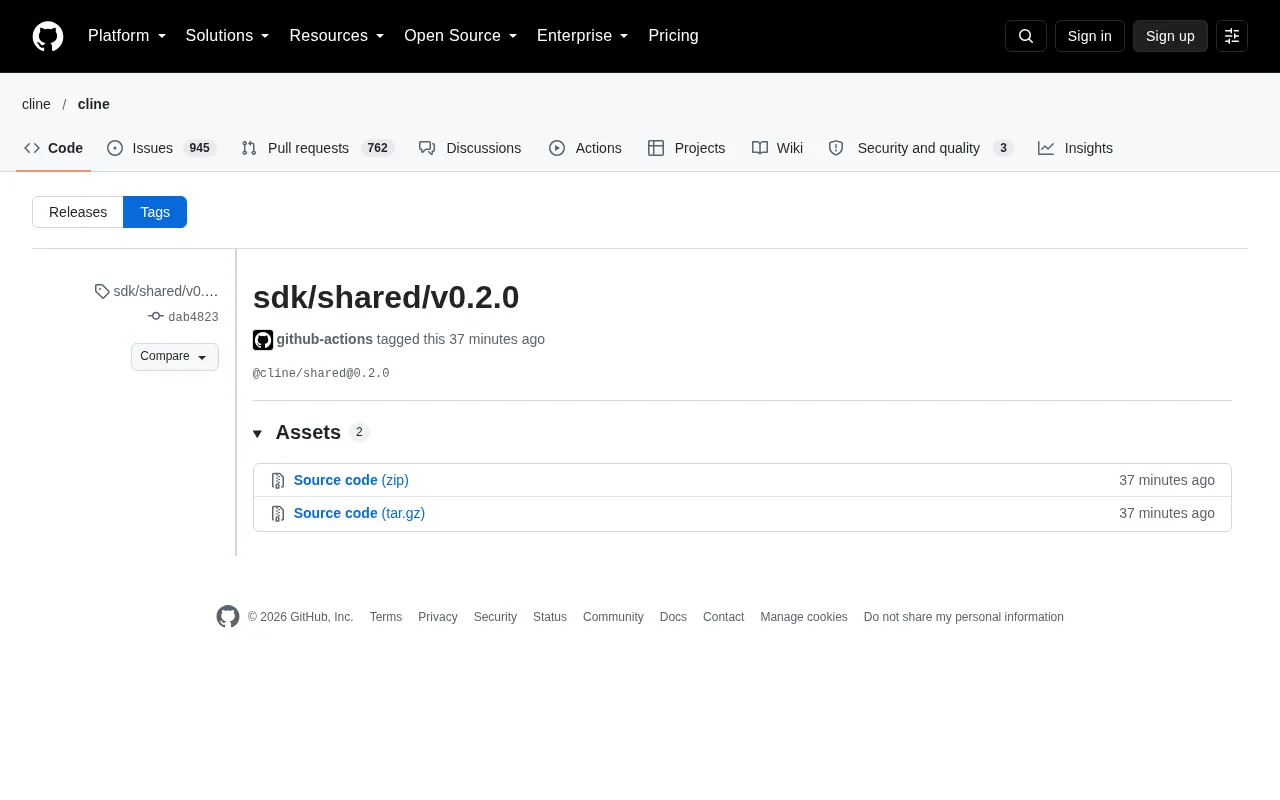
Cline released version 0.2.0 of its shared SDK package @cline/shared, tagged by GitHub Actions and corresponding to commit hash dab4823. The package carries core logic reused across components of the Cline AI coding assistant, and 0.2.0 is an early-stage iteration. Since the release page lacks a full changelog and asset details, developers cannot directly assess API or breaking changes and must consult the repository's commit history. The article notes that independent versioned SDK releases signal Cline is organizing internal shared code into reusable public packages, giving third-party tools clearer integration boundaries; dependent projects should test thoroughly before upgrading and watch for official follow-up notes.
Cline Releases @cline/shared 0.2.0: AI Coding Tool SDK Update
AI coding assistant Cline has recently released version 0.2.0 of its shared SDK package @cline/shared. While this update may seem like a minor bump in the version number, it's worth paying attention to for developers who build on the Cline ecosystem or integrate AI coding capabilities into their own tools.
Release Overview
According to the release record on GitHub, @cline/shared@0.2.0 was tagged by the github-actions automation pipeline at 03:33 on October 26, corresponding to commit hash dab4823. The release page contains 2 asset files, but some dynamically loaded content on the original page failed to display properly, so the specific changelog and asset details remain incomplete.
Judging from the version naming, 0.2.0 represents an early-stage iteration. As a shared module of the Cline project, @cline/shared typically carries core logic and utility functions reused across components, so version updates often signal adjustments or extensions to underlying capabilities.
Semantic Versioning (SemVer) and What 0.x Means
The version number 0.2.0 follows the Semantic Versioning specification: major.minor.patch. Under SemVer conventions, a major version of 0 indicates "initial development," where the public API is not considered stable, and any minor version bump (such as 0.1 to 0.2) may include breaking changes. This means projects depending on @cline/shared cannot assume that minor version upgrades are backward compatible the way they would with versions 1.x and above; when upgrading to 0.2.0, interface changes must be carefully verified.
Commit Hash and Automated Tagging
The dab4823 in the release record is the short hash of a Git commit, uniquely identifying the specific code snapshot that produced this version. github-actions as the tagger indicates that the release was completed automatically by a CI/CD pipeline rather than manually. This approach ensures the release process is reproducible and traceable, but it also means release notes usually require additional manual supplementation—which explains why the original page did not directly present a changelog.
Significance for the AI Coding Ecosystem
Cline is an active open-source AI coding assistant project in recent years, allowing developers to directly invoke large models within their editors to accomplish tasks such as code generation, refactoring, and debugging. The independent versioned release of its SDK indicates that the project is organizing internal shared code into reusable public packages, providing clearer interface boundaries for third-party tools to integrate Cline's capabilities.
However, since this release does not disclose specific API changes, new features, or breaking changes, developers who want to assess the impact of upgrading will still need to consult the commit history and changelog in the repository. For projects that depend on this package in production, thorough testing before upgrading is recommended.
The Role of a Shared Package in a Monorepo
In projects like Cline, @cline/shared is typically an internal package under a monorepo architecture, housing type definitions, constants, utility functions, and protocol interfaces shared by multiple sub-packages or applications. Publishing it independently to a package registry (such as npm) means external developers can import these shared logic modules like any ordinary dependency, without copying code or depending on the entire main repository.
The Boundary Between SDK and Editor Integration
AI coding assistants typically take the form of editor plugins (VS Code extensions, etc.), and internally they need to handle model invocation, prompt assembly, context management, and similar logic. Extracting these capabilities into an SDK is equivalent to providing a stable programming interface for third-party tools. Once the interface boundaries are clear, other IDEs or automation tools can reuse Cline's core capabilities at lower cost—this is also a common path for open-source projects moving from a "single product" to a "platform ecosystem."
What Developers Should Watch For
For developers using @cline/shared, the 0.2.0 release highlights several action items: confirm the differences between your current dependency version and 0.2.0, and check for interface incompatibilities; watch for official follow-up release notes; and verify that the assets generated by the automated release pipeline are complete and usable.
Against the backdrop of increasingly fierce competition in AI coding tools, standardized SDK iteration is one signal of a project maturing. Through its independent versioned release mechanism, Cline is laying the foundation for broader ecosystem integration.
One-line Summary
Cline releases shared SDK @cline/shared 0.2.0, automatically published but with no changelog disclosed.
Paragraph Summary
Cline recently released version 0.2.0 of its shared SDK package @cline/shared, tagged by a GitHub Actions automation pipeline and corresponding to commit hash dab4823. The package carries core logic reused across components of the Cline AI coding assistant, and 0.2.0 is an early-stage iteration. Because the release page does not fully disclose the changelog or asset details, developers cannot directly assess API changes or breaking changes and need to consult the repository's commit history. The article notes that independent versioned releases of the SDK show Cline is organizing internal shared code into reusable public packages, providing clearer interface boundaries for third-party tools to integrate its capabilities; projects depending on this package should test thoroughly before upgrading and watch for official follow-up notes.
Related articles

The Truth Behind Titanic's Sinking: Key Decisions and Communication Failures in the National Geographic Documentary
National Geographic's The Unsinkable Ship uses survivor testimony to reconstruct Titanic's fatal decisions—from the missing MSG telegram prefix and the broken boiler-room-to-bridge link to how 'unsinkable' thinking delayed damage control and evacuation.

74M-Parameter Open-Source Model Partially Outperforms Jev AI in Testing
Fastino AI's Glider 2.5 models, with just 74M–300M parameters, reportedly outperform Jev AI in some guardrail benchmarks per YouTube testing, run on consumer hardware, and even play Doom. We analyze small models' competitiveness and deployment value on specific tasks.

Gemini 4 Argon Hands-On: Aggressive Pricing, 3D Capabilities Need Coaching
Gemini 4 Argon hands-on: limited-time $2/$10 pricing, million-token output, strong 3D and reverse-engineering work, but weak front-end aesthetics and zero-shot ability need coaching.