Cline v4.1.26 Update Analysis: Cloud Tasks and Model Options Get a Full Upgrade

Cline v4.1.26 optimizes cloud task model configuration and sandbox progress, fixing compatibility and interaction issues.
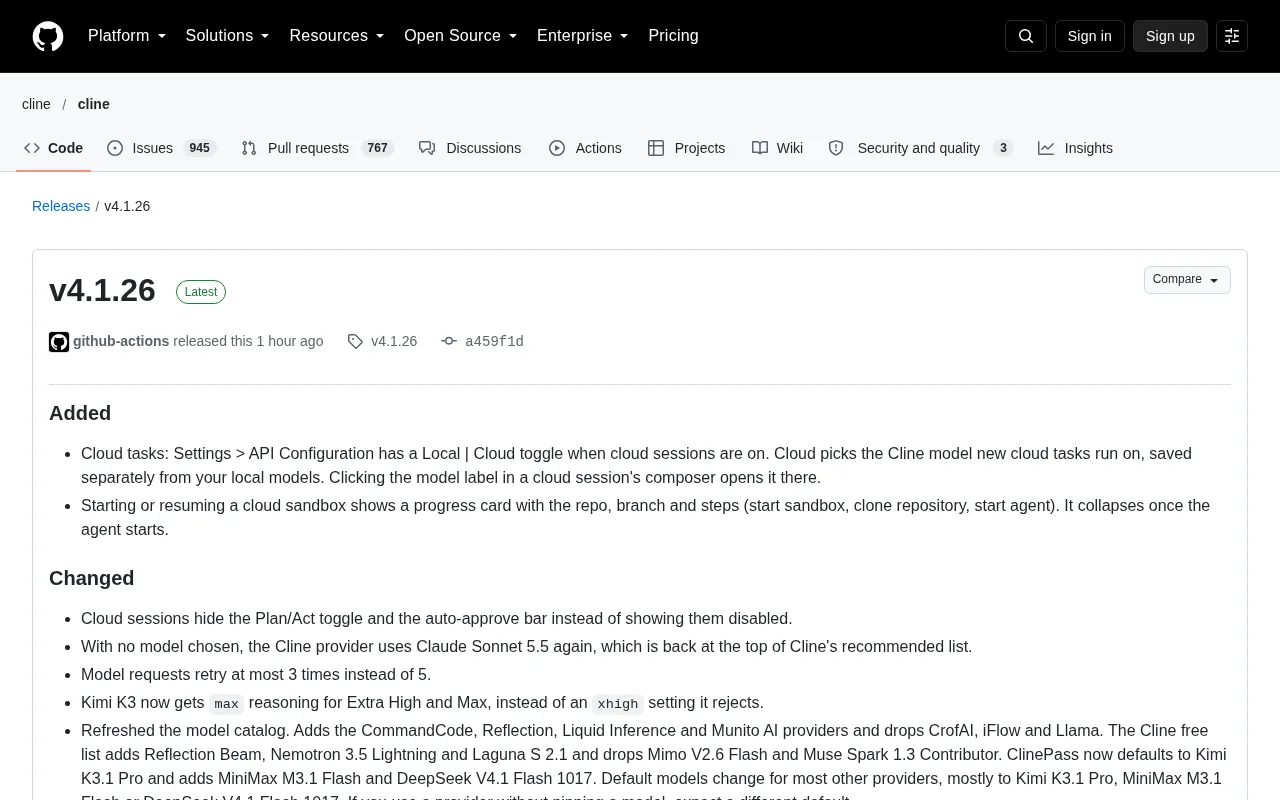
Cline released v4.1.26, improving cloud tasks and model selection. A Local | Cloud toggle saves cloud and local models independently, with model switching in the cloud session input; a sandbox startup card shows repository, branch, and steps, collapsing once the agent runs. The default model reverts to Claude Sonnet 5.5, the catalog gains providers and updated free/ClinePass lists, Kimi K3 high reasoning uses `max`, and retries drop from 5 to 3. Fixes cover GPT-6 `max_completion_tokens` on OpenAI/Azure/SAP AI Core, Gemini free-key 429s and lost tools, plus Plan/Act, focus, auto-compaction, and `ask_question`/`run_commands` behavior.
AI coding assistant Cline has released version v4.1.26, bringing a range of feature improvements and bug fixes. This update focuses on optimizing the cloud task experience and model selection logic, and resolves a batch of detail issues affecting workflows.
Cloud Task Experience Upgrade
Local vs. Cloud Model Switching
Cline has added a Local | Cloud toggle to the API configuration page in settings (available when cloud sessions are enabled). Model selection in cloud mode is saved independently from local models, meaning users can specify a different default model for cloud tasks than for local ones. Clicking the model label in the cloud session input box lets you adjust the cloud model directly, shortening the interaction path.
A Cloud Sandbox is the isolated execution environment Cline provides for cloud tasks: each time a task starts, the system clones a specified repository and branch into a temporary container, where an agent process then reads and writes code and executes commands, avoiding pollution of the developer's local workspace. Because of this, the models, credentials, and quotas used by cloud sessions may differ from local ones, requiring independent model configuration. Cloud sandboxes typically have lifecycle limits and are reclaimed after prolonged idle periods; restoring one requires spinning the container back up and re-cloning the repository, which is why startup progress needs to be shown step by step.
Sandbox Startup Progress Visualization
When starting or restoring a cloud sandbox, the interface displays a progress card listing the repository, branch, and current step (starting sandbox, cloning repository, starting agent). Once the agent begins running, the card automatically collapses to avoid taking up screen space. This change makes the cloud task startup process more transparent and makes it easier to pinpoint which step is stuck when problems occur.
Model Selection and Reasoning Parameter Adjustments
Default Model Rollback and Recommendation List Updates
When no model is selected, the Cline provider reverts to Claude Sonnet 5.5, which also returns to the top of Cline's recommendation list. The model catalog has been refreshed overall: providers CommandCode, Reflection, Liquid Inference, and Munito AI have been added, while CrofAI, iFlow, and Llama have been removed. The Cline free list now includes Reflection Beam, Nemotron 3.5 Lightning, and Laguna S 2.1, while Mimo V2.6 Flash and Muse Spark 1.3 Contributor have been removed. The ClinePass default model has changed to Kimi K3.1 Pro, with MiniMax M3.1 Flash and DeepSeekAd V4.1 Flash 1017 newly added. Default models for most other providers have also been standardized to these options.
The Model Catalog refers to Cline's built-in list of providers and models, including each provider's access endpoint, authentication method, available model list, and respective default model. The Cline client uses it to render selectable options in the settings page and to determine the fallback model when the user has not explicitly chosen one. The catalog is generally refreshed in full with each client release, so upgrades may result in providers being added or removed and default models changing; if users previously relied on a provider that has been delisted, they need to manually select another entry. ClinePass, meanwhile, is Cline's subscription-based access solution, whose default model and free list are maintained independently of each other.
Reasoning Effort and Retry Policy
Kimi K3's Extra High and Max reasoning effort levels now use the max parameter; the previously sent xhigh setting is rejected by this model. The maximum number of retries for model requests has been reduced from 5 to 3, cutting down on unnecessary waiting.
Reasoning Effort is a parameter supported by some reasoning models that controls how deeply the model thinks internally before giving an answer, with common levels from low to high being low, medium, and high, and some models offering even higher levels. Different vendors do not use uniform parameter names for their highest level—some accept high, while others require max or xhigh; sending the wrong one causes the API to reject the request outright with a parameter error. Retry policy refers to the mechanism by which the client automatically resends a request after a failure (such as a network interruption, rate limiting, or a server-side 5xx). A higher retry limit increases the success rate for transient failures, but prolongs waiting time during persistent failures, requiring a trade-off between fault tolerance and response speed.
Key Bug Fixes
Compatibility and Quota Issues
GPT-6 series models (such as gpt-6-sol and gpt-6.1-sol) now work properly on OpenAI and Azure OpenAI-compatible endpoints, and SAP AI Core no longer rejects requests with "Unsupported parameter: 'max_tokens'"—these models uniformly use the max_completion_tokens parameter. Another important fix targets the Gemini API: native Google Search is no longer sent when using a key from the gemini provider, the issue where free-tier keys reported a 429 quota error on every turn with Gemini 3+ has been resolved, and the issue where Cline tools were dropped on Gemini 2.x has also been fixed.
Both max_tokens and max_completion_tokens are parameters that limit the length of a model's single output; the former is a general field from the earlier Chat Completions API, while the latter is a new field introduced by OpenAI for reasoning models to calculate visible output separately from internal reasoning consumption. Newer models often accept only max_completion_tokens, and continuing to send max_tokens results in an "Unsupported parameter" error. In addition, Gemini free-tier keys have strict per-minute and daily request quotas, and exceeding them returns HTTP 429; if the client additionally attaches a native Google Search tool call on every turn, the request volume is further amplified, causing free keys to hit rate limits more quickly.
Interaction and Stability
Switching between Plan/Act modes during task startup no longer loses the first prompt, and the session no longer continues running with the other mode's tools. Disabled rules now stay disabled. After launching a command, keyboard focus no longer jumps into the terminal, so text being typed in the chat box does not accidentally end up in the shell. When cancelling a task or opening another task while Cline is asking a question, the next message is no longer treated as an answer to the old question. If the model disconnects after outputting only reasoning content, that turn is retried instead of ending the task outright.
Tool Behavior Corrections
Auto-compaction no longer applies to models with unknown context limits, and no longer repeats every few tool calls after the first compaction. The ask_question tool now lets the model proceed after you select an option, and empty answers are rejected. run_commands now returns an error rather than silently succeeding when passed an empty command list; under PowerShell, the tool tells the model the rules for quote escaping and requires confirmation before recursive deletion. On the interface side, task title badges now wrap instead of covering the close button, the GitHub connection check no longer flashes a loading indicator, and the spacing issue with the Local/Cloud toggle has also been fixed.
Update Recommendations
For users who rely on cloud tasks for team collaboration, the Local/Cloud model separation and sandbox progress card in this release are worth trying first. For developers using Gemini free keys or GPT-6 series models, this release's fixes directly resolve blocking issues, so upgrading as soon as possible is recommended.
One-line Summary
Cline v4.1.26 optimizes cloud task model configuration and sandbox progress, and fixes multiple compatibility and interaction issues.
Paragraph Summary
Cline has released version v4.1.26, focusing on improving the cloud task and model selection experience. A Local | Cloud toggle has been added to the settings page, with cloud and local models saved independently, and models can be switched directly in the cloud session input box; when a cloud sandbox starts, a progress card shows the repository, branch, and current step, and collapses automatically once the agent runs. On the model side, the default model has reverted to Claude Sonnet 5.5, the catalog has added several providers and adjusted the free and ClinePass lists, Kimi K3's high reasoning levels now use the max parameter, and the retry limit has dropped from 5 to 3. Fixes cover max_completion_tokens compatibility for GPT-6 series models on OpenAI, Azure, and SAP AI Core, as well as the 429 quota and tool-loss issues with Gemini free keys, and correct Plan/Act switching, focus jumps, auto-compaction, and tool behaviors including ask_question and run_commands.
Related articles

Data Scraping, AI Proofs, and Open Source Contracts: This Week's Deep Dive into the Tech World
From the 3D model crawler controversy and OpenAI's Lean formal proofs to AI agents challenging Brooks' Law and Debian rejecting LLM review, this week's tech discussions center on openness and verifiability.

Build a Reasoning Model from Scratch: An 11-Hour Open-Source Course Breakdown
Sebastian Raschka releases a free 8-episode, ~11-hour video course teaching you to build a reasoning model from scratch with Python and PyTorch—from a small Qwen3 model through Verifier, Inference Time Scaling, GRPO, and distillation, with open-source code on GitHub.

An 11-Hour Reasoning Model Course in Practice: How Small Models Learn to Think
Starting from Sebastian Raschka's 11-hour reasoning model course and HN buzz, this analyzes small-model training, legal text version control, Anthropic data policy, and product reliability reviews.