Cloudflare Ports TypeScript to Rust: A Look at the Tsrs Project

Cloudflare open-sources Tsrs, rewriting the TypeScript compiler in Rust for edge computing
Cloudflare has unveiled the experimental Tsrs project, reimplementing the TypeScript compiler's syntax parsing, type checking, and partial code generation in Rust. Driven by Workers edge computing needs—where spinning up Node.js for server-side TypeScript validation is too costly—Tsrs ports on demand, prioritizing high-frequency syntax and type features over full compatibility. Unlike Rust transpilers swc and oxc, it focuses on the type-checking layer, positioning it as a tsc replacement. Hacker News debate centers on motivation, behavioral compatibility of diagnostics, and ecosystem fit. Short-term impact on ordinary developers is limited, but the shift of compiler infrastructure to Rust is worth watching.
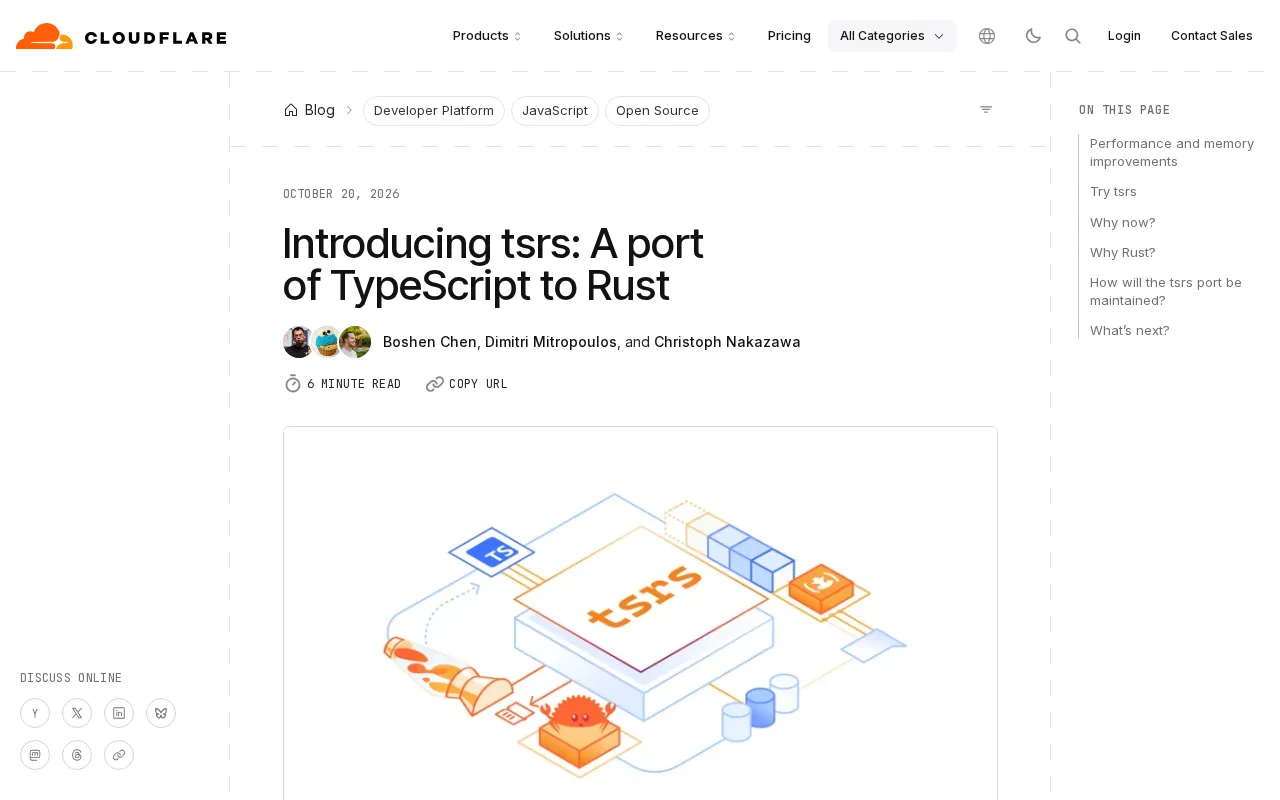
Cloudflare recently unveiled an experimental project called Tsrs—a port of the TypeScript compiler to the Rust language. The news earned 295 points and 138 comments on Hacker News, with discussion centered on three questions: "why rewrite it," "how much performance gain," and "how will it coexist with the existing toolchain."
What Tsrs Is: Replacing the Compiler Foundation
According to the Cloudflare blog, Tsrs isn't reinventing TypeScript but rather reimplementing the core logic of the TypeScript compiler in Rust. The official TypeScript compiler (tsc) is written in JavaScript/TypeScript, runs on Node.js, and performs type checking and code generation within the same process. Tsrs aims to move this pipeline to the Rust side, yielding structural gains in startup speed, memory footprint, and parallelism.
The project is directly tied to Cloudflare's own edge computing scenarios. The Workers platform needs to rapidly validate and transform user-submitted TypeScript code on the server side; if a Node.js runtime had to be spun up each time, cold-start and resource overhead would be unacceptable. Rewriting the compiler in Rust effectively turns "type checking" into a native capability that can be embedded in edge nodes.
Technical Approach: From Type Checking to Code Generation
Based on public information, Tsrs's porting scope covers TypeScript's syntax parsing, type checking, and part of the emit logic. The TypeScript compiler itself is enormous in code volume with a vast array of semantic rules, and a complete port would be measured in person-years of engineering effort. Cloudflare's approach is closer to "on-demand porting": prioritize the syntax subset and type features heavily used in Workers scenarios, then progressively advance toward full compatibility.
Worth noting are the related efforts already in the Rust ecosystem. Both swc and oxc implement TypeScript syntax parsing and partial transformation capabilities, but their positioning leans toward "transpilers within a bundling toolchain" rather than complete type checkers. Only if Tsrs can achieve results consistent with tsc at the type-checking level would it truly fill the missing piece in the Rust toolchain.
How swc and oxc Differ in Positioning
swc (Speedy Web Compiler) is a JavaScript/TypeScript transpilation and bundling tool written in Rust. Its core capability is converting syntax like TS/JSX into target JavaScript, with support for minification and module bundling; it has been adopted by frameworks such as Next.js. oxc (Ocean of Code) is a younger collection of Rust tools including a parser, linter, and transpiler, aiming for extreme parsing and transformation speed. What both share is that they center on syntax-level parsing and code transformation, performing only "erasure" of TypeScript's type semantics (deleting type annotations) rather than complete type checking. Real type checking requires building symbol tables, performing type inference and control-flow analysis—far more complex than transpilation. The unique value of tsc lies precisely in this type-checking layer, so if Tsrs can match tsc's diagnostic results, it fills exactly the gap left by swc/oxc.
The Three Focal Points of Community Discussion
First, is the motivation sufficient? Some HN commenters argue that the TypeScript compiler team has been continuously optimizing performance and Node.js startup overhead is also improving; whether the gains from a Rust rewrite can justify long-term maintenance costs remains to be seen.
Second, the boundaries of compatibility. TypeScript's type system contains a large number of edge-case semantics and editor-related behaviors, and any rewrite faces the test of "behavioral consistency." The community is broadly concerned about whether Tsrs will provide diagnostic message formats consistent with tsc; otherwise, IDE and CI integration will break.
Third, the relationship with the existing ecosystem. swc, oxc, and esbuild already occupy most of the toolchain positions on the Rust side. Tsrs's differentiation lies in type checking rather than transpilation, which makes it more of a tsc replacement than a bundler competitor.
Why "Behavioral Consistency" Is So Hard
TypeScript's type checking is not a purely formal specification; many semantic details are fixed by tsc's implementation and test cases, including error codes, error locations, message text, and even the reporting order of multiple errors. IDEs (such as VS Code's tsserver protocol) and CI tools all depend on these output formats. When rewriting the compiler, even if type determination results are correct, downstream tools may fail to parse or display incorrectly if the structure or order of diagnostic information differs. Moreover, each TypeScript version introduces new syntax and new rules, and rewriters must continuously track upstream changes—this constitutes the main burden of long-term maintenance and is the core reason the community questions "whether the gains can cover the costs."
Practical Impact on Developers
In the short term, Tsrs has no direct impact on ordinary front-end developers—it remains an experimental project and has not entered mainstream npm workflows. But its direction is worth watching: the trend of migrating compiler infrastructure to Rust is accelerating, with every step—from bundling and minification to type checking—being reimplemented. If Tsrs can get type checking working, the type-checking step in CI could shrink from "minutes" to "seconds" in the future.
For Cloudflare Workers users, the significance of this work is more direct: server-side TypeScript validation and builds are expected to become lighter, and the build pipeline for edge deployments shorter.
Conclusion
Tsrs is a high-risk engineering experiment: the TypeScript compiler is one of the most deeply coupled components in the front-end ecosystem, and rewriting it in Rust means tracking upstream semantic changes over the long term. By making this project public, Cloudflare is both validating a technical path and paving the way for the Workers build experience. Whether it can become a trustworthy replacement for tsc depends on compatibility coverage and community adoption speed, not on raw performance numbers alone.
One-line Summary
Cloudflare open-sources Tsrs, rewriting the TypeScript compiler in Rust to serve edge computing
Paragraph Summary
Cloudflare has unveiled the experimental Tsrs project, reimplementing the TypeScript compiler's syntax parsing, type checking, and part of its code generation logic in Rust. The motivation comes from Workers edge computing scenarios: validating user TypeScript code server-side incurs prohibitive cold-start and resource overhead when spinning up a Node.js runtime. Tsrs adopts an on-demand porting strategy, prioritizing the syntax and type features most used by Workers rather than one-shot full compatibility. Its distinction from Rust transpilation tools like swc and oxc is its focus on the type-checking layer, positioning it closer to a tsc replacement. Hacker News discussion centers on whether the motivation is sufficient, behavioral compatibility boundaries such as diagnostic messages, and its relationship with the existing toolchain. In the short term, its impact on ordinary developers is limited, but the trend of migrating compiler infrastructure to Rust is worth watching.
Related articles

Why Does Self-Play AI Always Get Crushed by Cheap Units? An RTS Developer's Account of the Dilemma
An independent developer trained an RTS commander AI with pure self-play, only to find it dominated historical versions but was crushed by human players using cheap tier-1 units. This article analyzes the causes of self-play strategy collapse, explores solutions such as exploiters, diversity rewards, and reward design, and introduces the open Bot Kit and AI league plan.

Which Multi-Agent Platform Wins? A Small Team's Battle Scars and Selection Considerations
A 27-person startup's ops lead tried two multi-agent platforms in four months and both failed. This article analyzes why small-team deployments break down, and offers selection guidance on integration depth, observability, and progressive rollout.

Thrive Holdings Takes ADT Private in $7.6 Billion Deal
Thrive Holdings acquires ADT for $7.6 billion in an all-cash take-private deal expected to close in Q1 2027. Analysis of the deal structure, ADT's asset value, and impact on the smart home security industry.