Codeberg Goes Down Due to Domain Issue: An Open-Source Code Hosting Crisis

Codeberg went down due to a domain issue, exposing the infrastructure fragility of nonprofit open-source hosting platforms.
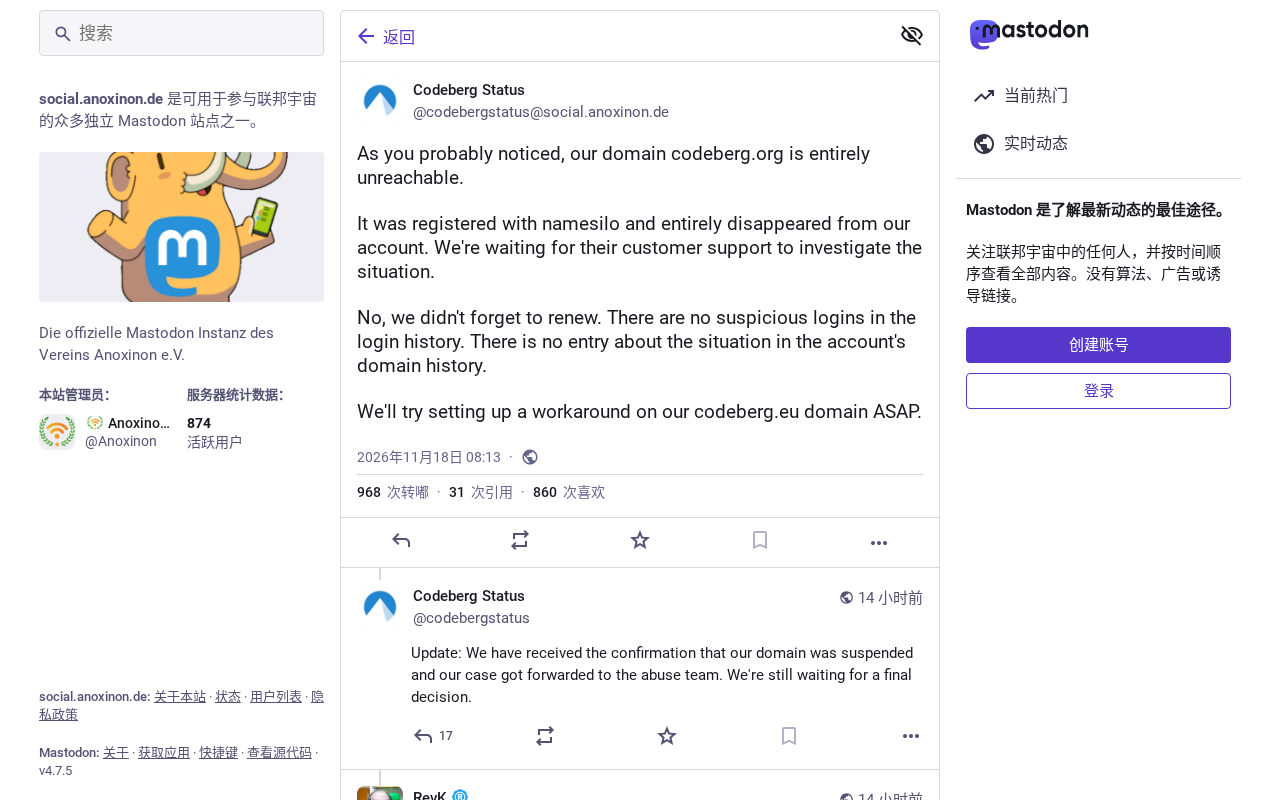
The open-source code hosting platform Codeberg experienced an outage due to a domain issue. The news originated from a Hacker News discussion but included only a title and a few comments, lacking technical details and official responses. The article outlines the background: Codeberg is operated by the German nonprofit association Codeberg e.V. and offers an alternative to commercial platforms for free and open-source software. A domain failure may manifest as DNS resolution failure, registration expiration, or server misconfiguration, with the specific cause still unclear. Such failures block users from accessing repositories, submitting code, and pulling updates, and may also affect projects that rely on it for CI builds and package management. Because nonprofit platforms have limited resources, recovery speed may be constrained by volunteer response and budget limitations. The article advises developers to follow official status channels and to consider multi-platform mirrors to diversify single-point-of-failure risk.
According to discussions on Hacker News, the open-source code hosting platform Codeberg experienced an outage due to a domain issue. The news drew attention within the community, but the original information contained only a title and a few discussion points, lacking technical details and official responses.

Event Overview
Codeberg is a nonprofit open-source code hosting platform operated by the German registered association Codeberg e.V., aiming to provide hosting services as an alternative to commercial platforms for free and open-source software projects. This outage was attributed to a "domain issue," but whether it was a DNS resolution failure, an expired domain registration, or a misconfiguration of name servers remains unclear.
In the Hacker News post, the news received only 11 upvotes and 2 comments, indicating low discussion volume. However, given Codeberg's user base within the open-source community, infrastructure failures of this kind could affect the daily workflows of a large number of developers.
Codeberg e.V. and Forgejo
Codeberg is operated by Codeberg e.V., a nonprofit association registered in Germany, and its tech stack is built on the open-source software Forgejo (formerly a fork of Gitea). Forgejo is a lightweight self-hosted Git service platform offering repository hosting, issue tracking, pull requests, and CI integration. Codeberg and the Forgejo project are closely related—some core Forgejo developers are also members of Codeberg, and its infrastructure is used to support Forgejo's continuous integration and development processes. This "platform as project incubator" relationship means that Codeberg's availability not only affects ordinary users but may also indirectly impact the development pace of upstream open-source projects themselves.
Typical Forms of DNS and Domain Failures
Domain issues typically involve several layers: domain registration status (e.g., suspension of resolution due to an unrenewed expiration), DNS record configuration (A/AAAA/CNAME records pointing to the wrong address), authoritative name server availability (NS servers going down or timing out), DNSSEC misconfiguration (expired signatures or broken chains causing resolution failures), and registrar-side lock or transfer states. Recovery times vary widely across these layers: DNS record corrections may take effect within minutes (depending on TTL), while recovery from the redemption period after domain expiration may take hours or even days. Since the public information does not specify the layer involved, it is currently impossible to determine whether this outage is a quickly fixable configuration problem or a longer interruption involving registrar processes.
Possible Impact of the Domain Issue
The domain name system is the entry point for internet services. For a code hosting platform, a domain failure means users cannot access repositories, submit code, or pull updates through the usual URLs. If the outage lasts long, projects relying on Codeberg for continuous integration or package management may face build failures.
Unlike commercial platforms, nonprofit hosting services usually have limited resources, and recovery speed may be constrained by volunteer response times and budget limitations. This is one reason the community is paying attention to this incident.
The Dependency Chain of Code Hosting Platforms
Modern software development relies on code hosting platforms for far more than "humans visiting web pages." CI/CD pipelines typically pull code via Git over HTTPS or SSH, package managers (such as Go modules, npm, Cargo) may directly reference repository addresses on hosting platforms, and container builds also clone dependencies from these addresses. Therefore, a domain resolution failure propagates down the dependency chain: even if the platform's servers themselves are running normally, all automation processes based on the domain name will fail as long as the domain cannot be resolved. Moreover, if a project hardcodes Codeberg domain paths in files such as go.mod, builds of those dependencies cannot complete during the outage until DNS is restored or a mirror is used as a substitute.
Operational Constraints of Nonprofit Hosting Platforms
Nonprofit platforms usually rely on donations and volunteers for maintenance, and they lag behind commercial cloud services in hardware redundancy, multi-region deployment, and 24/7 on-call response. Although foundational elements like domains and DNS are not costly, they require dedicated people to continuously monitor renewals, certificate rotation, and configuration audits. Organizations with limited resources often lack automated monitoring and alerting, so fault detection and diagnosis depend more on community feedback, which lengthens recovery times.
Community Reaction and Information Gaps
Currently, the publicly available information is extremely limited. The two comments on Hacker News provided no substantive technical analysis or official status updates. Codeberg has not yet issued a statement through that post, so the root cause, scope of impact, and estimated recovery time of the outage all remain unclear.
For developers who rely on Codeberg, it is advisable to follow its official status page or social media channels for the latest updates. With incomplete information, it is inappropriate to make excessive inferences about the cause of the outage.
Implications for Open-Source Infrastructure
This incident once again reminds us that the infrastructure the open-source ecosystem depends on is not invulnerable. Seemingly trivial operational tasks such as domain management, DNS configuration, and certificate maintenance actually form a critical chain for service availability. How nonprofit platforms can establish redundancy and failover mechanisms with limited resources is a topic worthy of long-term community discussion.
For project maintainers, diversifying hosting risk—for example, keeping mirrors on multiple platforms—is a pragmatic strategy for coping with single points of failure.
One-line Summary
Codeberg went down due to a domain issue, exposing the infrastructure fragility of nonprofit open-source hosting platforms.
Paragraph Summary
The open-source code hosting platform Codeberg experienced an outage due to a domain issue. The news originated from a Hacker News discussion, but the original information consisted only of a title and a few comments, lacking technical details and official responses. The article outlines the background: Codeberg is operated by the German nonprofit association Codeberg e.V. and provides an alternative to commercial platforms for free and open-source software. A domain failure may manifest as DNS resolution failure, registration expiration, or server misconfiguration, and the specific cause remains unclear. Such failures block users from accessing repositories, submitting code, and pulling updates, and may also affect projects that depend on it for CI builds and package management. Because nonprofit platforms have limited resources, recovery speed may be constrained by volunteer response and budget limitations. The article advises developers to follow official status channels and to consider multi-platform mirrors to diversify single-point-of-failure risk.
Related articles

AI Writes Your Code—Do You Still Need to Learn Git? Five Reasons
AI coding agents handle Git operations automatically—is it still necessary to learn Git? Five reasons: team communication, reviewing agent PRs, monitoring code changes, fallback when AI goes down, and the joy of learning—plus how the focus of learning Git is shifting in the agent era.

Anthropic Reportedly Prices IPO at $83 Per Share, Valuing Company at $1.5 Trillion
Anthropic reportedly prices IPO at $83 per share, above the expected range, with a fully diluted valuation of $1.5 trillion. This article analyzes the signal significance of the pricing and its impact on the AI industry's financing environment.
Open-Source Code Hosting Platform Codeberg Suffers Outage, Sparking Debate in Developer Community
Open-source code hosting platform Codeberg.org suffered an outage, sparking Hacker News debate over nonprofit platform stability and open-source infrastructure dependency risks.