Codex Practical Tutorial: AI Coding Agents from Beginner to Developer

Codex is an AI coding agent that autonomously executes development tasks, fundamentally different from ChatGPT.
Based on a Bilibili creator's tutorial, this article introduces the positioning and value of OpenAI Codex. The core difference between Codex and ChatGPT: ChatGPT "talks"—explaining knowledge and generating code snippets; Codex "acts"—autonomously reading code, understanding projects, fixing bugs, running tests, forming an end-to-end task loop. The article notes that in the AI era, the development paradigm is shifting from writing code by hand to directing AI to write code; those best at articulating requirements to AI are more productive, but programmers still need programming foundations to review and optimize AI output. It also outlines a learning path from understanding agent concepts, installation and configuration, simple tasks to complex projects and agent development, emphasizing that Codex suits engineers with some programming foundation seeking efficiency gains.
Why You Need to Know About Codex
If you're a developer, you've likely been hearing the term "AI coding agent" a lot lately. OpenAI's Codex is a representative tool in this space. Unlike ordinary chatbots, Codex can autonomously read code, understand project structure, fix bugs, run tests, and even execute scripts and commands. In other words, it doesn't just "talk"—it actually "does the work" to help you complete development tasks.
Many beginners, upon first seeing Codex, mistakenly assume it's just another entry point for ChatGPT. But in reality, the two have fundamentally different positioning. According to an analysis by a Bilibili creator in a tutorial, ChatGPT is more like a teacher: you ask it "How do I implement a login feature in Spring Boot?" and it explains the principles, provides code examples, but after generating the code, you still need to manually copy and paste it into your development tools. Codex, on the other hand, is more like a programmer sitting next to you: you simply say "Help me build the login feature," and it automatically examines the project, modifies code, generates code, tests and debugs—and once everything runs successfully, it tells you "It's done."
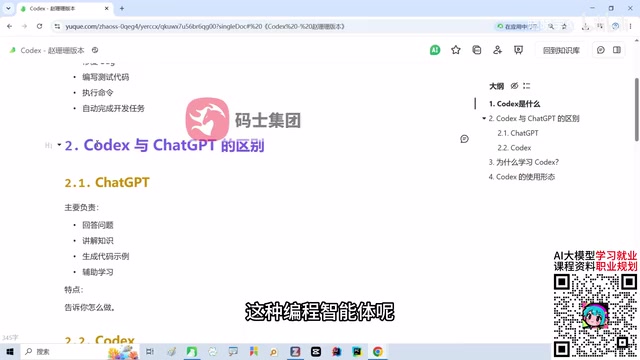
This difference means Codex is not a simple code generator, but an agent capable of independently executing development tasks. For developers who need repetitive coding, debugging, and testing, this "hands-on capability" can significantly boost efficiency.
The Core Differences Between Codex and ChatGPT
One Talks, the Other Acts
The creator used a vivid analogy: ChatGPT is responsible for "talking," while Codex is responsible for "acting." ChatGPT excels at answering questions, explaining knowledge, and generating code snippets—suitable for assisting learning or quickly getting ideas. But when you need to turn ideas into actual projects, Codex's autonomous execution capability proves its value.
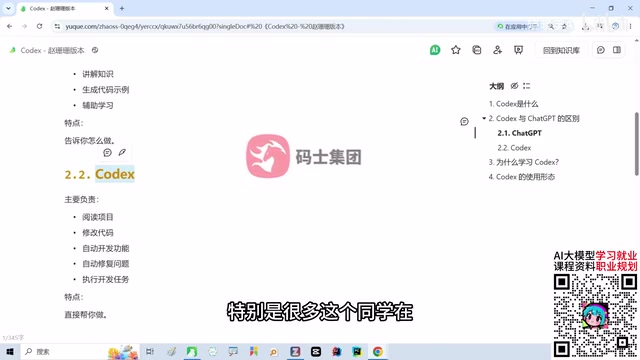
Behind this difference lies a divergence in product design philosophy. ChatGPT is conversation-centric, outputting text; Codex is task-centric, outputting runnable code changes. It can understand project context, automatically locate files that need modification, and run tests to verify results. For complex projects, this end-to-end approach eliminates a lot of manual work.
The Agent's Work Loop
Codex's workflow forms a closed loop: read code → understand requirements → modify code → generate code → test and debug → report results. In the video, the creator demonstrated how Codex independently completed a login feature development, from examining project structure to ultimately passing tests—all without manual code editing.
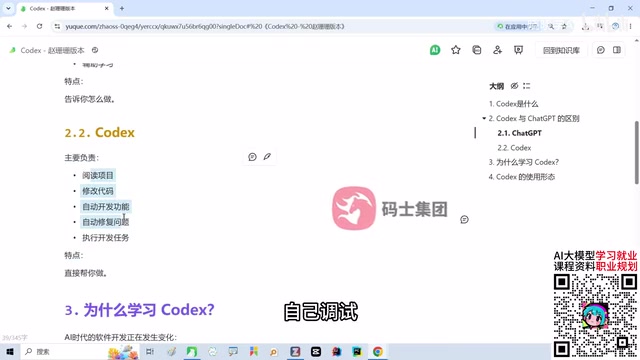
This loop capability means developers can focus more on requirement definition and result review rather than getting bogged down in coding details. Of course, this doesn't mean developers can completely let go—review and optimization remain essential steps.
What is an AI Coding Agent?
An agent refers to an AI system that can perceive its environment, make autonomous decisions, and execute actions to accomplish goals. In coding scenarios, the key difference between AI coding agents and ordinary code generation tools lies in "autonomy" and "tool use capability": they don't just output code snippets based on prompts—they can also invoke external tools like file readers/writers, terminal commands, and test runners, adjusting next actions based on execution results, forming a "think—act—observe" loop. Codex is a typical example of such an agent, combining the reasoning capabilities of large language models with the toolchain in the development environment to complete development tasks end-to-end.
Why Learn Codex Now
The Shift in Development Paradigm in the AI Era
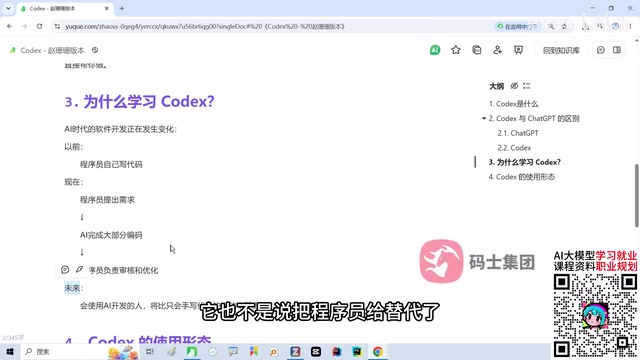
We are in a transition from "writing code by hand" to "directing AI to write code." In the past, developers had to write code line by line, with efficiency depending on individual coding speed; now, developers increasingly propose requirements, let AI agents handle most of the implementation, and take responsibility for review and optimization.
The creator emphasized in the tutorial that in the future, the most valuable people won't be the fastest coders, but those best at articulating requirements to AI. Because the development paradigm has changed: from writing code yourself to directing AI to write code. Learning tools like Codex is essentially about adapting to this new development paradigm.
Review Skills Remain Critical
Some may worry: if AI can write code, will programmers be replaced? The creator's view is clear: AI doesn't replace programmers—it changes the way they work. Programmers still need to review and optimize AI-generated code. If you know nothing about programming, you can't judge whether the code is correct or efficient. So, those who can develop with AI will be far more productive than those who write code purely by hand—but only if you have sufficient programming foundation to quality-check the output.
The Complete Path from Installation to Agent Development
Although the original tutorial title mentions "from installation and usage to agent development in practice," the source material mainly focuses on Codex's positioning and necessity. Based on the creator's explanation, we can outline a reasonable learning path for Codex:
- Understand the difference between agents and chatbots: Recognize that Codex is a task-execution tool, not a conversational one.
- Master basic installation and configuration: Follow official documentation to set up the environment and get familiar with basic commands and interaction methods.
- Start with simple tasks: For example, have Codex fix a known bug or add a small feature, and observe its workflow.
- Gradually move to complex projects: Have Codex participate in multi-file modifications, test writing, and debugging, accumulating prompt engineering experience.
- Explore agent development: Learn how to extend Codex's capabilities through mechanisms like MCP and Skills to build customized development assistants.
The creator promised to provide a resource package covering AI large models, Skills, MCP, and prompts—these resources can help learners get started faster. However, the source material doesn't elaborate on specific technical details, so it's recommended to learn alongside official documentation and hands-on projects.
What are MCP and Skills?
MCP (Model Context Protocol) is an open standard for connecting AI models to external data sources and tools in a unified way—such as databases, file systems, API services, etc. Through MCP, agents like Codex can dynamically obtain context beyond the project or call external services to accomplish more complex tasks. Skills typically refer to encapsulated, reusable capability modules that let agents perform specialized operations in specific scenarios. Together, they can transform Codex from a "general-purpose coding assistant" into a "customized development assistant" tailored to team workflows—this is also the core content of the "agent development" stage in the original learning path.
Summary: Who Is Codex For
Codex is suitable for engineers with some programming foundation who want to boost development efficiency. It's not a zero-barrier tool—you need to be able to review AI output to realize its value. If you're already familiar with ChatGPT's conversational programming, try introducing Codex into your daily development workflow and experience the shift from "copy-paste" to "autonomous execution." The future belongs to those best at articulating requirements to AI, and Codex is a practical entry point for practicing that skill.
Related articles

Fable 5.2 Builds FPS Game Saltline: AI-Generated 3D Games Take Another Step Forward
Saltline, an FPS built with Fable 5.2, sparked discussion on Hacker News. This article examines the technical challenges of AI-generated FPS games, the impact on indie developers, and the real limits of current AI game generation tools.

What Goal Is Reasoning Actually Solving? A Hacker News Discussion
A Hacker News discussion asks what goal reasoning actually solves. The article analyzes treating reasoning as an end in itself, contrasts decision-quality and generalization perspectives, and offers practical lessons for redesigning reasoning evaluation.

From Attention to Mamba: A Practical Recipe for Cross-Architecture Distillation
Explore a cross-architecture distillation recipe from Attention to Mamba, leveraging pretrained Transformers to accelerate SSM adoption and improve generation efficiency.