Configuration-Enhanced Radio Foundation Models: Breaking Through Channel Data Limitations

Incorporating channel configuration information into radio foundation model pre-training improves generalization under label scarcity.
This article introduces a study on configuration-enhanced radio foundation models (RFMs). To address the problem that existing RFMs ignore channel configuration (CFG) priors, the paper proposes jointly optimizing channel data and configuration descriptions during pre-training to generate configuration-enhanced embeddings. Experiments cover three downstream tasks—LoS/NLoS classification, timing advance estimation, and beam selection—across three data scales, and evaluate both in-distribution and out-of-distribution configuration scenarios. The results show that the embeddings consistently outperform or match baselines under both seen and unseen configurations, with the advantage being even more pronounced when labels are scarce.
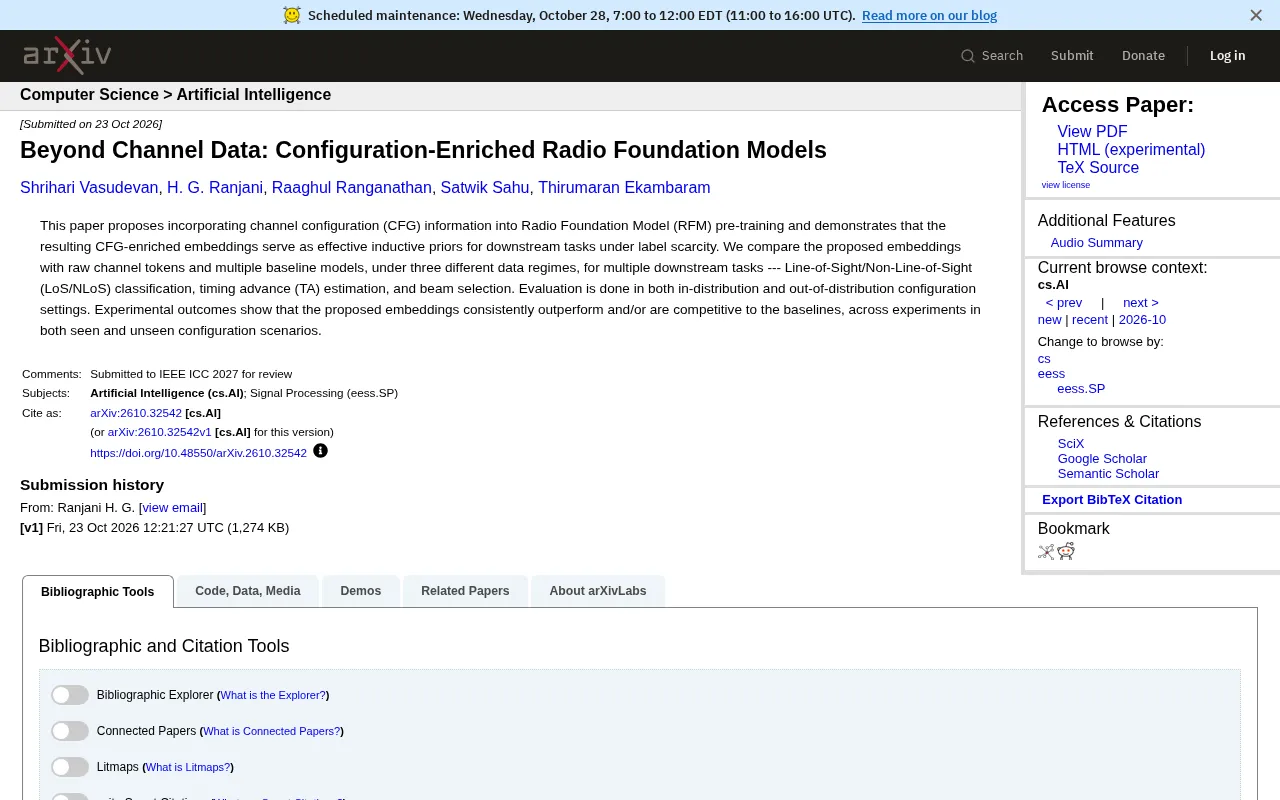
Radio Foundation Models (RFMs) are becoming a hot research topic in wireless communications, with the core idea of learning general representations of channel data through large-scale pre-training and then transferring them to downstream tasks. However, most existing methods only utilize raw channel data and ignore channel configuration (CFG), a key piece of prior information. A recent paper proposes incorporating CFG information into RFM pre-training and validates the effectiveness of such configuration-enhanced embeddings as an inductive prior.
Why Introduce Channel Configuration Information?
In wireless communication systems, channel configuration parameters (such as antenna configuration, bandwidth, and subcarrier spacing) directly affect the statistical properties of the channel. Traditional RFMs treat channel data as generic sequences, but the distribution of channel data differs significantly under different configurations. The authors argue that explicitly incorporating CFG information into the pre-training process can help the model learn more generalizable representations, especially in downstream tasks with scarce labels.
The motivation behind this idea is that configuration information itself is low-cost metadata that can be acquired easily. Using it as an additional input or conditioning signal is equivalent to providing the model with task-relevant inductive bias, thereby reducing dependence on large amounts of annotated data.
Inductive Priors and Inductive Bias: In machine learning, inductive bias refers to the set of assumptions a model makes in order to generalize to unseen data. For example, convolutional neural networks assume local translation invariance, and recurrent neural networks assume temporal dependence. Inductive priors are the concrete manifestations of these assumptions, usually injected in the form of model architecture, regularization, or additional inputs. When data are scarce, a strong inductive bias can significantly reduce the complexity of the hypothesis space, thereby reducing the need for annotated samples. Channel configuration information (such as the number of antennas and bandwidth) is exactly such a strong inductive bias in the wireless domain, because it directly determines the physical statistical properties of the channel (such as delay spread and Doppler shift). Injecting this prior into the model can help it focus more quickly on task-relevant feature dimensions.
Method Design: Configuration-Enhanced Pre-training and Embeddings
The core design of the paper is to introduce CFG information during the RFM pre-training stage to generate CFG-enriched embeddings. Specifically, during pre-training the model receives both channel data and the corresponding configuration descriptions, and through joint optimization the embedding space encodes configuration-related structural information.
In the evaluation stage, the authors compare this embedding with raw channel tokens and several baseline models. The experiments cover three different data regimes to simulate varying degrees of label scarcity. The downstream tasks include line-of-sight/non-line-of-sight (LoS/NLoS) classification, timing advance (TA) estimation, and beam selection.
Pre-training and Downstream Task Transfer: Pre-training refers to training a model on large-scale unlabeled data to learn general representations, which are then adapted to downstream tasks through fine-tuning or linear probing. In the wireless domain, pre-training data are usually massive channel estimates or received signals, while downstream tasks include classification (such as LoS/NLoS), regression (such as TA estimation), and selection (such as beam selection). The key challenge of transfer learning is distribution shift: the distribution of pre-training data and downstream task data may differ (for example, different configurations). Configuration-enhanced embeddings explicitly encode configuration information, enabling the model to represent channels conditionally and thus maintain performance under distribution shift. In addition, joint optimization of channel data and configuration descriptions usually adopts multi-task learning or conditional embedding approaches, for example encoding the configuration as a vector and concatenating it with channel features or fusing them through attention mechanisms.
Experimental Results: Consistently Outperforming or Matching Baselines
The paper evaluates under both in-distribution and out-of-distribution configuration settings. The results show that configuration-enhanced embeddings consistently outperform or at least match the baselines in both seen and unseen configuration scenarios. This means that the embedding can not only adapt to configurations seen during training but also generalize to new configuration environments, demonstrating strong robustness.
You may not have noticed that under label-scarce data regimes, the advantage of configuration-enhanced embeddings is even more pronounced. This validates the authors' hypothesis: the inductive prior provided by CFG information can effectively alleviate downstream tasks' dependence on annotated data.
In-Distribution and Out-of-Distribution Evaluation: In-distribution means the test configuration is the same as or similar to the training configuration, while out-of-distribution means the test configuration did not appear during training (such as a different number of antennas or bandwidth). Out-of-distribution generalization is a key metric for measuring model robustness, because configurations may change dynamically in real deployments. Configuration-enhanced embeddings can still maintain performance in out-of-distribution scenarios, indicating that the representations they learn not only memorize specific configurations but also capture the causal relationship between configurations and channel statistics. This generalization capability is particularly important for real systems, because configurations in wireless environments often adjust with the scenario, and the model needs to quickly adapt to new configurations without retraining.
Implications and Outlook
This study provides a new perspective for the design of radio foundation models: in addition to scaling data and model size, fully leveraging domain knowledge (such as channel configuration) as a structured prior may be the key to improving the practical utility of models. Future work can explore more complex configuration combinations, dynamic configuration scenarios, and the possibility of combining CFG information with other modalities (such as geographic information).
For engineers and researchers in the wireless communications field, this method demonstrates how to embed domain knowledge into foundation model pre-training, providing a low-cost, high-benefit technical path for wireless tasks in label-scarce scenarios.
One-line Summary
Incorporating channel configuration information into radio foundation model pre-training improves generalization under label scarcity.
Paragraph Summary
This article introduces a study on configuration-enhanced radio foundation models (RFMs). To address the problem that existing RFMs ignore channel configuration (CFG) priors, the paper proposes jointly optimizing channel data and configuration descriptions during pre-training to generate configuration-enhanced embeddings. Experiments cover three downstream tasks—LoS/NLoS classification, timing advance estimation, and beam selection—across three data scales, and evaluate both in-distribution and out-of-distribution configuration scenarios. The results show that the embeddings consistently outperform or match baselines under both seen and unseen configurations, with the advantage being even more pronounced when labels are scarce. This validates that using domain knowledge as an inductive prior can effectively alleviate dependence on annotated data and provides a new direction for RFM design.
Related articles

T3 Code: The Open-Source AI Coding Assistant's Comeback Story
T3 Code is an open-source AI coding assistant that unifies subscriptions like Codex and Claude, with powerful remote control and parallel task management.

Never Elected, Yet Ruled New York for 30 Years: The Ultimate Case Study in the Mechanics of Power
Robert Caro's biographies reveal how unelected Robert Moses ruled New York for 30 years through legal drafting and public authorities, and how Lyndon Johnson built leverage as a "powerless" Senate Majority Leader. Unpacking the underlying logic of accumulating and sustaining power.

The CPython 3.10 Recursion Trap and Synthetic Recovery in TokenGuard, an LLM Circuit Breaker
TokenGuard's author recounts a recursion crash caused by OrderedDict.pop in CPython 3.10 and introduces v0.3.0's Loop Nudge synthetic recovery, inline DLP scanning, and other new LLM agent circuit-breaker capabilities.