Crisis of Trust at OpenAI's Safety Leadership: The Tomek Korbak Incident

OpenAI's safety chief reportedly told researcher Tomek Korbak he is no longer trusted, highlighting internal AI governance tensions.
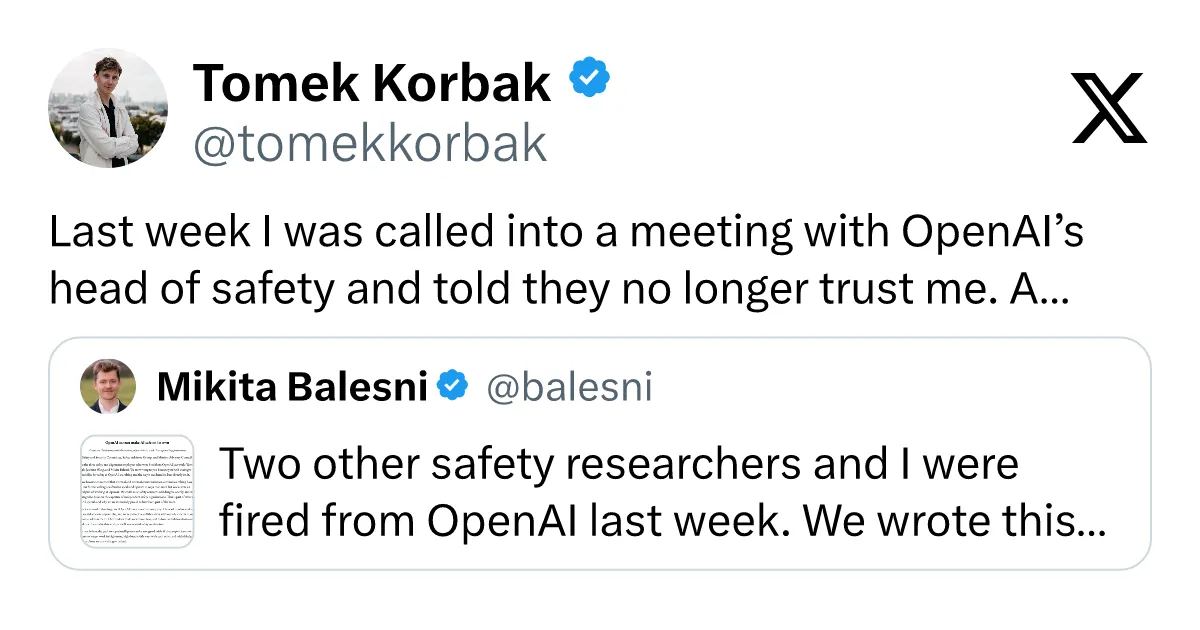
Researcher Tomek Korbak has disclosed that OpenAI's head of safety told him they "no longer trust" him, drawing attention in technical communities. With source information extremely limited, the full picture remains unclear — but the incident touches on one of AI's most sensitive issues: the independence and authority of safety teams. OpenAI has previously weathered multiple safety personnel departures, with some researchers publicly questioning the company's safety culture. Whether safety researchers can evaluate model risks without interference and raise objections when needed is a core question of AI governance. The article urges caution given sparse information, while noting that such recurring incidents signal intensifying internal tensions over safety priorities at top AI labs.
Incident Overview
A piece of news about OpenAI's internal safety team has recently sparked discussion in technical communities such as Hacker News. According to available information, an individual named Tomek Korbak disclosed that OpenAI's head of safety told him they "no longer trust" him. Though brief, this statement touches on one of the most sensitive topics in today's AI industry — trust and governance within AI safety teams.
Given the extremely limited source material (a Hacker News post with only 3 upvotes and 0 comments), this article can only offer a limited background overview and analysis based on existing clues, and cannot provide a complete account of the specific details or the full sequence of events.
Background: The Role and Tensions of AI Safety Teams
As a leading global AI research institution, OpenAI's safety team bears critical responsibilities: evaluating model risks, developing alignment strategies, and overseeing the release cadence of large language models. The safety team's position naturally creates tension with business teams that prioritize speed of productization and commercialization.
Over the past period, OpenAI has undergone multiple personnel and structural changes within its AI safety function. The departures of certain safety researchers and their subsequent public statements have sparked widespread discussion. These events typically reflect a core contradiction: how to ensure the independence and authority of safety evaluations while rapidly advancing frontier model capabilities.
"Alignment" refers to the research direction of ensuring that AI systems' behavioral goals remain consistent with human intentions and values. This field encompasses a range of approaches — from technical methods such as reward modeling and Reinforcement Learning from Human Feedback (RLHF), to institutional measures like release reviews and red-team testing. OpenAI once established a dedicated "Superalignment" team to address long-term safety challenges posed by future, more powerful AI systems. However, around 2024, the team experienced a wave of departures among core members, including co-leads Ilya Sutskever and Jan Leike. Upon leaving, Leike publicly voiced concerns about the company's safety culture, stating that "safety culture and processes have taken a back seat to shiny products." This context has made personnel developments within the safety team a subject of particularly close industry scrutiny.
Why "Trust" Matters
In AI safety governance, "trust" is not an abstract emotional term — it is a substantive question of institutional design. Safety researchers need to be able to evaluate potential model risks without interference and must have the authority to raise objections or even block a release when necessary. When trust breaks down between a head of safety and an individual researcher, it may signal:
- Disagreements or friction within the safety evaluation process
- Problems with internal communication mechanisms
- Inconsistent understandings of risk assessment standards
When a researcher publicly states they have been told they are "no longer trusted" — whatever the specific reason — it warrants external scrutiny of governance transparency within AI labs.
A Measured Take: Limited Information Demands Caution
It must be emphasized that the publicly available information is extremely thin — amounting to little more than a headline-level statement, lacking full context and absent any response from OpenAI or other parties involved. A one-sided account is insufficient to serve as the basis for judgment on the entire incident.
In a field as highly specialized and sensitive as AI safety, any conclusions should be grounded in cross-verification from multiple sources. Readers should avoid over-interpreting fragmentary information and wait for more reliable disclosures before forming a complete picture.
Implications for the Industry
Even with the details still unclear, the recurring nature of such reports itself reflects a broader trend: as AI capabilities advance rapidly, internal debates within top-tier labs over safety priorities, governance mechanisms, and decision-making authority are intensifying. For the industry as a whole, establishing clear, transparent, and effectively checks-and-balances-equipped safety governance frameworks has never been more important.
We will continue to follow developments in this story and provide deeper analysis as more reliable information becomes available.
Currently, AI lab safety governance models fall roughly into two categories: the embedded model, where the safety team operates as an internal department within the company (as at OpenAI and Anthropic); and the external oversight model, which relies on government agencies, third-party audits, or industry standards bodies to provide checks. Both have limitations — embedded safety teams are susceptible to commercial pressures, while external oversight faces challenges of lagging technical understanding and insufficient enforcement. The United States, the EU, and the UK have begun exploring mandatory model safety evaluation reporting requirements, but how to give safety assessments meaningful "veto power" remains an unresolved core question. Recurring incidents like the Tomek Korbak case serve as an important source of pressure driving the industry and regulators to reconsider the mechanisms that protect the independence of safety teams.
Related articles

Building a Tower Defense Game in UE5 with AI in 2 Hours: A Full No-Code Walkthrough
A Bilibili tutorial breaks down how to build a 3D tower defense game in Unreal Engine 5 with AI and no code, covering Unreal MCP vs. C++ paths, prompt engineering, AI art boundaries, and how faster iteration changes the dev workflow.

Agent Clan: Command Multiple AI Coding Assistants Simultaneously with Mid-Air Gestures
Agent Clan turns Claude Code and Codex agents into a 3D team on screen, supporting fist summoning, pinch selection, drag-to-approve permissions, and local gesture and voice processing, free on Mac and Windows.

Inkling 2 Small: A 594B MoE Model That Can "See" and Revise
Thinking Machines Lab releases Inkling 2 Small, a 594B-parameter MoE model activating only 17B, focused on long-horizon coding and visual tasks where it can see and refine its own output, with inference and fine-tuning via the Tinker platform.