CrowdGPT: The Ambition and Challenges of Decentralized Collaborative LLM Training
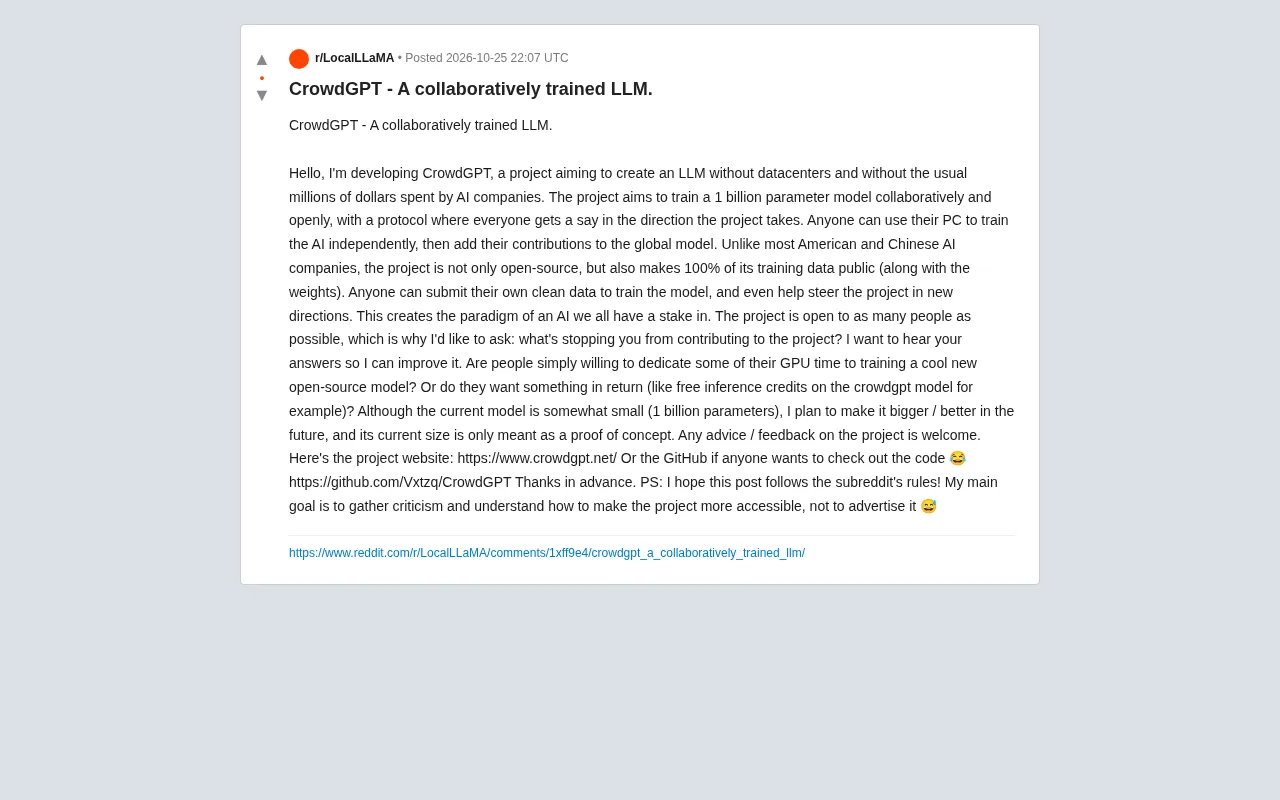
CrowdGPT aims to let volunteers worldwide collaboratively train a 1B-parameter open-source LLM on personal PCs, with incentives as the core challenge.
CrowdGPT is a community-initiated experimental project that aims to bypass data centers and massive investment by letting volunteers worldwide collaboratively train a 1B-parameter open-source LLM on their own PCs, committing to 100% public training data and model weights. The founder solicited feedback on Reddit, bluntly asking what stops people from contributing, exposing the project's biggest weakness: without clear returns, will people contribute GPU compute for free? The article analyzes gradient synchronization, heterogeneous hardware, and quality control challenges, as well as CrowdGPT's differentiated positioning around data transparency and community governance, noting its success or failure will offer valuable lessons for distributed collaborative training.
At a time when training large AI models routinely costs tens of millions of dollars, a project called CrowdGPT is attempting to take a completely opposite path: no data centers, no burning cash — instead, letting volunteers around the world collaboratively train a 1-billion-parameter open-source model on their own PCs. The project's founder posted on Reddit soliciting feedback, and the core question was blunt: What's stopping you from contributing?
Project Vision: AI That Belongs to Everyone
CrowdGPT's goal is to create a large language model with "no data center, no millions of dollars in investment." Unlike most Chinese and American AI companies, the project is not only open-source but also promises to make 100% of training data and model weights public. Anyone can train independently on their own computer and then merge their contributions into the global model.
This model attempts to build an "AI that belongs to everyone" paradigm — you can not only submit your own clean data to train the model but also participate in deciding the project's direction. The founder emphasizes that the current 1-billion-parameter scale is only a proof of concept, with plans to go bigger and better in the future.
From a technical perspective, the main difficulties in collaborative LLM training lie in gradient synchronization and communication overhead. Participants have heterogeneous hardware and varying network bandwidth, so efficiently aggregating distributed training results is a key challenge. The project currently open-sources its code on GitHub, with more information available at crowgpt.net.
Gradient synchronization is the core communication step in distributed training: each participating node computes gradients based on local data, then must exchange and aggregate gradients with other nodes to ensure all model replicas stay consistently updated. Common approaches include All-Reduce or parameter server architectures. Within a data center, nodes typically have high-bandwidth, low-latency dedicated networks (such as InfiniBand), making gradient synchronization overhead manageable; in a volunteer network, however, participant bandwidth varies widely, latency fluctuates significantly, and home networks often lack public IP addresses, making synchronization a bottleneck. To mitigate this, the industry commonly uses gradient compression (quantization, sparsification), local multi-step updates (such as Local SGD), and asynchronous updates — trading communication frequency for convergence stability.
Community Feedback: Enthusiasm and Skepticism Coexist
On Reddit, the founder candidly stated that the main purpose of the post was to gather criticism rather than promote the project. The question he raised touches the core contradiction of open-source collaboration: Are people willing to contribute GPU time for free? Or do they need some form of return (such as free inference credits)?
The answer to this question is not simple. Open-source communities have a long tradition of volunteers contributing computing power (such as Folding@home), but LLM training places far higher demands on VRAM and compute than ordinary scientific computing. Training a 1-billion-parameter model on a consumer-grade GPU could take days or even weeks, and the resulting contribution is ultimately a public good — this constitutes a classic collective action dilemma.
Collective Action Problem refers to the situation where individuals can benefit from a public good but lack the incentive to bear the cost of providing it, ultimately leading to under-provision of the public good. In the CrowdGPT scenario, the trained model is a public good that anyone can use for free, while contributing GPU compute requires bearing electricity costs, hardware wear and tear, and time costs — yet the benefits are shared by all. Common approaches to solving this dilemma include: selective incentives (such as allocating inference credits or attribution rights based on contribution), linking reputation to governance rights, and lowering the contribution threshold to an extremely low level (such as requiring only idle compute). The reason distributed computing projects like Folding@home have persisted is partly that contributors are mostly members of the scientific community or driven by disease-related causes, whereas LLM training has a higher VRAM threshold, making incentive design more difficult.
Folding@home is a distributed computing project initiated by Stanford University that uses volunteers' idle CPU/GPU resources to simulate protein folding for disease research. The key difference from CrowdGPT lies in task granularity: protein simulations can be split into a large number of independent small tasks, where volunteers compute each one and send back the results, requiring almost no real-time inter-node communication; LLM training, by contrast, is a tightly coupled iterative process where every gradient step requires global synchronization, with far higher communication overhead and consistency requirements. Therefore, CrowdGPT cannot simply replicate Folding@home's crowdsourcing model and must design specialized approaches for synchronization strategies, fault tolerance mechanisms, and contribution verification.
A Third Path for Open-Source AI?
The current open-source model ecosystem is dominated by large companies: Meta's Llama series, Mistral's open-weight models, and China's Qwen, DeepSeekAd, and others. Although these models have open weights, their training data and processes are often opaque. CrowdGPT's differentiation lies in its fully transparent data pipeline and community governance.
This model is reminiscent of the success of Linux and Wikipedia — decentralized collaboration can produce high-quality public goods. But AI model training is special in that: compute costs are high, technical barriers are high, and quality control is difficult. Without commercial reward incentives, whether the community can sustain contributions is an open question.
The founder's exploration is worth watching, but the question he raised also exposes the project's weak spot: until the incentive design is clear, most potential contributors will likely remain on the sidelines. For developers interested in open-source AI and distributed training, this is an experiment worth tracking — whether it ultimately succeeds or fails, it will provide valuable lessons for community collaborative training.
One-line Summary
CrowdGPT aims to let volunteers worldwide collaboratively train a 1-billion-parameter open-source LLM on personal PCs, with incentives as the core challenge.
Paragraph Summary
CrowdGPT is a community-initiated experimental project that aims to bypass data centers and massive investment by letting volunteers worldwide collaboratively train a 1-billion-parameter open-source large language model on their own PCs, with a commitment to making 100% of training data and model weights public. The founder solicited feedback on Reddit, directly asking "what's stopping you from contributing" and putting the project's biggest weakness on the table: without clear returns, are people willing to contribute GPU compute for free? The article analyzes technical challenges such as gradient synchronization, heterogeneous hardware, and quality control, as well as CrowdGPT's differentiated positioning in the open-source model ecosystem emphasizing data transparency and community governance, noting that its success or failure will provide valuable lessons for distributed collaborative training.
Related articles

The Truth Behind Titanic's Sinking: Key Decisions and Communication Failures in the National Geographic Documentary
National Geographic's The Unsinkable Ship uses survivor testimony to reconstruct Titanic's fatal decisions—from the missing MSG telegram prefix and the broken boiler-room-to-bridge link to how 'unsinkable' thinking delayed damage control and evacuation.

74M-Parameter Open-Source Model Partially Outperforms Jev AI in Testing
Fastino AI's Glider 2.5 models, with just 74M–300M parameters, reportedly outperform Jev AI in some guardrail benchmarks per YouTube testing, run on consumer hardware, and even play Doom. We analyze small models' competitiveness and deployment value on specific tasks.

Gemini 4 Argon Hands-On: Aggressive Pricing, 3D Capabilities Need Coaching
Gemini 4 Argon hands-on: limited-time $2/$10 pricing, million-token output, strong 3D and reverse-engineering work, but weak front-end aesthetics and zero-shot ability need coaching.