CSS-Tricks Has a New Owner: A Landmark Frontend Community Site Changes Hands
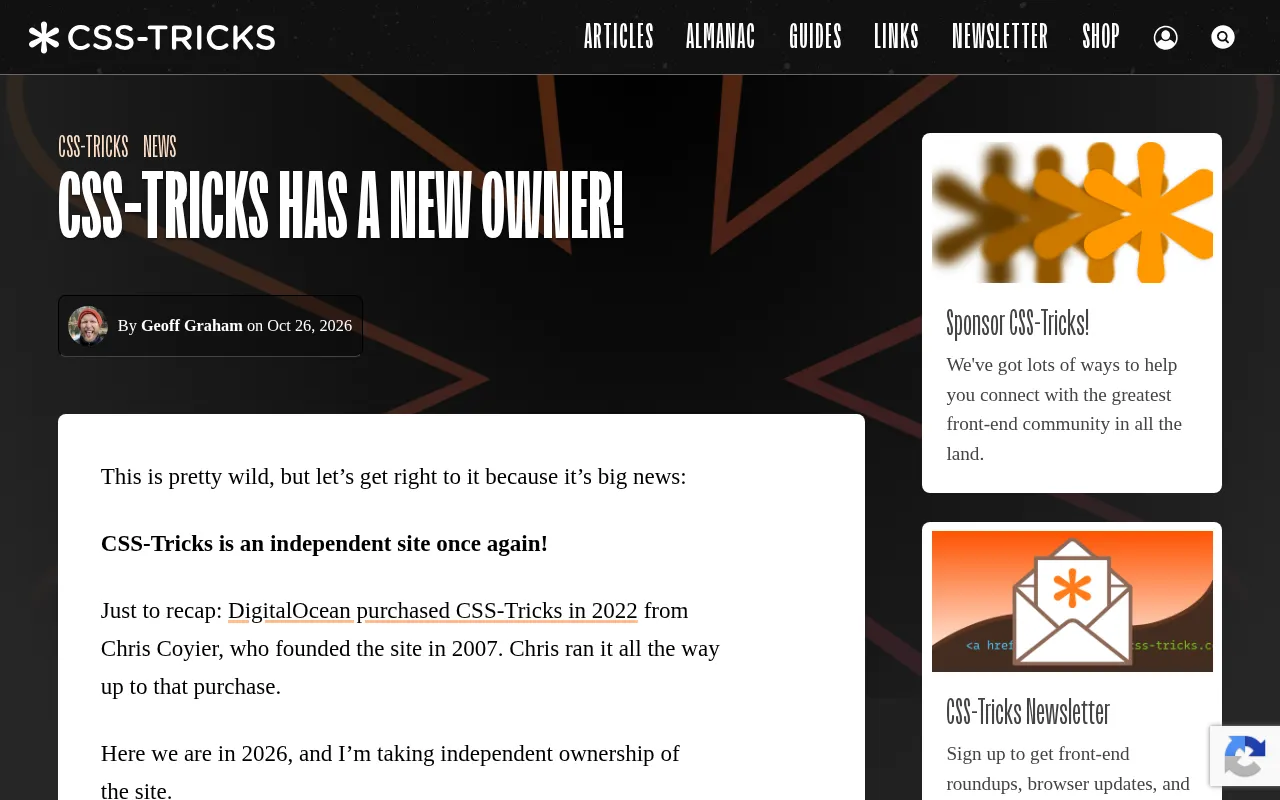
CSS-Tricks changing owners sparks heated Hacker News discussion, reflecting the survival challenges of technical content sites.
The frontend technical blog CSS-Tricks has announced a change of ownership, drawing 267 points and 61 comments on Hacker News, showing the developer community's interest in this long-established site. Ownership changes at technical content sites often come with expected adjustments to editorial direction, content strategy, and business model. Readers care most about whether existing content will be retained, whether update frequency will be maintained, and whether paywalls or new ad formats will be introduced. The CSS-Tricks case is not isolated—independent tech blogs generally face sustainability challenges amid pressure on traffic and advertising models. For developers, this is a reminder that relying on a single content source carries risk; they should broaden their information channels and keep local archives of important materials.
The well-known frontend technical blog CSS-Tricks has announced a change of ownership. The news drew attention on Hacker News, garnering 267 points and 61 comments, reflecting the developer community's interest in where this long-established site is headed.
Why an Ownership Change Draws Attention
CSS-Tricks has long been an important destination for frontend developers learning CSS techniques and consulting practical tutorials. Its content is more than technical documentation—it carries the learning memories of an entire generation of developers. That's precisely why the ownership change quickly gained traction on Hacker News—267 points indicates that a considerable number of developers saw the news right away and were willing to upvote it.
For the tech community, a change of ownership at a long-running content site often signals possible adjustments to editorial direction, content strategy, and even business model. Behind the 61 comments lies a common question among readers: "Will this site still be the same?"
The Industry Signal Behind a Content Site Changing Hands
The CSS-Tricks case is not an isolated phenomenon. Under shifting traffic structures and pressure on advertising models, the operational sustainability of independent tech blogs has always been a challenge. An ownership change usually means someone is willing to take over and continue investing, which is itself a positive signal; but the new owner's motives and plans will determine whether the site can sustain its existing community trust.
For readers, the concerns boil down to a few points: Will existing content disappear? Will the update frequency be maintained? Will new paywalls or ad formats be introduced? The answers to these questions often only become clear after the new owner makes a public statement.
Common monetization paths for independent tech blogs include display advertising, sponsored content, affiliate marketing, and paid memberships, among which display advertising is highly dependent on traffic scale. In recent years, direct answers on search engine results pages, feed distribution on social platforms, and the rise of AI summary tools have reduced the click-through rate from search to original sites, putting pressure on ad unit prices and fill rates as well. Meanwhile, tightening browser privacy policies and the gradual phasing out of third-party cookies have diminished the effectiveness of behaviorally targeted advertising. With multiple factors compounding, the model of content plus advertising alone is increasingly hard-pressed to cover the costs of writing, editing, and technical maintenance—this is the structural backdrop behind many long-established tech sites choosing to sell or seek buyers.
Reactions and Expectations from the Developer Community
Hacker News discussion threads are always direct. Comments under this kind of news typically split into two camps: one worries that commercialization will dilute content quality, while the other believes an injection of new resources could bring better maintenance and updates. Judging by the voting heat, the community is at least willing to stay engaged rather than write it off outright.
For Chinese-speaking frontend developers, CSS-Tricks is likewise a frequently consulted reference site. This ownership change reminds us that relying on a single content source carries risk; building diverse information channels and keeping local archives of important materials is the more prudent approach.
Hacker News's ranking mechanism is determined jointly by vote count and time decay; 267 points means the item received relatively concentrated support within hours of posting, thereby reaching the front page and gaining more exposure. The 61 comments indicate that while discussion is heated, no overwhelming controversy has formed. It's worth noting that points reflect a judgment of "worth a look" rather than a positive evaluation of the event itself, so it should not be simplistically interpreted as the community endorsing the new owner. Disagreements in the comment section typically center on the tension between content independence and operational sustainability—which is exactly why this kind of news resonates so easily.
Summary
CSS-Tricks changing owners is a landmark event for the frontend community. How it unfolds will test the survival logic of technical content sites in today's environment. For developers, staying informed while broadening learning channels is a pragmatic attitude toward such changes.
One-line Summary
CSS-Tricks changing owners sparks heated discussion on Hacker News, reflecting the survival challenges facing technical content sites.
Paragraph Summary
The frontend technical blog CSS-Tricks has announced a change of ownership, and the news garnered 267 points and 61 comments on Hacker News, showing the developer community's interest in this long-established site. The article notes that ownership changes at technical content sites often come with expectations of adjustments to editorial direction, content strategy, and business model; readers care most about whether existing content will be retained, whether update frequency will be maintained, and whether paywalls or new ad formats will be introduced. The CSS-Tricks case is not isolated—independent tech blogs generally face sustainability challenges under pressure on traffic structures and advertising models. For developers, this serves as a reminder that relying on a single content source carries risk; they should broaden information channels and keep local archives of important materials.
Related articles
Build a Reasoning Model from Scratch: An 11-Hour Open-Source Course Breakdown
Sebastian Raschka releases a free 8-episode, ~11-hour video course teaching you to build a reasoning model from scratch with Python and PyTorch—from a small Qwen3 model through Verifier, Inference Time Scaling, GRPO, and distillation, with open-source code on GitHub.

An 11-Hour Reasoning Model Course in Practice: How Small Models Learn to Think
Starting from Sebastian Raschka's 11-hour reasoning model course and HN buzz, this analyzes small-model training, legal text version control, Anthropic data policy, and product reliability reviews.

Lightpanda: A Headless Browser Built for AI and Automation
Lightpanda is a headless browser built from scratch in Zig for AI and automation, with 37,852 GitHub stars. This analysis covers its technical approach, design choices, and use cases.