Deal Pilot: How an AI SDR Uses Multilingual Emails to Conquer Japan, the US, and Southeast Asia

Deal Pilot enters cross-border sales markets in Japan, the US, and Southeast Asia with multilingual AI cold email automation.
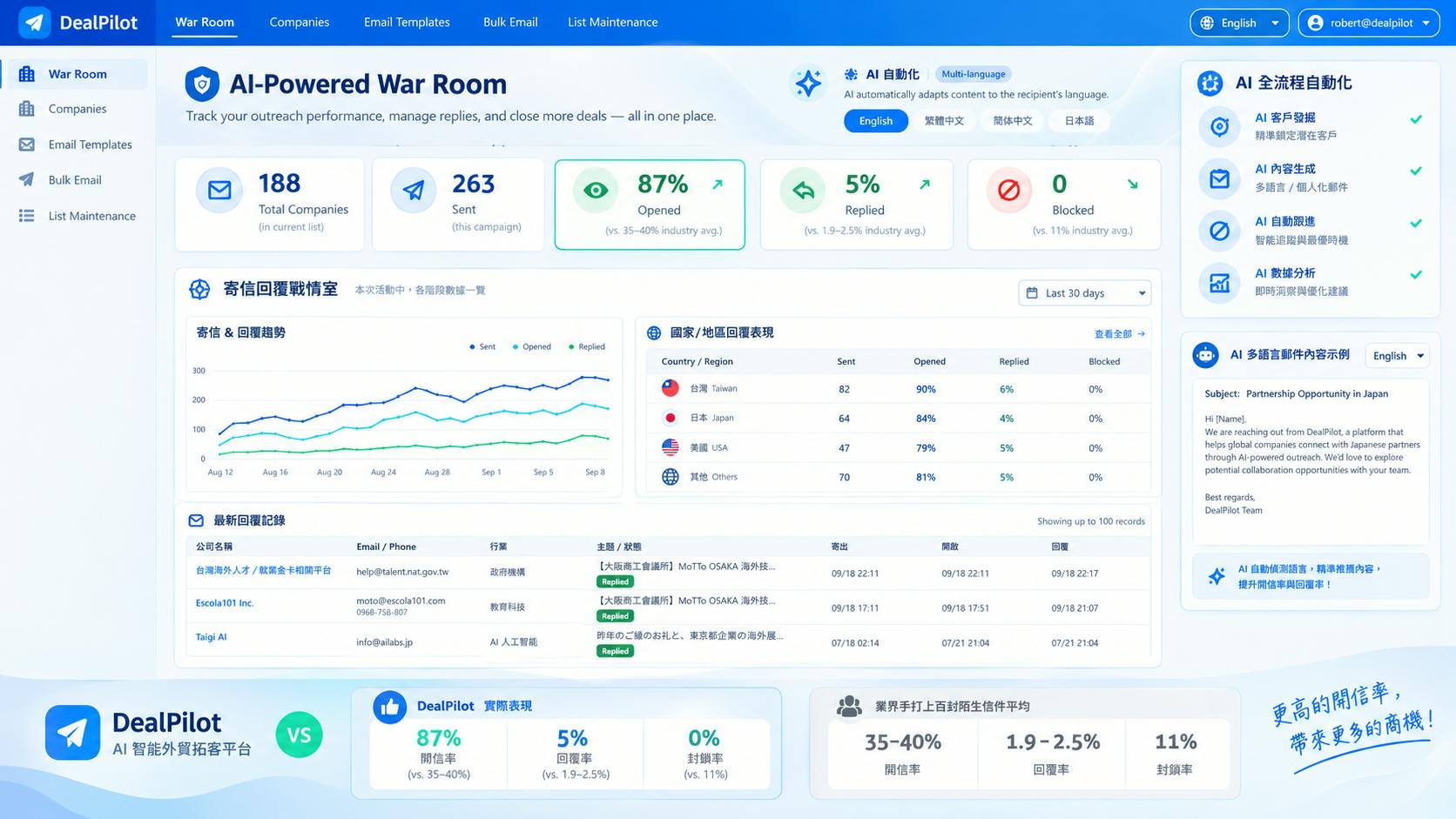
Deal Pilot is an AI sales development tool launched on Product Hunt, optimized for Japan, the US, and Southeast Asia, supporting native personalized cold email writing and follow-up in English, Japanese, and Chinese. Its workflow covers finding and verifying decision-makers by country and role, generating emails in the corresponding language, and automatically following up until meetings are booked—essentially replacing repetitive SDR execution work with AI. The product team disclosed a 6.0% reply rate across 644 A/B-tested emails, above the low single-digit industry average, though test conditions are not fully disclosed. With 70 upvotes and a 14th-place ranking on Product Hunt, it remains early-stage, with deliverability, domain reputation, and personalization at scale still to be validated.
In a context where the labor costs of Sales Development Representatives (SDRs) are high, AI-driven automation tools are attempting to take over the entire process from lead prospecting to meeting booking. Deal Pilot, newly launched on Product Hunt, is one such tool, and its differentiation lies in: being specifically optimized for the Japanese, US, and Southeast Asian markets, with native support for personalized cold email writing and follow-up in English, Japanese, and Chinese.
According to information on its Product Hunt page, Deal Pilot achieved a 6.0% reply rate across 644 A/B-tested emails. This figure is noteworthy in the cold outreach space—after all, the industry average reply rate typically hovers in the low single digits.
What Problem It Solves: The Localization Gap in Cross-Border Sales
Most traditional SDR tools are centered on English-speaking markets. When companies try to enter Japan or Southeast Asia, they often face two challenges: first, finding contacts who actually hold decision-making authority; second, writing emails in the recipient's native language that are appropriate and don't come across as mass mailings.
Deal Pilot's entry point is precisely these two issues. According to the official description, it can find and verify decision-makers by country and job title, then write personalized cold emails in English, Japanese, or Chinese, and follow up continuously until a meeting is booked. This "country + role" targeting approach is closer to the real needs of cross-border sales than generic job title filtering.
Multilingual Is Not Simple Translation
You may not have noticed that Deal Pilot emphasizes "writing" rather than "translation." In Japanese business communication, honorific levels and email structure follow strict conventions; the tone of Chinese business emails also differs noticeably from directly translated English versions. If the tool merely machine-translates English templates, it would be hard to improve reply rates. Judging from the 6.0% A/B test result, Deal Pilot has done targeted work on language adaptation.
SDR (Sales Development Representative) is a dedicated role in a company's sales organization responsible for front-end prospecting. Main duties include lead prospecting, cold email/phone outreach, initial qualification screening, and meeting booking, then handing qualified opportunities to Account Executives (AEs) for follow-up. The SDR model is widely adopted among B2B companies in Europe and the US, but labor costs and turnover are high—the total annual cost of one SDR often reaches tens of thousands to around one hundred thousand dollars, with a large amount of time consumed by repetitive outbound calls and follow-ups. This is precisely the space AI SDR tools are trying to enter—automating standardized steps such as lead screening, first-round outreach, and continuous follow-up. Understanding this role division helps determine which part of the workflow products like Deal Pilot actually replace, rather than vaguely "replacing salespeople."
Cold Email refers to a first business outreach email sent when the recipient has not previously expressed interest and no existing relationship exists between the parties, which is fundamentally different from marketing emails based on subscriptions or existing relationships. It is typically subject to anti-spam regulations in various countries, such as the US CAN-SPAM Act, Japan's Act on Regulation of Transmission of Specified Electronic Mail (which requires marketing emails to identify the sender and provide an opt-out method), and the EU's GDPR. The success of cold emails depends heavily on sending domain reputation, email content relevance, and follow-up cadence. Industry average reply rates generally hover in the low single digits, with 1%–5% being a common range. Therefore, while a 6.0% reply rate may not be revolutionary, it is indeed above average in cold outreach scenarios—which explains why evaluating such tools requires looking at both reply rate and sample conditions.
Core Mechanism: A Closed Loop from Lead to Meeting
Deal Pilot's workflow can be broken down into three stages:
Decision-maker discovery and verification—targeting contacts by destination country and role, and verifying email validity. This step determines whether subsequent emails reach the right people.
Personalized cold email writing—generating email content in the corresponding language based on the contact's country and role.
Continuous follow-up—automatically following up when the first email receives no reply, until a meeting is booked.
This process essentially uses AI to replace the repetitive execution work of SDRs, allowing sales teams to focus on the meetings themselves rather than upfront outreach.
The Reference Value of A/B Test Data
644 emails, 6.0% reply rate—these two figures come from the Product Hunt page and are test results self-disclosed by the product team. For those evaluating such tools, this data provides a baseline, but it should be noted that the sample size and test conditions are not fully disclosed. Cold email reply rates vary greatly across industries and deal sizes; 6.0% is better used as evidence that "the tool is effective in the test scenario" rather than a universal promise.
Market Positioning and Competitive Landscape
The AI SDR space is not lacking players, but most products focus on European and American markets. Deal Pilot's choice of Japan, the US, and Southeast Asia as its primary regions has its logic: the Japanese market has extremely high requirements for localized communication, with high barriers to entry but relatively less competition; the Southeast Asian market is growing fast with high English acceptance; and the US market is the largest base.
Judging from its Product Hunt performance, Deal Pilot received 70 upvotes and ranked 14th, which is above-average attention. Four comments indicate limited discussion heat, and the product is still in an early exposure stage.
Limitations Worth Noting
A common challenge for cold email automation tools lies in: email deliverability, domain reputation management, and avoiding anti-spam policies. The Product Hunt page does not elaborate on Deal Pilot's technical approach in these areas. Additionally, whether AI-generated personalized emails will lose their "personalization" advantage at scale is a question such products need to continuously answer.
For B2B teams currently expanding into Japan or Southeast Asia, Deal Pilot offers an option worth testing. But it is too early to view it as a complete replacement for SDRs—a more realistic positioning is: enabling existing sales teams to cover more target customers at lower cost.
Email deliverability and domain reputation are technical thresholds that cold email tools cannot avoid. The sender's IP and domain accumulate reputation scores; if bounce rates, spam complaint rates are high, or sending volume spikes, emails are likely to land in spam folders or even be blocked by service providers. Professional practices typically include: using a dedicated subdomain with SPF, DKIM, and DMARC authentication configured, controlling daily sending volume and gradually "warming up" the domain, regularly cleaning invalid email addresses to reduce hard bounces, and setting up an opt-out mechanism. For products that rely on AI to generate and send emails at scale, these infrastructure capabilities often determine final results more than copy quality, and are a key dimension for assessing whether they can be used at scale.
Summary
The core value of Deal Pilot lies in productizing "cross-border localized cold emails." The 6.0% reply rate data provides a reference starting point, and its native multilingual writing capability and design for targeting decision-makers by country + role hit the real pain points of cross-border sales. The product is still early-stage, and actual results need validation from more users.
One-line Summary
Deal Pilot enters the cross-border sales markets of Japan, the US, and Southeast Asia with multilingual AI cold email automation.
Paragraph Summary
Deal Pilot is an AI sales development tool launched on Product Hunt, optimized for the Japanese, US, and Southeast Asian markets, supporting native personalized cold email writing and follow-up in English, Japanese, and Chinese. Its workflow covers three stages: finding and verifying decision-makers by country and job title, generating emails in the corresponding language, and automatically following up until a meeting is booked—essentially using AI to replace the repetitive execution work of SDRs. The product team disclosed a 6.0% reply rate across 644 A/B-tested emails, above the low single-digit level common in the cold email industry, though test conditions and sample background are not fully disclosed. The product received 70 upvotes and ranked 14th on Product Hunt, still in an early exposure stage; email deliverability, domain reputation, and maintaining personalization at scale remain challenges to be validated.
Related articles
 Tech Frontiers
MuJoCo: An Analysis of DeepMind's Open-Source General-Purpose Physics Simulator
An in-depth analysis of Google DeepMind's open-source physics simulator MuJoCo: high-performance C++ kernel, MJCF modeling format, contact solving principles, MJX GPU acceleration, and robot reinforcement learning use cases.
 Tech Frontiers
Claude API Quick Start: The Official Quickstarts Project Collection
Anthropic's official claude-quickstarts project collection helps developers quickly build deployable apps with the Claude API. Nearly 20k stars, Python-based, great for beginners and prototyping.
 Tech Frontiers
AI Agents Connecting Directly to APIs: Which Calls Can Be Safely Allowed?
AI agents can call any API, but the real challenge is deciding which calls can be safely allowed. This article analyzes allowance decisions from three dimensions—intent matching, least privilege, and controllable impact—and argues that the control layer should sit outside the agent, combined with audit traceability to build a trustworthy API call governance mechanism.