Debian Developer Quits: Controversy Over Politicization of Open Source Projects
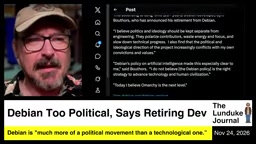
A twenty-year Debian senior developer quits over project politicization and AI policy controversy, sparking open-source governance debate.
Cyril Bouthors, a senior Debian developer, recently announced his departure, stating that the project is "more like a political movement than a technical project" and advocating the separation of politics and engineering. He cited Debian's AI policy as the trigger and publicly praised the Omarchy project, which does not screen contributors by political stance. Commentators cited cases like openSUSE and Godot, claiming codes of conduct have been weaponized for stance screening, causing self-censorship. The controversy is two-sided: the material only presents the commentator's one-sided view and lacks official responses. The incident reflects rising open-source governance costs, with project governance style becoming a factor in developers' technology choices, and the loss of senior talent may affect Debian and its derivative ecosystem's long-term technical direction.
A senior developer who worked on the Debian project for over twenty years, Cyril Bouthors, recently announced his departure, citing that the project has become "more like a political movement than a technical project." This statement has sparked widespread discussion in the open-source community and once again brought the controversy over politicization in open-source governance to the forefront.
Departure Statement: Politics and Engineering Should Be Separated
According to a report by the YouTube tech commentary channel Lunduke Journal, Cyril Bouthors stated clearly in his departure announcement: "I believe politics and ideology should be kept separate from engineering. They polarize contributors, waste energy and focus, and slow down technical progress." He also mentioned that the project's political and ideological direction increasingly conflicts with his own beliefs and values.
What makes this statement noteworthy is that it comes from a developer who has been deeply involved in Debian for a long time. As the upstream foundation for numerous Linux distributions, Debian's governance style has always been regarded as a reference model for the open-source community. Bouthors's departure is seen by commentators as a signal: when a project's narrative focus shifts from code to stances, some technical contributors will choose to vote with their feet.
AI Policy as the Trigger
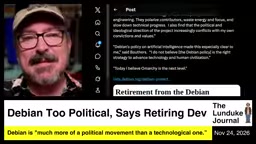
Bouthors specifically mentioned that Debian's policy on artificial intelligence was what finally made up his mind. He said he does not believe Debian's AI strategy is the right direction for advancing technology, and bluntly stated that "Omarchy is the next level."
Omarchy is a project promoted by well-known developer DHH, known for not screening contributors based on political stance. Commentators believe that the appeal of such projects lies precisely in providing a safe haven for ordinary developers who "just want to write code."
It should be noted that the specific details of the AI policy are only based on the commentator's paraphrase in the available information; Debian's official documents are not presented in the source material. However, it can be confirmed that AI governance is becoming a new point of divergence in open-source projects—it involves technical direction, ethical stances, and community rules simultaneously, and can easily escalate from an engineering issue into a dispute over values.
Background of the Debian AI Policy Controversy
As a long-standing community distribution, Debian's policy-making requires public discussion and broad consensus, with a lengthy and debate-filled process. In recent years, internal divisions within the community have intensified over the governance of AI-generated content (such as code, documentation, and training data licensing): one side advocates strict restrictions on AI contributions to protect copyright and software freedom, while the other worries that excessive restrictions will hinder technological innovation. The "AI strategy" Bouthors refers to may involve these undecided rule directions, but the available material only comes from the commentator's paraphrase and lacks official documentation. This divergence highlights the sensitivity of AI governance in open-source projects—it involves technical direction, legal ethics, and community values simultaneously, and can easily escalate from an engineering issue into a dispute over stances.
Lessons from Past Politicization of Open Source
In the program, the commentator listed several cases of open-source projects that sparked controversy due to politicization, as background references for the Debian incident.
According to his description, openSUSE once had management adopting an exclusionary attitude toward those holding different political views, with a board member even describing contributors with so-called "wrong thinking" as "rotten flesh that needs to be cut out." The Godot project also saw mass bans of contributors following a statement that "the project should not be politicized."
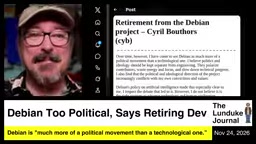
The common thread in these cases is that codes of conduct and community norms, originally intended to maintain a collaborative environment, have in some scenarios been used as tools for stance screening. The commentator claims that this has led some contributors to refrain from publicly expressing disagreement with the project's direction for fear of affecting their career development.
However, it should be pointed out that the above cases are all one-sided narratives by the commentator; the material does not provide official responses from the relevant projects or independent third-party verification. Readers should remain cautious when accepting them.
The Original Intent and Distortion of Codes of Conduct
Codes of conduct are basic rules established by open-source communities to create a friendly, harassment-free collaborative environment, typically exemplified by the Contributor Covenant, which emphasizes respect and inclusivity. Their original purpose is to protect the participation of marginalized groups and reduce conflict. However, in some projects, the enforcement of codes of conduct has been criticized for lacking transparent procedures and even being used as a tool to exclude dissidents. The "weaponization" phenomenon referred to by the commentator is the alienation of rules from maintaining a collaborative environment into a mechanism for stance screening, causing contributors to self-censor out of fear. The core of this controversy lies in the balance of governance: how to ensure safe participation while preventing rules from being abused to the detriment of open discussion. The relevant cases in the material are all one-sided narratives and should be judged cautiously in conjunction with the projects' official records.
Divergent Views: Escape or Normal Turnover?
There are two interpretations of Bouthors's departure.
The commentator's position is clear: he believes this is a positive signal that developers can finally freely leave "over-politicized" projects, and says the open-source world is entering a phase of rapid reshuffling of the project landscape—people-centered, technology-focused projects will attract more contributors, while politics-first projects may face a brain drain.
Another perspective might hold that open-source projects can never fully detach from social issues, and that codes of conduct and diversity policies are meant to protect the sense of safety for marginalized groups participating in collaboration; labeling this uniformly as "politicization" may overlook the practical complexity of community governance. The material does not present specific arguments from this side, but it is an indispensable aspect for understanding the controversy.
The Omarchy Project and the "Depoliticized" Development Model
Omarchy is a project promoted by well-known developer David Heinemeier Hansson (DHH), notable for explicitly not screening contributors based on political stance and advocating that developers focus on the code itself. This "technology-first" positioning has attracted a group of contributors weary of mainstream open-source community governance and is seen as a safe-haven option. However, this model also raises questions: is it feasible to completely avoid social issues? How can community safety and inclusivity be ensured? Omarchy's practice reflects the divergence in governance paths within the open-source world—some projects move toward explicit value statements, while others try to retreat to the purely engineering domain. The tension between these two approaches is reshaping the direction of contributor flow.
Practical Impact on the Open-Source Ecosystem
Setting aside the dispute over stances, this incident reflects a real problem: the governance cost of open-source projects is rising. As community rules, ethical statements, and political expressions occupy more and more discussion bandwidth, the time maintainers spend on code review, releases, and architecture design is inevitably squeezed.
Debian's technical legacy is indisputable—infrastructure such as the apt package manager supports numerous distributions, including Linux Mint. The commentator also acknowledges this, saying that his operating system is partly built on the foundation Debian laid over a decade ago. Precisely for this reason, the loss of senior developers deserves more attention: it is not only a personal choice but may also affect the project's long-term technical direction.
For ordinary developers and enterprise users, the practical takeaway from this trend is: when choosing a technology stack and contribution targets, in addition to evaluating code quality and community activity, whether the project's governance style matches one's own expectations is also becoming a variable that needs to be taken into account. The diversity of the open-source ecosystem means that choices always exist, and the choice itself is the most direct feedback on a project's direction.
Debian's Technical Legacy and the apt Package Manager
Debian was founded by Ian Murdock in 1993 and is known for its stability, free software philosophy, and vast software repository. One of its core contributions is the apt (Advanced Package Tool) package management system, which automates software installation, upgrades, and dependency resolution and has become the foundation for numerous Linux distributions. Ubuntu, Linux Mint, and others are built directly or indirectly on Debian, forming a vast derivative ecosystem. Debian's Social Contract and Constitution are also early models of open-source governance. For this reason, changes in Debian's governance style and the loss of technical talent may ripple through the entire network of derivative distributions via the upstream, which is also the structural reason the Bouthors departure incident has received widespread attention.
One-line Summary
A twenty-year Debian senior developer announces departure over project politicization and AI policy controversy, sparking open-source governance debate.
Paragraph Summary
Cyril Bouthors, a senior developer on the Debian project, recently announced his departure, stating bluntly that the project has become "more like a political movement than a technical project" and advocating the separation of politics and engineering. He cited Debian's AI policy as the trigger for his departure and publicly praised the Omarchy project, which does not screen contributors based on political stance. The commentator cited cases such as openSUSE and Godot, claiming that codes of conduct have been weaponized for stance screening, leading contributors to self-censor. The controversy has two sides: the material only presents the commentator's one-sided view and lacks official responses from the relevant projects. The incident reflects the rising cost of open-source governance, with project governance style becoming a factor for developers when choosing a technology stack, and the loss of senior talent may affect the long-term technical direction of Debian and its derivative ecosystem.
Related articles
Palmer Luckey Interview Goes Viral: From Ukraine to a Floating City, the Complete Worldview of a Tech Hawk
A deep dive into the Palmer Luckey interview: his take on Trump and Ukraine, why he favors public executions, and the governance logic behind Slab, the billion-dollar floating city project from 2017.

Worst Gmod TTT Round Ever: When the Random Role Pack Hits Rock Bottom
Yogscast's Gmod TTT series hits its worst random role pack yet: Illusionist, Marshal, and Quartermaster all flop, the Frenchman is absurdly broken, and Gun Game drags on forever. A breakdown of role balance and mode design issues.

Complete Android Developer Verification in 10 Minutes: A Must-Read for Global App Compliance
Full guide to Android Developer Verification: over 99% of apps on Google Play are auto-registered; developers distributing outside Play must complete identity verification, package name registration, and ownership checks via Android Developer Console—about 10 minutes total.