DECIDE Framework: Model-Free Quantification of Decision Importance in Data Analysis
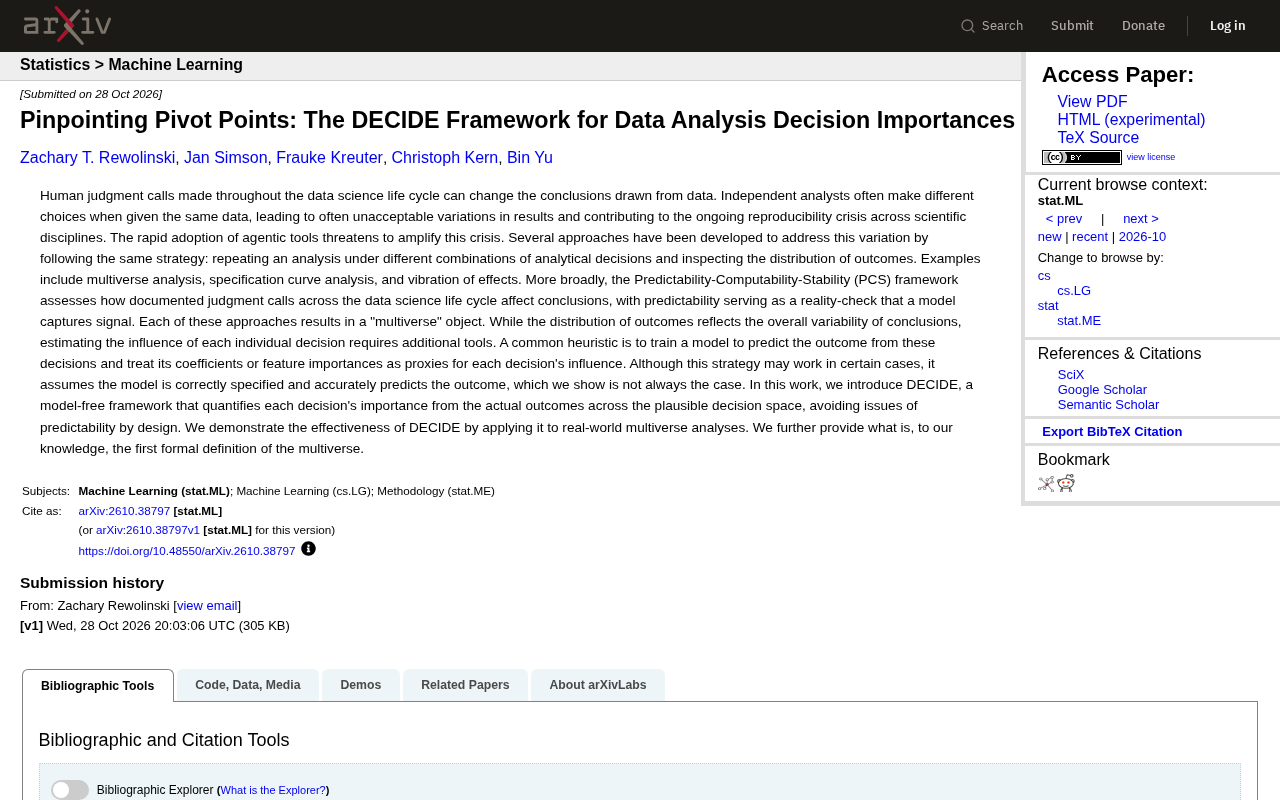
The DECIDE framework model-free quantifies each analytical decision's actual impact on conclusions, addressing the reproducibility crisis.
The article discusses how analytical decision choices cause result variation and contribute to the cross-disciplinary reproducibility crisis. Mainstream approaches like multiverse analysis, specification curve analysis, and vibration of effects reveal result distributions but struggle to estimate individual decision influence. Traditional heuristics use model coefficients as proxies but depend on correct specification and accurate prediction, which do not always hold. DECIDE bypasses prediction and directly quantifies each decision's importance from actual outcomes in a model-free way, and provides the first formal definition of a multiverse. The article also notes that agent tools may amplify decision variation, and DECIDE offers a more robust tool for identifying critical decision nodes.
Every judgment call in the data analysis process can change the final conclusion. When independent analysts work with the same data, they often make different decisions, leading to non-negligible variation in results—one of the root causes of the cross-disciplinary reproducibility crisis. With the rapid adoption of agent-based tools, this variation problem may be further amplified. A recent study proposes the DECIDE framework, which attempts to quantify the impact of each analytical decision on conclusions in a model-free manner, starting directly from actual outcomes.
Multiverse Analysis: The Mainstream Path for Quantifying Decision Variation
To address result fluctuations caused by analytical decisions, researchers have developed several methods: multiverse analysis, specification curve analysis, and vibration of effects. These methods follow the same strategy—repeatedly executing analyses under different combinations of analytical decisions and examining the distribution of results. The broader PCS framework (Predictability-Computability-Stability) evaluates how documented judgment calls across the data science lifecycle affect conclusions, with predictability used as a reality check on whether a model captures the signal.
These methods all produce a "multiverse" object. The distribution of results reflects the overall variability of conclusions, but estimating the influence of each individual decision requires additional tools.
Specification curve analysis is a visualization and statistical presentation form of multiverse analysis: it sorts all reasonable analytical specifications (i.e., decision combinations) by effect size and plots them as a curve, while simultaneously displaying the decision-choice matrix corresponding to each specification. This makes it possible to intuitively see the overall distribution range of effect sizes and to identify which decision combinations produced significant or non-significant results, thereby avoiding bias from "selective reporting."
Vibration of effects focuses on describing the magnitude of fluctuation in effect estimates within the space of reasonable analytical choices: if the direction or significance of an effect changes dramatically under different reasonable specifications of the same data, the conclusion is highly sensitive to decisions. It is often used to assess the robustness of a given conclusion and is conceptually consistent with multiverse analysis, but places greater emphasis on the effect-size distribution itself as a diagnostic indicator.
Limitations of Traditional Heuristic Methods
A common heuristic approach is to train a model to predict outcomes from decisions and use its coefficients or feature importance as a proxy for each decision's influence. The study points out that this strategy may work in some cases, but it assumes the model is correctly specified and can accurately predict outcomes—which the authors prove is not always true. When the model is misspecified or has insufficient predictive power, coefficient-based estimates of decision importance become distorted.
Model misspecification refers to a statistical model used to predict or explain outcomes not matching the actual data-generating mechanism—for example, omitting nonlinear relationships or interaction terms, or adopting incorrect distributional assumptions. In such cases, model coefficients no longer reflect the true decision–outcome relationship, and importance rankings based on coefficients or feature importance may systematically deviate. Even if the model's overall predictive accuracy is acceptable, coefficient estimates for individual decisions may be unstable due to collinearity, overfitting, or insufficient sample size. This is precisely the motivation behind DECIDE: rather than relying on a potentially incorrect surrogate model, it measures decision influence directly on the observed outcome distribution.
DECIDE: Direct Quantification That Bypasses the Prediction Step
DECIDE is a model-free framework that quantifies the importance of each decision directly from actual outcomes in the space of reasonable decisions, avoiding the predictability problem by design. In other words, it does not rely on the coefficients or feature importance of any surrogate model, but instead computes decision influence based on the truly observed outcome distribution. The authors applied DECIDE to real-world multiverse analyses, validating its effectiveness.
In addition, the study provides what the authors believe is the first formal definition of a "multiverse," offering a conceptual foundation for future research in this field.
Model-free here does not mean using no statistical computation at all, but rather not relying on a surrogate predictive model from decisions to outcomes to infer importance. DECIDE directly utilizes the actual set of outcomes produced by multiverse analysis, quantifying each decision's contribution by comparing differences in outcome distributions under different decision values. The advantage of this approach is that it bypasses the two presuppositions of "whether the model is correctly specified" and "whether predictive power is sufficient," making importance estimates closer to the true observed sources of variation.
Practical Significance for the Agent Era
With the growing prevalence of agent-based tools in data analysis, the number and speed of automated decisions are both increasing, and the decision variation problem may be further amplified. The value of model-free methods like DECIDE lies in this: it does not need to assume a correct predictive model, but directly measures the actual impact of each judgment call on conclusions. This provides analysts with a more robust tool for identifying which decisions are the true "critical nodes" that change conclusions, enabling more evidence-based judgments in multiverse analysis.
For teams concerned with reproducibility and analytical robustness, incorporating decision importance quantification into routine workflows can help clarify the respective boundaries of human judgment and algorithmic choices before automated tools intervene on a large scale.
One-line Summary
DECIDE framework quantifies each analytical decision's actual impact on conclusions in a model-free way, addressing the reproducibility crisis.
Paragraph Summary
The article discusses how analytical decision choices lead to result variation and become one of the root causes of the cross-disciplinary reproducibility crisis. Existing mainstream approaches such as multiverse analysis, specification curve analysis, and vibration of effects present result distributions by repeating analyses under different decision combinations, but struggle to estimate the influence of individual decisions. Traditional heuristic methods train models to predict outcomes from decisions and use coefficients or feature importance as proxies, yet they depend on correct model specification and accurate prediction, which do not always hold. The DECIDE framework bypasses the prediction step and directly quantifies the importance of each decision from actual outcomes in the space of reasonable decisions in a model-free manner, and provides the first formal definition of a multiverse. The article also notes that the proliferation of agent-based tools may amplify decision variation, and that DECIDE offers a more robust tool for identifying critical decision nodes.
Related articles

DeepSeek Open-Sources DeepInfer: What Is an Inference Framework Actually For?
DeepSeek open-sources its inference framework DeepInfer under Apache 2.0, supporting DeepSeek V4.1 Flash offline inference. This article explains its request scheduling, FlashMLA/DeepGEMM compute optimization, DSPark speculative verification acceleration, and what it means for developers and ordinary users.

Open-Source AI Learning Agent: A Full Workflow Experience from Topology Graphs to Exam Generation
Explore an open-source AI learning agent: built on DeepSeek API, it constructs knowledge systems via topology graphs, with automatic document generation, notes, super documents, and exams. Learn about its Agent workflow and design highlights.

DeepSeek Whale Girl Open-Source MV Meme: AI Industry Coded Slang About Pivoting to Closed Source
Bilibili's DeepSeek Whale Girl rap MV uses fictional memes to tease the AI open-source vs. closed-source debate, with lyrics full of industry slang. This article explains the meme culture, the Whale Girl symbol, and the open/closed tension.