Decision Models vs. LLMs: What 4.8× Speed and 7.4× Cost Savings Actually Tell Us
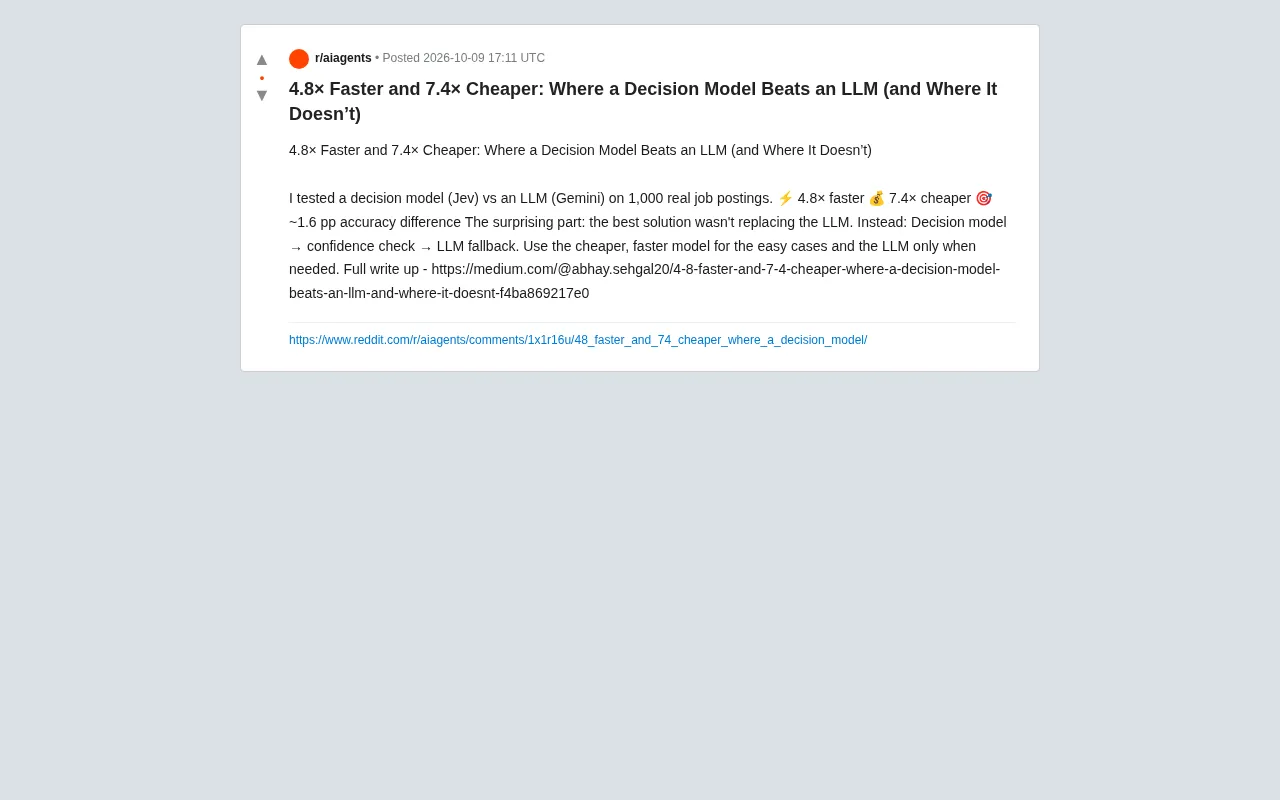
Decision models beat LLMs on speed and cost; the real win is a layered fallback architecture combining both.
A developer compared a lightweight decision model (Jev) against a general-purpose LLM (Gemini) on 1,000 job listing records, finding the decision model to be 4.8× faster, 7.4× cheaper, and only ~1.6 percentage points behind in accuracy. The key insight isn't "which one wins" — it's a layered fallback architecture: the decision model handles high-confidence cases first, with uncertain cases routed to the LLM as a fallback. This concentrates expensive LLM resources on genuinely complex edge cases, echoing the software engineering principle of handling common cases cheaply. The author also notes the findings are from a single task and that confidence threshold tuning and model maintenance costs remain real engineering challenges.
When Specialized Models Meet General-Purpose LLMs
Large language models (LLMs) are being stuffed into almost every automation pipeline — but are they really the optimal solution for every type of task? One developer shared a compelling set of benchmark results on Reddit: a head-to-head comparison between a lightweight decision model (Jev) and a general-purpose LLM (Gemini), tested on 1,000 real-world job listing records.
The results are thought-provoking. The decision model was 4.8× faster, 7.4× cheaper, and only about 1.6 percentage points behind on accuracy. These numbers directly challenge the reflexive "just use an LLM" mentality and reveal a trade-off that gets overlooked far too often in engineering practice.

The Real Trade-offs Behind the Numbers
Let's break down what these three core metrics actually mean:
- 4.8× faster: Decision models are typically small models trained for specific tasks. They have shorter inference paths and lower call overhead, resulting in far lower latency than general-purpose LLMs with tens of billions of parameters.
- 7.4× cheaper: This is the most critical factor in production. At millions of calls, a 7.4× cost difference translates to an order-of-magnitude difference in your bill.
- ~1.6 pp accuracy gap: Here's the key. A 1.6 percentage point accuracy difference is nearly negligible in many business contexts — but in high-stakes decision-making, it may be entirely unacceptable.
In other words, choosing the right model is fundamentally a cost–speed–accuracy triangle trade-off problem, not a simple question of which technology is newer or more advanced.
The Real Optimal Solution: Not Replacement, But Layering
The most valuable insight in this post is precisely that it doesn't offer a black-and-white "replace A with B" conclusion.
The author found that the best approach isn't to replace LLMs with decision models outright — it's to build a layered fallback architecture:
Decision Model → Confidence Check → LLM Fallback
The logic of this pipeline is straightforward:
Layer 1: Decision Model Handles Simple Cases
The vast majority of real-world data is actually "easy to classify." Letting a fast, cheap decision model handle these high-confidence, straightforward cases first allows it to absorb the bulk of traffic almost instantly.
A decision model here refers specifically to a lightweight model trained for a single classification or judgment task. Common forms include gradient boosting trees (XGBoost, LightGBM), small fine-tuned BERT variants, or Tiny-series models distilled from larger LLMs. Unlike general-purpose LLMs, these models lack open-ended generation capabilities — but precisely because of that, their parameter counts are typically in the millions rather than the tens of billions. They don't require large GPU memory for inference and can run at high speed on CPUs or edge devices. For job listing classification, the model only needs to learn "does this description meet a specific role's criteria?" With enough representative training samples, it can approach or even match a large model's accuracy within that domain. Its core advantage is an extremely short inference path: LLMs must model full sequences through attention mechanisms before outputting a single token, while a decision model typically needs only a few vector transformations to produce a probability score — which is the fundamental reason it achieves nearly a 5× speed improvement.
Layer 2: Confidence Check as a Router
When the decision model's confidence on a given record falls below a threshold, the system doesn't force an output. Instead, it flags that record as "uncertain" and passes it to the next layer. This step is the architecture's intelligent switch.
Confidence scores in classification models are typically represented as the maximum probability value from the Softmax output, indicating "how sure the model is about its prediction." However, raw Softmax probabilities are often overconfident, and need to be adjusted through calibration methods such as Temperature Scaling or Isotonic Regression to better reflect true accuracy. Only after calibration is a confidence score suitable for use as a routing threshold. In practice, engineers plot reliability diagrams on a validation set to find the critical point where "when confidence ≥ threshold, is the actual accuracy also high enough?" — determining when to trust the decision model's output and when to escalate to the LLM. Threshold selection is fundamentally a Pareto trade-off between recall (avoiding missed escalations of edge cases) and cost (reducing unnecessary LLM calls).
Layer 3: LLM Only When Necessary
Only truly complex, ambiguous, or edge-case records get routed to the more expensive LLM. This means the costly large model is deployed only where it matters most — preserving the overall accuracy ceiling while keeping the vast majority of costs in check.
Why This Approach Matters
This layered design didn't emerge from nowhere. It echoes a classic principle in software engineering: handle the most common cases with the cheapest means, and reserve heavy weapons for exceptions — similar to how cache hits reduce origin server load.
For teams deploying LLMs in production, this benchmark offers several actionable takeaways:
- Don't default to routing everything through an LLM. Many tasks that seem to require "understanding" can actually be handled efficiently by a well-trained specialized model.
- Treat cost as an architectural constraint. A 7.4× cost difference means that at scale, a layered architecture may be the only sustainable option.
- Confidence scores are the bridge between two worlds. How you define and calibrate your confidence threshold directly determines the system's accuracy-to-cost equilibrium.
Scope and Caveats
Of course, this data comes from a single developer testing a specific task — job listing classification — on just 1,000 records. The generalizability of these findings still needs validation across more scenarios. The decision model also requires task-specific training and maintenance, and those hidden costs aren't fully reflected in the comparison.
Additionally, setting the confidence threshold is an art that requires careful tuning: too low, and too many tasks flood to the LLM, eroding the cost advantage; too high, and edge cases that should be reviewed get passed through unchecked, dragging down accuracy.
Beyond the sample size limitation mentioned above, there's another category of hidden cost worth highlighting: distribution shift. Decision models are trained on a fixed data distribution. If the feature distribution of business data changes (e.g., the job market spawns new role categories), model performance can degrade rapidly. General-purpose LLMs, with their broad pretraining corpora, typically generalize better to new concepts. Maintaining a decision model therefore requires continuous distribution monitoring, periodic retraining, or triggering active learning pipelines — all of which constitute additional MLOps overhead that can't be ignored in a total cost of ownership (TCO) calculation. In a layered architecture, a pragmatic mitigation strategy is to build an "uncertainty zone expansion" mechanism into the decision model: when monitoring metrics show an overall drop in model confidence, automatically increase the proportion of traffic routed to the LLM for stability, while simultaneously triggering a retraining pipeline.
Conclusion
This practical post from Reddit isn't advocating for the victory of one model type over another. Instead, it offers a more mature engineering perspective: in the LLM era, real competitive advantage doesn't come from whether you use a large model — it comes from knowing which model to use, and where. A hybrid architecture combining a decision model, confidence-based routing, and an LLM fallback is very likely the standard form that production-grade AI systems will take going forward.
Related articles

OpenAI Math Breakthrough, Anthropic IPO, and Reasoning Model Tutorial
OpenAI unveils math, CS, and physics results, claiming proof that ETH is false; Anthropic files for IPO, disclosing revenue and customer data; SpaceX gets $40B GPU financing; open-source model tool-calling accuracy issues and constrained decoding; 8-video reasoning model tutorial.

14 Core Concepts of Reasoning Models: From Chain of Thought to GRPO Explained
A systematic breakdown of 14 core concepts of reasoning models: chain of thought, test-time compute, verifiers, RLVR and GRPO, distillation, and reward hacking, plus rules for controlling thinking-token costs to help you decide when reasoning is worth paying for.

OpenAI's Claimed Refutation of ETH Sparks Debate, Meta Bets Big on AI Infrastructure
OpenAI claims an AI-assisted discovery that challenges the Exponential Time Hypothesis (ETH) and launches the mid-tier GPT-6.1 Tera. Cloudflare discloses a cross-customer data leak postmortem, and Meta plans $95B in AI infrastructure financing.