Decoding the Underlying Logic of Large Models: A Practical Introduction from Prompts to Agents

Bilibili creator A-Shui uses analogies to break down large-model principles, training pipelines, and applications, emphasizing that data quality determines the model's ceiling.
The article summarizes the core content of Bilibili creator A-Shui's introductory tutorial on large models. It first uses Transformer as the dividing line, explaining how attention mechanisms, encoder-decoder architecture, and positional encoding made large-scale training possible. It then uses the analogy of "going to college and finding a job" for pre-training and post-training, emphasizing the key role of data scale and quality. It introduces general, industry, and vertical models plus language, CV, and multimodal architecture classifications, noting that multimodality is the trend. In the workflow, data preparation (collection, preprocessing, annotation) is listed as the top priority. Finally, it lists applications in education, healthcare, finance, and daily office work, reminding readers that AI can only assist and cannot replace humans, and encouraging them to start truly using AI by asking questions and practicing.
Going from only knowing how to say "hello" to AI to actually making it a capable assistant in work and study isn't separated by a more expensive membership—it's separated by a clear understanding of the underlying logic. In a tutorial, Bilibili creator A-Shui uses several vivid analogies to connect the past and present of large models, the training pipeline, and real-world applications into a coherent thread. The information density is high, and it fills exactly the gap many beginners have: "they can use the tools but don't understand the principles."
A Dividing Line: Before and After Transformer
To understand why today's large models could explode in capability, you first need to find that dividing line—Transformer. Before it appeared, building a model meant doing one very narrow thing: if you wanted to recognize animals, you fed it lots of animal images; if you wanted to write articles, you specifically trained writing ability. These models had no generalization ability—switch the task and they were helpless—and their capability ceiling was limited.
Transformer changed the game with three mechanisms. The attention mechanism establishes association weights between words in a sentence—for example, in "I love China," the relationship between "I" and "China" can be computed. The encoder-decoder architecture became the foundational structure for many subsequent models. And positional encoding injects word-order information into the model, so that "the cat catches the mouse" and "the mouse catches the cat" are no longer treated as the same thing. The creator repeatedly emphasized in his explanation that zero-foundation learners only need to build conceptual understanding of these pieces—no need to grind through the details—but they are high-frequency interview topics.
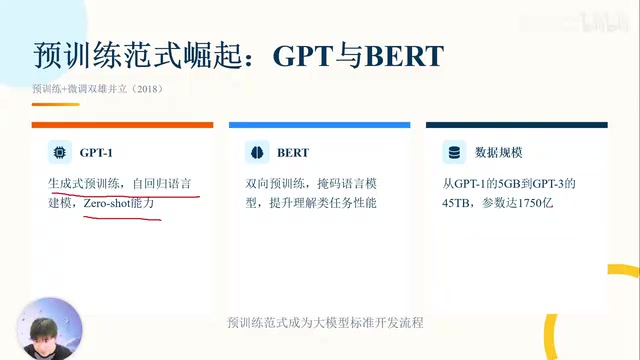
Transformer's real role was "paving the road": it made large-scale training possible. Data scale jumped from tens of megabytes, hundreds of megabytes, and a few gigabytes in the early days to orders of magnitude measured in terabytes and even petabytes. GPT-1, as the prototype of large models, already demonstrated zero-shot capability—handling tasks it had never specifically learned—relying on the foundation built by broad data. At the same time, training uses a masking mechanism similar to a "mock exam": when predicting "I love China," the following words must be covered up, otherwise training loses its meaning.
Attention Mechanism is the core component of Transformer. Its basic idea is to let the model, when processing a certain word, dynamically focus on other relevant words in the sentence and assign them different weights. Taking "I love China" as an example, when understanding "love," the model computes its association strength with "I" and "China," thereby capturing semantic relationships. This mechanism breaks free from the limitation of Recurrent Neural Networks (RNNs) processing sequences step by step, allowing parallel computation and greatly improving training efficiency. Self-Attention is a special form of the attention mechanism, referring to computing attention among elements within a sequence itself; it is the cornerstone of Transformer's encoder and decoder. Understanding the attention mechanism helps grasp why large models can handle long-distance dependencies and complex semantics.
Pre-training and Post-training: Going to College and Finding a Job
The core pipeline of large models can be split into two stages: pre-training and post-training. The creator used human growth as a very apt analogy. Pre-training is like going from kindergarten through college—everyone learns general knowledge. Post-training (also called fine-tuning or alignment) is like the career differentiation after college graduation: some go into industry, some become doctors, some become lawyers—the knowledge learned differs. Training efficiency optimization is like differences in study methods: different methods naturally lead to different speeds.
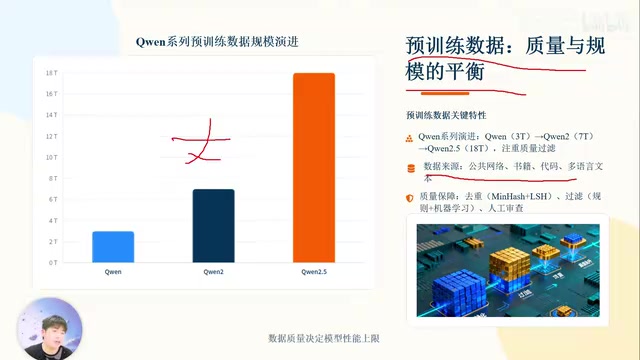
The weight of data in this pipeline was repeatedly emphasized. The "large" in "large model" is directly reflected in large parameter counts and large data volumes. Taking the Qwen series as an example, early versions had about 3T of pre-training data, later versions increased to 7T, then to more than 10T—the leap was very fast. Data sources are mostly public corpora, code, and various types of text, but even data that has passed historical testing may contain duplicates or errors, requiring deduplication, filtering, and manual review. The creator's original words were blunt: if you learn something wrong while studying, can you get it right on the exam?
Pre-training refers to training a model on large-scale unlabeled text through self-supervised learning objectives (such as predicting the next word), enabling it to grasp the general patterns of language and world knowledge. This stage has extremely high computational cost, but the resulting model possesses strong generalization ability. Post-training is fine-tuning and alignment on top of the pre-trained model using a small amount of labeled data or human feedback, making it conform to specific tasks or human preferences. Common methods include Supervised Fine-Tuning (SFT) and Reinforcement Learning from Human Feedback (RLHF). Pre-training determines the breadth of the model's knowledge; post-training determines the model's behavioral norms and task adaptability. The two have clear division of labor and jointly shape the final usable AI assistant.
General, Industry, and Vertical: How to Choose Among Three Types of Models
By coverage, large models can be divided into general models, industry models, and vertical-domain models. General models such as Qwen, GPT, Llama, DeepSeekAd, and Kimi understand a bit of every industry—they can write articles, generate code, do calculations, and process images. Industry models focus on specific domains such as healthcare, finance, and industry. Vertical-domain models are even narrower, targeting specific business scenarios such as customer service, recruitment, and medical image recognition.
Here the creator offered a fairly realistic judgment: if your industry or company does not yet have a usable large model, that is actually an opportunity—whether for promotion and salary increase or for starting your own business, a blue-ocean market means room to grow. Another classification method is by technical architecture: language large models, CV large models, and multimodal large models. Multimodal models integrate text, images, and audio to achieve cross-modal generation. The creator said outright that this is already the current trend, and models that don't support multimodality will be used by fewer and fewer people.
In the Workflow, Data Preparation Is the Top Priority
A complete large-model workflow is roughly: determine the goal (general, industry, or vertical), data collection, model training, iterative evaluation, deployment services, and then continuous iteration as data updates. There is an easily overlooked detail in the data collection stage: even industry models need to collect general data. A model that only learns finance and doesn't understand general knowledge will give overly one-sided answers—just like someone who only learns one craft from childhood and can't find a job when switching roles.
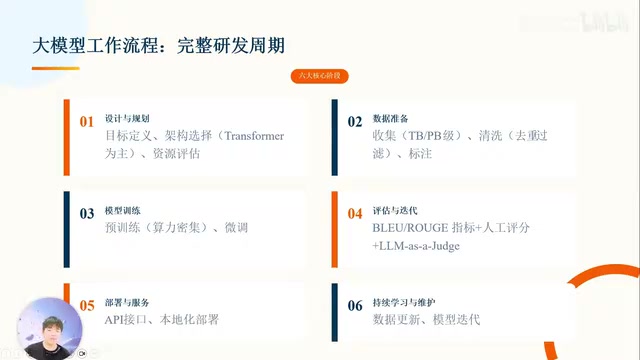
So which stage is most important? The creator's answer is data preparation, not model training or evaluation. Data preparation has three steps: first collect, regardless of whether it's clean or dirty; then preprocess, turning dirty data into clean data—this step is closely tied to model quality; finally, manual annotation, where annotation standards change with the business—if you're recognizing all animals, label cats and dogs; if you're only recognizing dogs, label only dogs.
Data annotation is a key step in supervised learning, referring to manually labeling data samples (such as "positive/negative" in sentiment classification, or bounding boxes in object detection). Annotation quality directly affects model learning outcomes, because the model induces patterns from annotated data. Annotation standards must be strictly aligned with business goals: if the business only needs to recognize dogs, there is no need to annotate other animals, avoiding the introduction of noise. In addition, annotation costs are relatively high, often requiring detailed annotation specifications and quality spot checks. For the post-training stage of large models, high-quality instruction fine-tuning data often needs to be written or reviewed by experts, which explains why data preparation is regarded as the top priority.
Real-World Applications: From Education to Daily Office Work
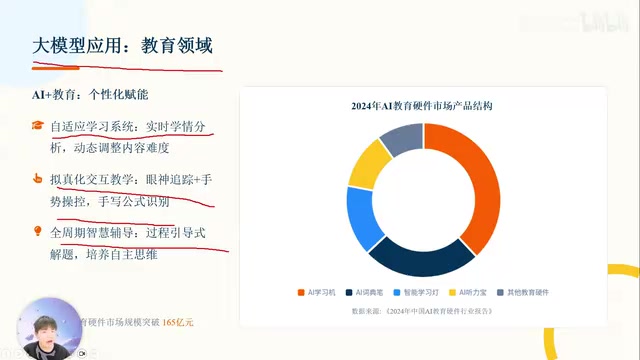
In terms of industry applications, education is the example explained in the most detail. Adaptive learning systems can dynamically create plans based on each student's learning situation, and digital-human interactive teaching is promoting educational equity. According to data cited by the creator, the market size related to the education industry has already exceeded 160%, and he judged that there is still room for growth. In healthcare, AI can assist diagnosis and provide medication references, but the creator specifically reminded: models cannot achieve 100% accuracy—they can only assist and must never replace doctors. In finance, they can generate analysis reports and make predictions, also for reference only.
Everyday usage is even more down-to-earth. Taking Qwen as an example, the discovery page includes tools for generating PPTs, meeting notes, text rewriting, image generation, and weekly report writing. The creator also demonstrated having the model generate video—the effect was "a bit silly but usable"; for better results, you can choose paid tools like Kling. Going further, AI tools can already connect to Excel and Word to help write directly within the workflow, and the effect is quite powerful.
Practical Advice for You
After watching the entire tutorial, the most valuable thing is not any specific tool, but a shift in the posture of use. The creator made it clear at the end: this video is not the endpoint of learning about large models, but the starting point. Stop only saying "hello" to AI—boldly ask questions, practice, and put the knowledge you learn to use. At the same time, remember that bottom line: AI-generated content needs human verification; it is only an assistant, and when problems arise, responsibility still lies with people.
For those who want to go deeper, concepts such as the attention mechanism, encoder-decoder structure, and positional encoding are worth revisiting and studying carefully. For those who just want to use tools well, understanding the division of labor between pre-training and post-training and knowing that data quality determines a model's ceiling is enough to help you judge whether a model is reliable.
Related articles

Hermes Agent in Depth: From Deployment to Skills, MCP, and Hooks
A complete walkthrough of Hermes Agent based on a YouTube deep-dive: VPS deployment, soul.md and user.md memory layering, auto-generated skills, MCP and connectors for Notion, multiple profiles and sub-agent delegation, gateway and shell hooks, and voice call configuration essentials.

Codependency in Addiction: Let Go of the Rope So the Other Person Can Move Toward Recovery
Stanford addiction expert Dr. Anna Lembke explains how codependency sustains addiction: when families stop over-intervening, attend Al-Anon, and let go, addicted individuals are more likely to recover.

Where Does Autonomous Driving Training Data Come From? Cosmo 3 Uses Scene Graphs to Generate Multi-Sensor Data
Cosmo 3 offers a generative solution for autonomous driving training data: controlled generation via world scene graphs, synchronized RGB and LiDAR output, and continuous generation for closed-loop simulation, now open for developer trials.