Deep Dive into the Node.js Repository: The Runtime Foundation Behind 120k Stars

Analyzing the 120k-star influence, layered architecture, governance, and developer value of the nodejs/node repository.
The article provides an in-depth analysis of the nodejs/node repository on GitHub, which has over 120,000 stars and nearly 40,000 forks. It notes that the repository carries the entire Node.js runtime implementation, combining the V8 engine with an event-driven, non-blocking I/O model to make JavaScript a mainstream server-side choice. The repository is clearly layered: lib/ holds JS core modules, src/ is the C++ interaction layer with V8, deps/ manages dependencies like V8, libuv, and OpenSSL, and test/ and doc/ support testing and documentation. The article also covers the TSC governance model and the Current/LTS/Maintenance release cadence, and explains how developers can use test cases to troubleshoot runtime issues and gradually contribute to open source through good first issues.
Deep Dive into the Node.js Repository: The Runtime Foundation Behind 120k Stars
On GitHub, there's a repository with over 120,000 stars and nearly 40,000 forks that firmly holds the core position in the JavaScript ecosystem — it's nodejs/node. This repository is not only where the Node.js runtime source code lives, but also the starting point for countless backend services, command-line tools, and full-stack applications.
One Repository, Half the JavaScript World
Node.js combines the Chrome V8 engine with an event-driven, non-blocking I/O model, elevating JavaScript from a browser scripting language to a mainstream choice for server-side development. The nodejs/node repository carries the entire implementation of this runtime, including core modules, C++ bindings, build scripts, and cross-platform adaptation layers.
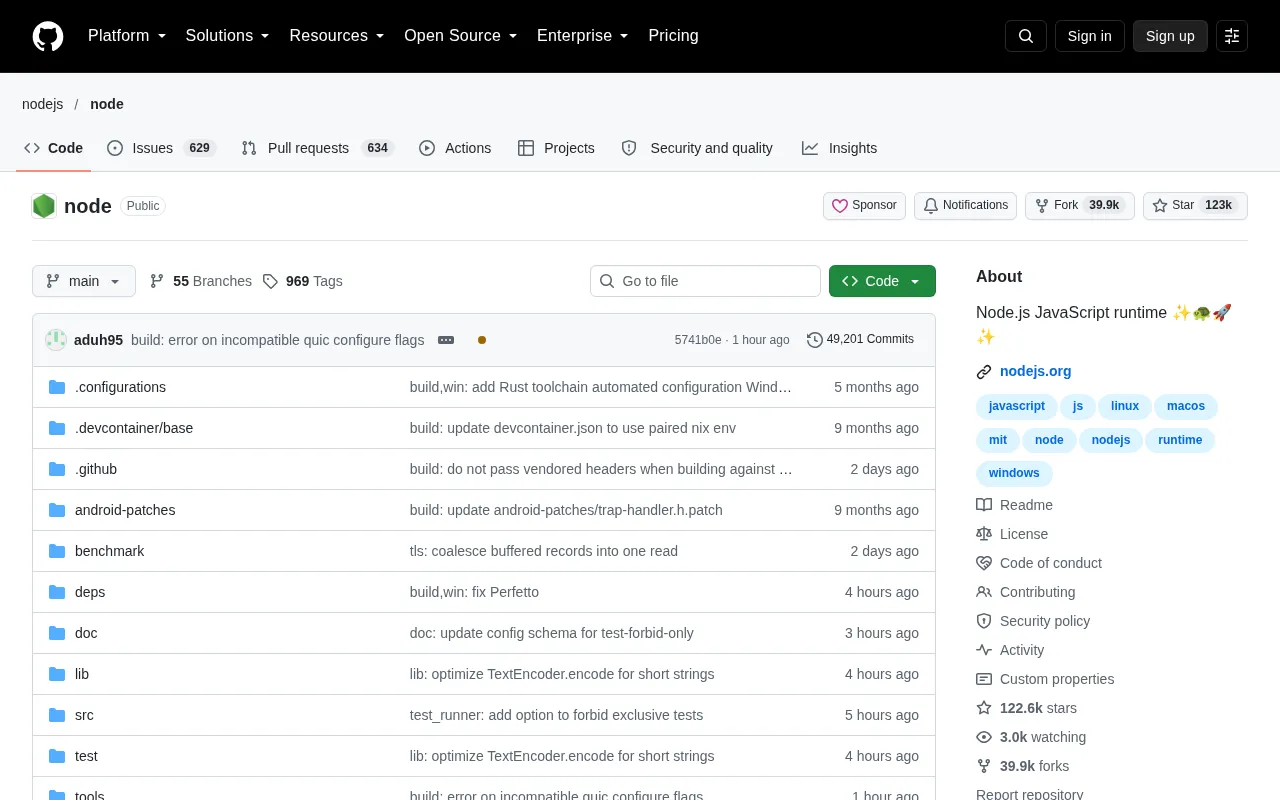
From the data, the repository's activity and influence are highly matched: 122,592 stars mean it has long ranked among GitHub's most popular projects, and 39,933 forks indicate that a large number of developers customize, experiment with, or contribute code based on it. Adding 76 stars in a single day shows that even for such a "veteran" project, attention remains steady.
Technical Depth in the Repository Structure
Browsing the repository's file organization gives an intuitive sense of Node.js's engineering complexity. The lib/ directory holds JavaScript-level core modules, src/ is the C++ implementation and interaction layer with V8, deps/ manages key dependencies like V8, libuv, and OpenSSL, the test/ directory contains a massive test suite, and doc/ provides API documentation and contribution guidelines.
This layered design allows Node.js to remain approachable for JavaScript developers while flexibly replacing or upgrading dependencies at the底层. For example, libuv handles the event loop and asynchronous I/O, V8 executes JavaScript, and the two are connected through binding code in src/. Understanding this chain is key to deep performance tuning and troubleshooting in Node.js.
libuv and the Event Loop
libuv is the underlying support library for Node.js's cross-platform asynchronous I/O. Written in C, it encapsulates different operating systems' event notification mechanisms (Linux's epoll, macOS's kqueue, Windows's IOCP) and provides a unified asynchronous API upward. Node.js's event loop is implemented within libuv, containing multiple phases such as timers, pending callbacks, poll, check, and close callbacks, determining when callbacks execute.
Understanding libuv's thread pool (4 threads by default, handling blocking operations like file I/O and DNS resolution) helps explain why some "asynchronous" operations can still block the event loop. The deps/uv directory is the libuv source code; upgrading libuv often brings performance and platform compatibility improvements.
V8 Engine and the C++ Binding Layer
V8 is Google's high-performance JavaScript engine, responsible for parsing, compiling (including JIT), and executing JS code, as well as managing memory and garbage collection. Node.js does not implement JS semantics itself; instead, it embeds V8 and exposes additional host capabilities through C++ code in src/.
src/ and lib/ are connected through internal bindings (such as internalBinding): JS modules in lib/ call native methods exposed by src/, which in turn call libuv, OpenSSL, or operating system interfaces. This chain of JS → C++ → system calls is the core clue for diagnosing crashes, memory leaks, and performance bottlenecks, and is also why Node.js can maintain both developer friendliness and low-level controllability.
Community Collaboration and Release Cadence
Node.js adopts an open governance model, with the Technical Steering Committee (TSC) responsible for directional decisions, and a large number of contributors participating through pull requests. The repository's issue and PR counts remain high year-round, but the maintenance team maintains order through a labeling system, automated CI, and release processes.
For version releases, Node.js distinguishes between Current, LTS, and Maintenance phases, with LTS versions providing long-term support for enterprise applications. This cadence allows developers to choose between new features and stability, and is an important reason why Node.js is widely adopted in enterprise environments.
Practical Significance for Developers
For ordinary developers, the value of the nodejs/node repository goes beyond "source code reference." When encountering hard-to-reproduce runtime bugs, needing to confirm the behavioral boundaries of an API, or wanting to understand the implementation progress of an experimental feature, directly consulting the test cases and documentation in the repository is often more reliable than searching for secondhand information.
At the same time, the repository's contribution guide (CONTRIBUTING.md) and "good first issue" label provide a clear entry point for developers who want to participate in open source. From documentation fixes to test additions to core module repairs, the participation path is gradual.
Conclusion
120,000 stars is a result, not a cause. The true value of nodejs/node lies in its continuous maintenance of a stable, open, and evolvable JavaScript runtime, and in enabling developers worldwide to collectively participate in its improvement. Whether for daily use or deep source code exploration, this repository deserves serious attention.
Related articles

Why Does Self-Play AI Always Get Crushed by Cheap Units? An RTS Developer's Account of the Dilemma
An independent developer trained an RTS commander AI with pure self-play, only to find it dominated historical versions but was crushed by human players using cheap tier-1 units. This article analyzes the causes of self-play strategy collapse, explores solutions such as exploiters, diversity rewards, and reward design, and introduces the open Bot Kit and AI league plan.

Which Multi-Agent Platform Wins? A Small Team's Battle Scars and Selection Considerations
A 27-person startup's ops lead tried two multi-agent platforms in four months and both failed. This article analyzes why small-team deployments break down, and offers selection guidance on integration depth, observability, and progressive rollout.

Thrive Holdings Takes ADT Private in $7.6 Billion Deal
Thrive Holdings acquires ADT for $7.6 billion in an all-cash take-private deal expected to close in Q1 2027. Analysis of the deal structure, ADT's asset value, and impact on the smart home security industry.