Deepgram Acquires Daily: Voice AI Infrastructure Consolidation and Open-Source Commitment

Deepgram acquires Daily to add real-time transport and orchestration, committing to keep Pipecat open source.
Speech recognition provider Deepgram announced its acquisition of real-time audio/video API platform Daily, creator of open-source voice AI orchestration framework Pipecat, and committed to keeping Pipecat open source. The article analyzes the deal as vertical integration of the long voice AI pipeline, bringing recognition, real-time transport, and orchestration under one company to offer developers a more complete end-to-end solution with lower integration costs and latency. It also notes that the open-source commitment doesn't mean business as usual: Pipecat's governance, roadmap priorities, commercial edition boundaries, and ability to freely integrate non-Deepgram components are key variables to watch.
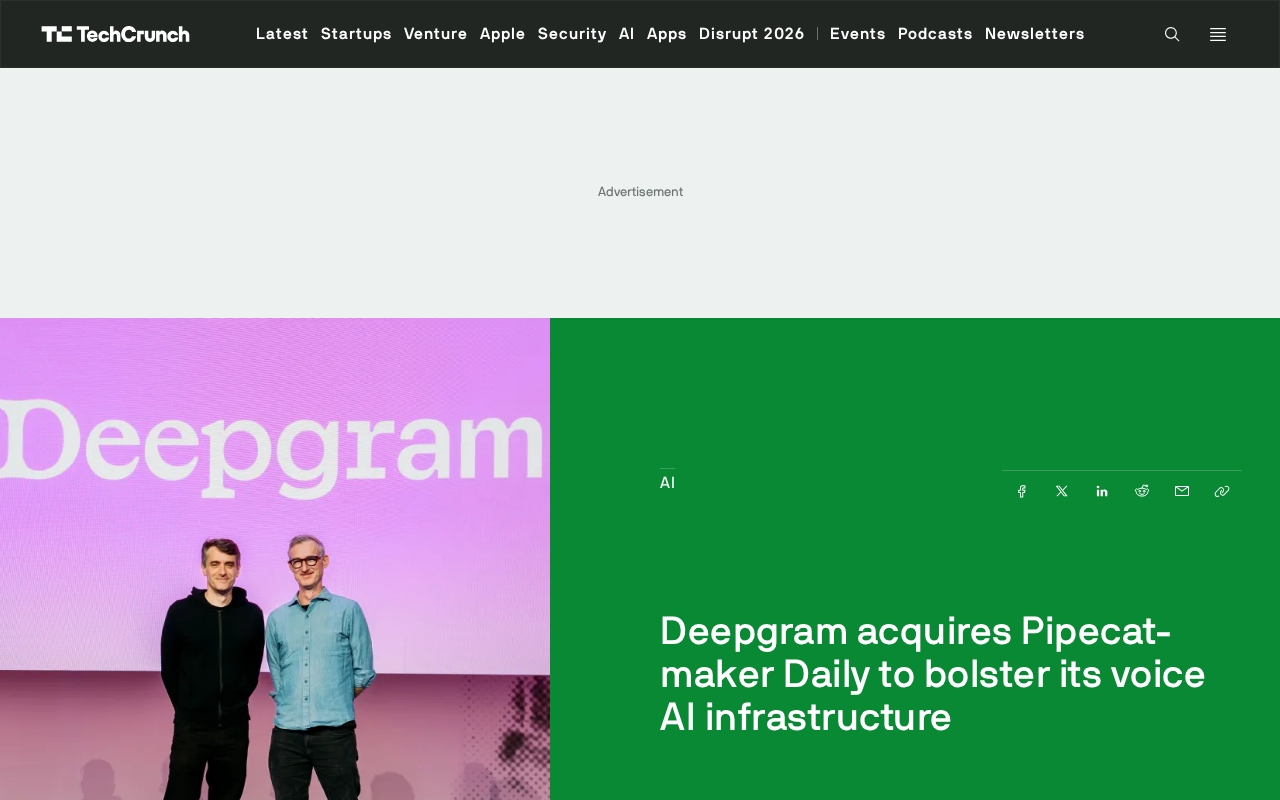
A key consolidation is taking place in the voice AI space. Speech recognition provider Deepgram has announced its acquisition of Daily, a real-time audio and video API platform—and the creator of the open-source voice AI framework Pipecat. The company has made it clear that Pipecat will remain open source.
Who's involved in the acquisition
Deepgram has a long track record in the speech recognition (ASR) space, providing underlying transcription capabilities for a large number of voice applications. Daily, meanwhile, is known for its real-time audio/video communication APIs, which developers can use to quickly build audio/video interaction scenarios. The overlap between the two: Pipecat, incubated by Daily, is an open-source orchestration framework for building voice AI agents that strings speech recognition, speech synthesis, dialogue models, and real-time transport into a single pipeline.
The essence of this acquisition is bringing "recognition capability" and "real-time transport and orchestration layer" under one company.
Why voice AI needs infrastructure consolidation
The typical pipeline for a voice AI application is long: audio capture, noise reduction, VAD, ASR, LLM inference, TTS, and playback, with interruption handling and low-latency scheduling in between. Developers have historically had to stitch together APIs from multiple vendors themselves, resulting in high engineering costs and hard-to-control latency.
The Deepgram acquisition of Daily targets exactly this vertical integration of the pipeline. By bringing real-time transport and the Pipecat orchestration layer into its own system, Deepgram can offer developers a more complete end-to-end solution rather than just selling a transcription interface. For teams building voice agents, this means less integration work and more controllable latency.
VAD (Voice Activity Detection) is a key upstream component in the voice pipeline: it determines which segments of an audio stream are human speech and which are silence or noise, thereby deciding when to start ASR and when a sentence ends. Without reliable VAD, a system either wastes compute on silence or cuts off the user's speech. VAD sensitivity directly affects the "interruption" experience of a voice agent—whether a user's interjection is captured in time depends on the responsiveness of this layer.
Barge-in refers to the system needing to immediately stop TTS playback and switch to listening and recognition when the user speaks while the AI is talking. This seems simple but actually requires tight coordination among TTS, playback buffering, VAD, and ASR; any high latency in one link causes the AI to talk over the user or fail to hear them. This is one reason why the real-time transport layer and the recognition layer must be deeply integrated.
End-to-end latency is the core metric for voice agent experience, typically the sum of capture, network transport, ASR, LLM time-to-first-token, and TTS time-to-first-packet. The industry's often-cited "sub-second response" is actually the result of budget allocation across the entire pipeline, not something determined by the speed of any single model.
What Pipecat remaining open source means
The most critical line in the official statement: Deepgram promises to keep Pipecat open source.
This commitment has real significance. Pipecat's reputation among voice AI developers largely depends on its open-source nature and framework neutrality—it can connect to different ASR, TTS, and model providers. If it were closed-sourced or deeply tied to Deepgram after the acquisition, the community would likely drift away.
A commitment to open source does not mean everything stays the same. The governance structure of the open-source project, roadmap priorities, and the functional boundaries between commercial and open-source editions are all variables to watch going forward. What developers really care about is whether Pipecat can still freely integrate non-Deepgram components.
Vendor neutrality in voice AI frameworks manifests as pluggable abstraction layers: Pipecat defines ASR, TTS, and LLM each as unified interfaces, so developers can swap implementations in configuration without changing business logic. This design lets teams choose flexibly by language, cost, and latency, and avoids lock-in to a single vendor. After the acquisition, whether neutrality is maintained depends on whether onboarding new components requires Deepgram review, whether default configurations favor its own services, and whether maintenance of non-Deepgram adapters is marginalized.
Open-source governance concerns who holds code decision-making power: whether the project still accepts external PRs, who sets the roadmap, and whether there is an independent governance committee or neutral foundation hosting it. A common risk pattern is "open core"—the base framework remains open source, but enterprise-grade features (such as high-availability scheduling, monitoring, and compliance capabilities) are moved into a commercial edition, effectively steering users to pay the acquirer.
Impact on developers and the competitive landscape
For teams using Pipecat, direct short-term changes are limited, but in the medium term three things need attention: whether the framework's vendor neutrality is maintained, whether commercial support tilts toward the Deepgram ecosystem, and whether the open-source community's contribution channels remain open.
From a competitive standpoint, the voice AI infrastructure layer is shifting from "point API competition" to "full-pipeline solution competition." By acquiring to fill in real-time transport and orchestration capabilities, Deepgram is positioning ahead of this wave of demand for voice agent applications. Whether other voice API vendors follow with similar consolidation moves is worth watching.
The barrier to entry in voice AI is shifting from model capability to engineering pipeline. Whoever lets developers get voice agents running faster and with lower latency is more likely to occupy the infrastructure position.
One-line Summary
Deepgram acquires Daily to fill in the real-time transport and orchestration layer, committing to keep Pipecat open source.
Paragraph Summary
Speech recognition provider Deepgram announced its acquisition of real-time audio/video API platform Daily, the creator of open-source voice AI orchestration framework Pipecat, with an official commitment to keep Pipecat open source. The article analyzes the essence of the deal: bringing speech recognition together with real-time transport and orchestration under one company, achieving vertical integration of the long voice AI pipeline (capture, VAD, ASR, LLM, TTS, playback) to offer developers a more complete end-to-end solution with lower integration costs and latency. It also notes that an open-source commitment does not mean everything stays the same—Pipecat's governance structure, roadmap priorities, commercial edition boundaries, and whether it can continue to freely integrate non-Deepgram components are all variables developers need to watch. Competitively, voice AI infrastructure is shifting from point API competition to full-pipeline solution competition.
Related articles

T3 Code: The Open-Source AI Coding Assistant's Comeback Story
T3 Code is an open-source AI coding assistant that unifies subscriptions like Codex and Claude, with powerful remote control and parallel task management.

Never Elected, Yet Ruled New York for 30 Years: The Ultimate Case Study in the Mechanics of Power
Robert Caro's biographies reveal how unelected Robert Moses ruled New York for 30 years through legal drafting and public authorities, and how Lyndon Johnson built leverage as a "powerless" Senate Majority Leader. Unpacking the underlying logic of accumulating and sustaining power.

The CPython 3.10 Recursion Trap and Synthetic Recovery in TokenGuard, an LLM Circuit Breaker
TokenGuard's author recounts a recursion crash caused by OrderedDict.pop in CPython 3.10 and introduces v0.3.0's Loop Nudge synthetic recovery, inline DLP scanning, and other new LLM agent circuit-breaker capabilities.