DeepSeek Harness in Practice: AI-Engineered Programming from Beginner to Enterprise Deployment

How Harness engineering programming lets AI truly land in enterprise-grade projects rather than stopping at small demos.
Based on Bilibili creator Zhuge Laoshi's course, this article outlines the three-stage evolution of AI programming from prompt engineering to context engineering to agents, and highlights Harness ("harnessing engineering") as an engineering methodology for enterprise deployment. It notes that non-technical users can only build simple demos with AI; complex projects involving microservices and high concurrency can stall due to hallucination, non-standard code, and long-conversation intelligence degradation. The course demonstrates a compliant hands-on approach combining Claude Code, VS Code, and a domestic large model, emphasizing that with Harness, domestic models already perform well. The core point: AI programming shifts people toward high-value work like requirements decomposition, architecture design, and code review.
AI programming tools keep emerging, but few solutions can genuinely be deployed in enterprise-grade projects. In a course on Bilibili, creator Zhuge Laoshi delivered a complete walkthrough of "Harness AI Engineering Programming," from concepts to hands-on practice, using an e-commerce project to demonstrate how to complete complex business development with Claude Code combined with domestic large models. Based on that course, this article outlines the evolution of AI programming, the core ideas behind Harness, and the key pitfalls to avoid in enterprise deployment.
The Three Stages of AI Programming: From Prompts to Agents
To understand the value of Harness ("harnessing engineering"), you first need a clear picture of how AI prompting technology has evolved. In the course, Zhuge Laoshi divides it into three stages—a framework that's very helpful for understanding where today's AI programming tools stand.
Prompt Engineering: The Starting Point of Q&A
When ChatGPT first appeared, "prompt engineer" briefly became a hot job title. The core of this stage is "how to state the problem clearly"—the clearer your question, the more accurate the AI's answer. But it suits relatively simple problems; once a task grows complex, a one-sentence prompt is no longer enough.
Context Engineering: Feeding the AI Enough Background Information
As task complexity rises, prompts alone no longer suffice. The course offers a vivid example: ask Doubao to write an in-depth technical article in the style of a certain tech writer, and if you give only a one-sentence instruction, the AI has no idea what your style is. The right approach is to compile your past articles into a document and upload it, so the AI can learn before it writes.
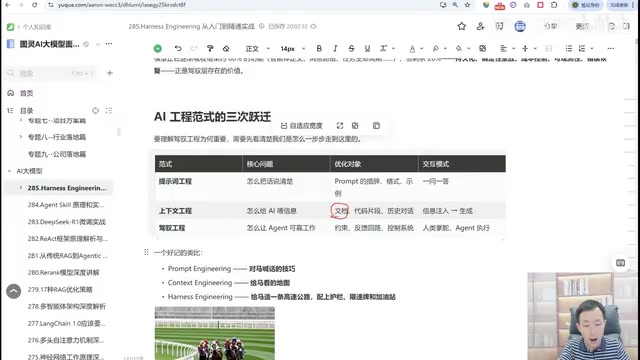
Apply this idea to AI programming: upload the company's existing core code to the large model, let it imitate the coding standards, and then generate new code. Zhuge Laoshi observes a reality—more than 90% of the developers in his livestream are still at this stage when using AI for programming.
Agents: Executors That Break Down Complex Tasks
The hottest direction of the past year or two is the Agent. The course uses booking a flight as an analogy: when a user says "book me a flight to Beijing," the agent needs to break this down into opening the website, searching flights, comparing prices, selecting a seat, placing the order, paying, and other steps, executing them one by one. Writing code is the same—AI programming tools like Claude Code and Codex are essentially agents capable of autonomously planning and executing multi-step operations.
The core difference between an agent and ordinary conversational AI lies in autonomy and tool-use capability. A typical agent system usually contains four components: a planning module (breaking goals into subtasks), a memory module (storing conversation history and intermediate results), a tool-calling interface (such as reading and writing files, executing commands, and calling APIs), and a reflection mechanism (adjusting strategy based on execution results). In AI programming scenarios, tools like Claude Code can complete complex tasks precisely because they can autonomously read project files, run tests, and modify code based on error messages, forming a "generate–verify–correct" loop. This is fundamentally different from early ChatGPT, which could only passively answer questions—agents turn large models from a "knowledge base" into an "executor," and this is also the precondition for Harness engineering to be deployable.
What Is Harness: Letting AI Truly "Tame" Enterprise-Grade Projects
Many developers are unfamiliar with Harness. Zhuge Laoshi mentions that many viewers in the livestream typed "2" to indicate they had never encountered the concept. Harness translates to "harnessing engineering" or "tack"—its role is to solve the deployment of AI programming in complex enterprise-grade projects.
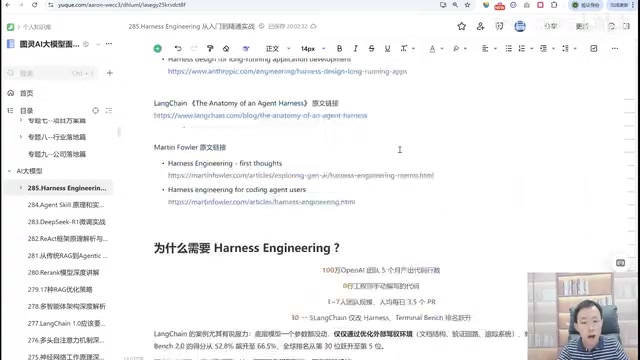
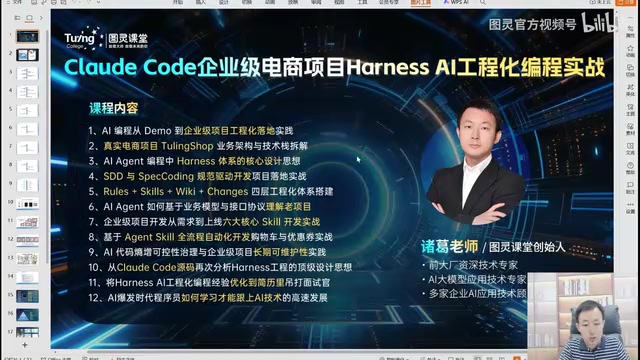
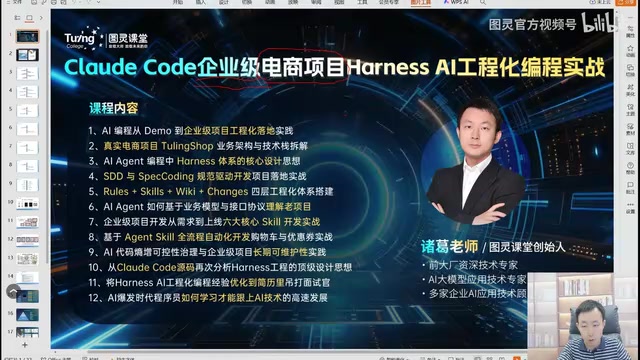
Most Harness tutorials on the market stay at the conceptual level: you get the gist after listening, but when it comes to actually using it, you don't know where to start. The differentiator of this course is that it's practice-driven, running an e-commerce project throughout the explanation—everyone is familiar with e-commerce, so no extra background explanation is needed, and the methodology itself applies to all large enterprise-grade projects.
The course comes with a 50-plus-page Harness AI engineering programming document and corresponding code, covering the complete chain from environment setup to hands-on project practice.
From an engineering practice perspective, Harness is not a specific software product or framework, but a system of constraints and guidance built around large models. It typically includes several layers: project-level context injection (such as providing code standards, architecture documents, and domain knowledge to the model in a structured way), task decomposition and step-by-step execution workflows, automated review and test verification mechanisms for generated code, and context compression and state management strategies for long conversations. You can think of it as putting reins and a harness on the "wild horse" that is the large model—the model's own capabilities are unchanged, but through engineered peripheral control, its output becomes more stable and better aligned with the constraints of enterprise projects. This is also why the same model delivers significantly better results when paired with the Harness methodology.
The Real Pain Points of Enterprise-Grade AI Programming
In the course, Zhuge Laoshi raises a sharp question: are the claims that "even beginners can build projects with AI programming from zero to one" actually reliable?
His judgment: what non-technical product managers or people from other industries build with AI programming is mostly web pages, small demos, and small products with simple business logic. Once they face enterprise-grade projects that truly test technical depth—microservices, distributed systems, high concurrency—the problems surface.
The most typical problem: when AI programming gets stuck on an issue it can't solve, and dozens of rounds of interaction still yield no solution, users who don't understand code are completely stuck and the project cannot move forward. In addition, the course mentions several types of problems developers commonly encounter in practice:
- Hallucination: AI-generated code references non-existent APIs or logic
- Non-standard code: generated code is incompatible with the company project's existing standards
- Intelligence degradation: model output quality drops noticeably after long conversations
Zhuge Laoshi believes that Harness engineering programming is precisely the systematic solution to these problems.
Long-conversation intelligence degradation (also called "context degradation") is a common phenomenon in current large models. Its technical root lies in the fact that although model context windows keep expanding, the attention mechanism exhibits "lost in the middle" over long sequences—information located in the middle of a conversation is easily ignored, causing the model to gradually lose constraints set early on. In AI programming, this manifests as: after dozens of rounds of conversation, the model starts forgetting the project's existing code standards, repeatedly making mistakes that were already corrected, and even fabricating APIs out of thin air. Engineered countermeasures include: periodically summarizing key constraints and project state and re-injecting them, splitting long tasks into independent short sessions, and using external files (such as standards documents) instead of conversation history to carry persistent information.
Hands-On Environment: Claude Code + VS Code + Domestic Large Model
The course demonstration uses Claude Code combined with VS Code as the development environment, while the backend model is a domestic JLM large model (self-supplemented with the latest model) rather than Claude's official model. The reason is straightforward: Claude requires circumventing the Great Firewall, which poses compliance risks when demonstrating in a public livestream.
It's worth noting that Zhuge Laoshi emphasizes that even with a domestic model, paired with this Harness engineering methodology, the results are already quite good; if a company uses the Claude model internally and applies the same methodology, the results will only be better. This is pragmatic good news for domestic developers—compliant model choices will not become an obstacle to AI engineering.
In the course, Zhuge Laoshi also introduces his background: he served as a senior architect for many years at major internet companies such as JD.com and Vipshop, and in recent years has started his own businesses, running both an online education company and a large-model outsourcing company that helps enterprises deploy large-model projects. The course content comes from real project practice in his outsourcing business.
Core Content Covered by the Course
Judging from the syllabus, the content revolves around frontier practices in AI engineering programming, aimed mainly at developers who want to systematically use AI programming in real projects. Core modules include:
- Basic Harness concepts and the three-stage evolution of AI prompting
- Claude Code + VS Code environment setup and usage
- E-commerce project practice: the complete workflow from requirements to code generation
- Close reading of source code and methods for reviewing AI-generated code
- Practical pitfalls: handling hallucination, standards, intelligence degradation, and other issues
- Deconstructing the underlying logic of real interview questions
For developers still wavering between "old-school programming" and AI programming, the core message of this course is: AI programming does not replace people; it frees people to shift their energy to higher-value work. As the course says, even if 80%–90% of the code is completed by AI, there is still plenty for humans to do—requirements decomposition, architecture design, code review, and fallback troubleshooting—and these are precisely the problems that Harness engineering is meant to solve.
Final Thoughts
It's no surprise that anxiety about AI programming is spreading among developers, but Zhuge Laoshi's course offers a rational perspective: the ceiling of a tool depends on the engineering capability of its user. The value of engineering methodologies like Harness is not to make non-technical people perform magic, but to enable technical developers to truly embed AI capabilities into enterprise-grade development workflows. For developers who want to systematically master AI engineering programming, this path from concept to practice is worth considering.
One-line Summary
How Harness engineering programming lets AI truly land in enterprise-grade projects rather than stopping at small demos.
Paragraph Summary
Based on a course by Bilibili creator Zhuge Laoshi, this article systematically outlines the three-stage evolution of AI programming from prompt engineering to context engineering to agents, and highlights Harness ("harnessing engineering") as an engineering methodology for landing enterprise-grade projects. The article points out that non-technical users can only build simple demos with AI; when facing complex projects like microservices and high concurrency, problems such as hallucination, non-standard code, and long-conversation intelligence degradation can stall a project. Using an e-commerce project as an example, the course demonstrates a compliant hands-on approach combining Claude Code with VS Code and a domestic large model, emphasizing that with the Harness methodology, domestic models already perform quite well. The core viewpoint: AI programming does not replace people; it shifts them toward high-value work such as requirements decomposition, architecture design, and code review.
Related articles

The Truth Behind Titanic's Sinking: Key Decisions and Communication Failures in the National Geographic Documentary
National Geographic's The Unsinkable Ship uses survivor testimony to reconstruct Titanic's fatal decisions—from the missing MSG telegram prefix and the broken boiler-room-to-bridge link to how 'unsinkable' thinking delayed damage control and evacuation.

74M-Parameter Open-Source Model Partially Outperforms Jev AI in Testing
Fastino AI's Glider 2.5 models, with just 74M–300M parameters, reportedly outperform Jev AI in some guardrail benchmarks per YouTube testing, run on consumer hardware, and even play Doom. We analyze small models' competitiveness and deployment value on specific tasks.

Gemini 4 Argon Hands-On: Aggressive Pricing, 3D Capabilities Need Coaching
Gemini 4 Argon hands-on: limited-time $2/$10 pricing, million-token output, strong 3D and reverse-engineering work, but weak front-end aesthetics and zero-shot ability need coaching.